Facebook
 Google
 GitHub
 Linkedin
Carlo Gavazzi Releases Photoelectric Amplifier With Multiplexing Capability
Carlo Gavazzi has released an amplification module for combining multiple photoelectric sensors without crosstalk and with integrated diagnostics per channel.
Photoelectric sensors use a wavelength of light to detect objects. Typically, a sending unit transmits a light source, and a receiving unit detects the light. If an object breaks the beam, the sensor outputs a signal to the control system that an object is detected. Recently, Carlo Gavazzi released a powerful amplifier that allows multiple photoelectric sensors to be used in harsh environments.
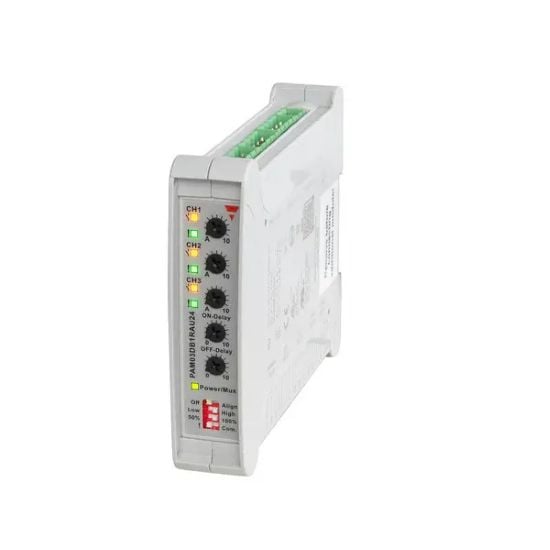
Up to 30 sensor sets can be multiplexed with PAM03 photoelectric amplifier modules. Image used courtesy of Carlo Gavazzi
The PAM03 Photoelectric Amplifier
Operating up to three photoelectric sensors simultaneously, the PAM03 amplification module from Carlo Gavazzi can facilitate combining three sensors and output three different signals.
To ease with setup, the PAM03 uses its LED indicator lights to facilitate optimized alignment. Automatic or manual trimmer functions aid with sensor alignment. The LEDs are also used for diagnostic purposes. When a sensor throws a fault code or malfunctions, the PAM03 will use its integrated LEDs to indicate error codes.
The PAM03 runs on 24 - 42 VDC and can support sensors with a sensing range of up to 50 m. The output of each channel is a single-pole double-throw (SPDT), which gives designers a normally open contact and a normally closed contact.

Sensors in automatic car washes detect the vehicle being washed, even in wet and dirty conditions. Image used courtesy of Unsplash
Reducing Crosstalk
For applications where multiple amplifiers need to be used in the same network, the PAM03 uses the master/slave topology and allows up to 10 connected modules, resulting in up to 30 multiplexed sensors connected to the same network. This topology reduces crosstalk between sensors.
Sensing in Harsh Environments
The PAM03 is designed for use with MOF series sensors from the Carlo Gavazzi catalog. When paired with the PAM03, these sensors are suitable for use in conditions where the environment has high amounts of dust, fog, and steam. These environments can be difficult to use photoelectric sensors in, as the particles in the air will deflect the light, resulting in false detection of objects.
One might ask, “Why use a photoelectric sensor in harsh environments?” A photoelectric sensor can detect objects from far distances without making contact with the object. A car wash, for example, needs to detect when the vehicle is in position, but there is steam and water vapor in the air, which would block typical photoelectric sensors. With one module, the PAM03 is capable of powering up to three photoelectric sensors with reading ranges of up to 50 m, despite harsh conditions.

Conveyor systems rely on multiple sensors to detect objects. Image used courtesy of Unsplash
Multiple Sensors Without a Control System
In common automation applications, a PLC might be used for adding logic along with multiple sensors. In smaller situations, such as stone-crushing conveyors and industrial doors, a control system might be too expensive. The PAM03 is capable of combining three sensors and outputting their status via relay contacts, thus adding automation to simple automation applications.