Facebook
 Google
 GitHub
 Linkedin
Autonomous Machinery Boosts Agriculture at Agritechnica 2025
Take a look at the latest cost-cutting, sustainability-boosting automated agricultural technologies aiming to help shape the future of farming.
Look no further to see some of the latest agricultural technologies emerging from the internationally recognized Agritechnica 2025 trade show (November 9-15) in Hanover, Germany.
While Bonsai Robotics first introduced its AI-backed autonomous farm and industrial vehicles at FIRA USA, the company provided another opportunity for industry experts and customers to explore the Amiga vehicle capabilities at Agritechnica. Alongside Bonsai, AGC Technologies introduced its Agfield autosteering system and Terraguide 3D land levelling system. New Holland also made an appearance at the show, debuting its R4 Electric and Hybrid Power robots.
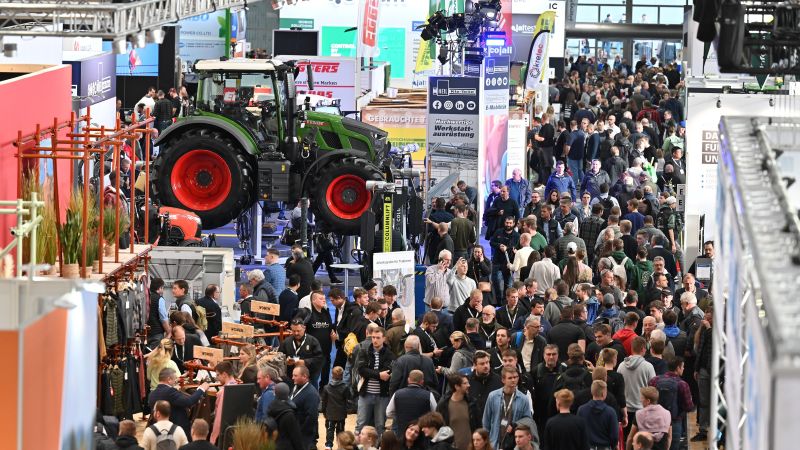
Pioneers and innovators in the field of automated and precision agriculture came together at the Agritechnica 2025 trade show. Image used courtesy of Agritechnica
Vision-Enhanced Autonomy
Bonsai’s 136-181 kg Amiga Flex provides users with a max payload capacity of up to 360 kg and a towing capacity of up to 725 kg. The nimble Amiga Flex is designed to withstand harsh outdoor environments, boasting an IP65 protection rating that protects against low-pressure water jets from any direction and prevents the ingress of dust and other particulates.
For autonomous operations, the Amiga Flex provides AI-assisted navigation, obstacle avoidance, tracking analysis, and workflow optimization in real-time. These capabilities are made possible through Bonsai Intelligence’s Bonsai Autonomy and Bonsai Pilot. The Bonsai Intelligence system is complemented by a compute and sensor suite to execute navigation, perception, and task functionalities.
Amiga Flex is designed with a durable chassis tested for performance, protection, and traction across different outdoor terrains. The robot is emission-free, and users can configure its size to suit different operating environments (such as hoop houses and greenhouses) and other crop/agricultural uses. Amiga Flex has a max operating speed of up to 5 mph, provides a max runtime of up to 8 hours, and features a beacon, bump stops, and brakes for user safety.
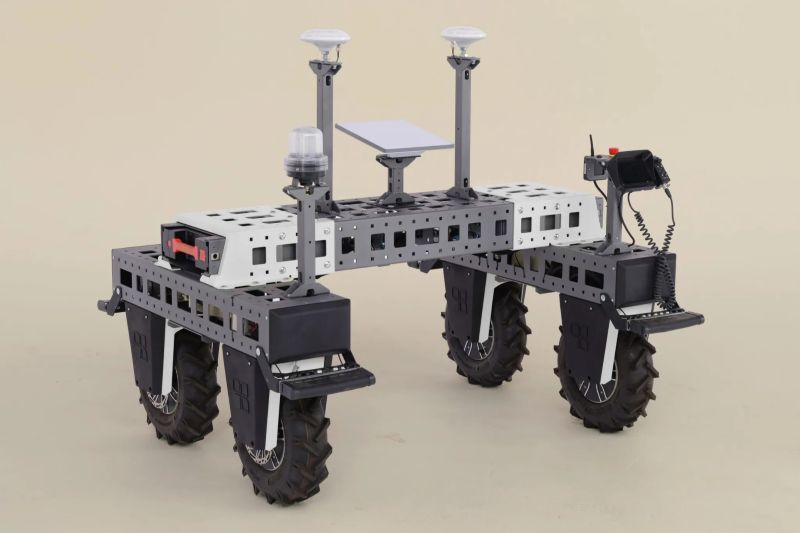
The configurable, compact Amiga Flex is suited for light-duty applications in industrial and agricultural settings. Image used courtesy of Bonsai Robotics
Autosteering and 3D Land Levelling
Automated technologies for agriculture not only reduce the manual strain on farm workers but also enhance decision-making and promote precision agriculture. AGC Technologies' new Agfield automated steering system is designed to enable workers to navigate field paths and complete passes hands-free, alleviating fatigue and maintaining accurate positioning with the assistance of a real-time kinematic global navigation satellite system (GNSS). Ploughing and sowing seeds with correct positioning helps to ensure that there are no overlaps or gaps, conserving fuel and saving on resource costs.
Added ISOBUS compatibility ensures that the electric steering system communicates directly with added seeding and spraying components to turn them on or off at the right time. The system also automates headland turns, compensates for uneven terrain, and offers multiple pattern configurations for different agricultural uses.
AGC Technologies' Terraguide Scraper All-in-One levelling system is designed to help simplify the formerly difficult operation of earthmoving by combining inspection, planning, and delivery into a single, intelligent workflow. The system uses high-precision GNSS to scan the landscape in real-time and autonomously instruct the scraper's hydraulics to extract and fill in the land with centimeter-level accuracy, eliminating the need for repeated passes with laser towers or human computations.
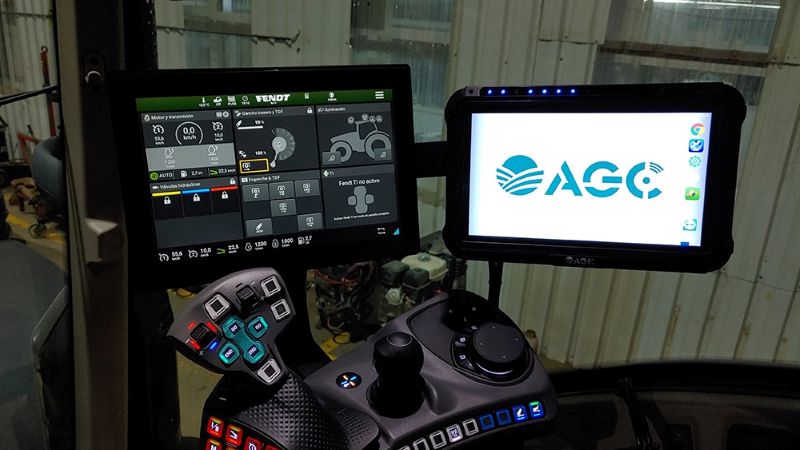
AGC Technologies' Agfield autosteering system includes an interactive, durable tablet, electric steering, and a built-in 4G modem. Image used courtesy of AGC Technologies
This "survey-while-you-work" method aims to greatly reduce the guesswork and weariness involved with land preparation by enabling operators to see precisely where soil has to be moved through a user-friendly cab display. The outcome is a more streamlined operation that helps execute more precise levelling of fields for ideal water distribution and consistent crop development while also reducing fuel usage and equipment wear by reducing needless passes.
Autonomous Robots for Specialty Crops
The R4 series from New Holland comprises autonomous, cabless vehicles that use GPS, LiDAR, and enhanced perception to help execute tasks without human intervention for demanding and monotonous activities required in orchards and vineyards. The technology eliminates the need for conventional hydraulic systems by maximizing traction and minimizing soil compaction while powering implements electronically.
The series includes two specialized models: the R4 Electric Power, a compact battery-powered machine designed for short vineyard rows, and the R4 Hybrid Power. This latter model uses a diesel engine (consuming vegetable oil-based fuels) and an electric generator. In order to guarantee accurate and effective fieldwork, both versions come with smart implement management, which automatically modifies activities such as spray flow and headland rotations.
Lowering Costs and Promoting Sustainability
By utilizing high-precision robotics to automate labor-intensive field tasks, these machines greatly decrease the industry's dependence on limited worker availability while also reducing growers' overall ownership costs. Additionally, the shift to electric and hybrid powertrains promotes sustainable farming practices, moving away from emissions-generating fossil fuel-based power and aiming to reduce negative environmental impacts.