Facebook
 Google
 GitHub
 Linkedin
Baumer HOG800 Encoders: Tough, Smart, and Ready for Anything
Baumer's new HOG800 encoders combine ruggedness with intelligent features, simplifying maintenance and boosting reliability in industrial settings.
Think about it: keeping complex machinery running smoothly in places like steel mills or offshore platforms is a real challenge, and traditional heavy-duty encoders, while robust, often struggle to keep up with the demands of modern automation. And when they fail? Well, that can mean big trouble.
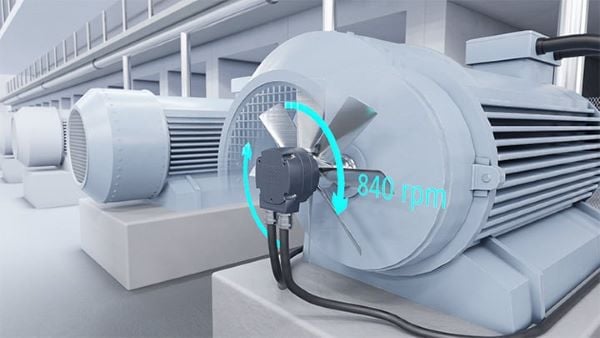
Baumer has recently released the HOG800 family of encoders loaded with new smart functions. Image used courtesy of Baumer
But now, there's a better way: the Baumer HOG800 series. These aren't your average encoders. They're a next-generation breed, blending exceptional durability with smart functionality, and have the highest standards of reliability and precision.
Introducing The HOG800 Encoder For Asynchronous Motors.
So, what makes the HOG800 series so different from your standard encoders? Baumer has drastically improved the protection against corrosion, shaft currents, overvoltage, and mechanical stress, but it's the added intelligence that makes these encoders stand out.
Baumer has incorporated smart functions from its industrial encoder platform. This lets you easily configure resolution, output level, and rotation direction using the Baumer Sensor Suite, making commissioning and maintaining your encoders much simpler. And you can even read and label electronic nameplates with the same suite.
Perhaps the most useful feature is the continuous monitoring capability. The Sensor Suite monitors sensor status, outputs, temperature, and duty cycle. This allows you to catch potential problems early on before they escalate into major disruptions. Think of it as preventative maintenance at its best.
And don't worry about these encoders being clunky and oversized. Baumer has managed to keep the design compact. The encoders are only 84mm wide, so they'll fit in even the most restricted spaces. Plus, the sealed design makes field installation simple, even in harsh environments, and the encapsulated sensing unit is protected against dirt and dust, too, which has an IP40 rating during terminal box installation.
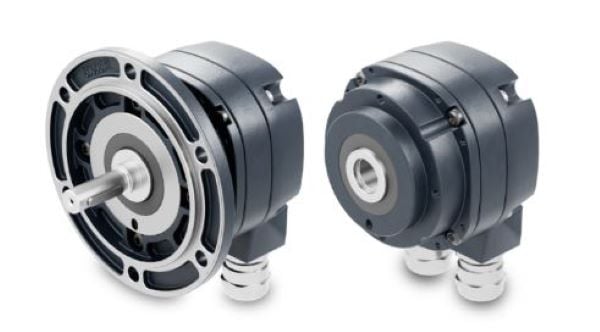
The HOG800 encoders will feature four distinct variants that are designed for a variety of industries. Image used courtesy of Baumer
The Four Variants of The HOG800 Series.
Now, let's discuss the different HOG800 models. The HOG840 is a cost-effective option ideal for wind turbines and general machinery due to its high C4 corrosion protection rating (according to DIN EN ISO 12944). It can handle temperatures from -30 to 85°C and supports cable lengths up to 200 meters (HTL-P).
The HOG860 is for more demanding applications, such as heavy machinery and asynchronous drives. It features extended electrical protection and specialized parameterization options. It also offers advanced status monitoring and can withstand temperatures from -40 to 100°C. It has CX corrosion protection for extra resistance in highly corrosive environments.
The HOG870 is designed for safety-critical applications. It features redundant sensing and evaluation, along with six additional outputs, and is designed to ensure maximum safety and reliability.
Finally, the HOG890 is unique. In addition to incremental signals, it features three digital switches for long-distance transmission of standstill, speed, direction, and status information. This makes it suitable for applications that require sending data over long distances.
The HOG800 series truly represents a new generation of heavy-duty encoders. They're tougher, smarter, and easier to use than previous models. With enhanced robustness, user-friendliness, and intelligent features, these encoders ensure reliable operation and simplify commissioning in the most demanding applications. They're not just about keeping things running; they're about keeping them running better by providing customers with tougher and more reliable systems.
Related Content