Facebook
 Google
 GitHub
 Linkedin
TRi PLC Updates FX1616-BA PLC With Surface-Mount Redesign
The FX1616-BA controller’s transition to surface-mount technology aims to combat component obsolescence and improve manufacturing consistency.
Device manufacturers need to stay competitive, which sometimes means changing their manufacturing processes to deliver a more robust, dependable product. Triangle Research International (TRi) is doing just that by switching the manufacturing process of its popular FX1616-BA PLC to surface-mount technology. The switch to a surface-mount design aims for long-term component availability, faster manufacturing, and reduced exposure to component obsolescence.
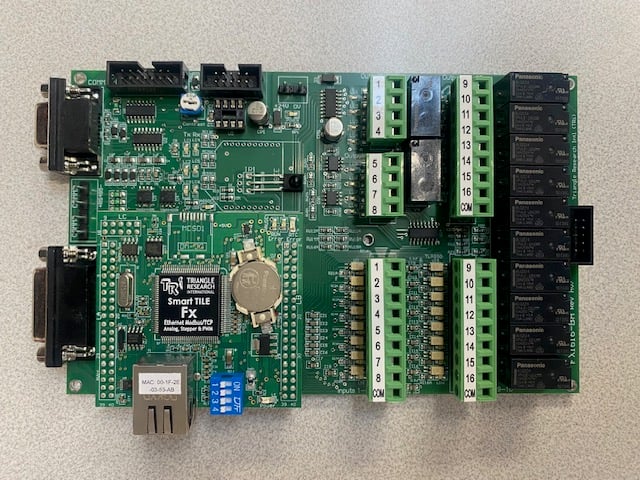
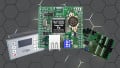
TRi PLC’s FX1616-BA PLC comes in an open-board design. Image used courtesy of Triangle Research International
Introducing the FX1616-BA PLC
Not all PLCs are designed for automated assembly machines; some are designed for building automation applications. The FX1616-BA is a building automation-focused PLC designed for OEM companies that provide custom automated solutions to customers. The standard FX1616-BA comes with 32 digital inputs and outputs capable of using 24 VAC or VDC, eight analog inputs, four analog outputs, three high-speed encoder inputs, and six pulse-frequency counter inputs.
The FX1616-BA can communicate over Modbus TCP as a client or server via its integrated Ethernet port, or over RS485 / RS232. There is even an infrared remote control interface for providing customers with wireless control options.
To program the PLC, TRi PLC offers its TRiLogi ladder logic and basic software. The software can be downloaded for educational purposes. Customers can also utilize a simulator designed to help debug custom programs.
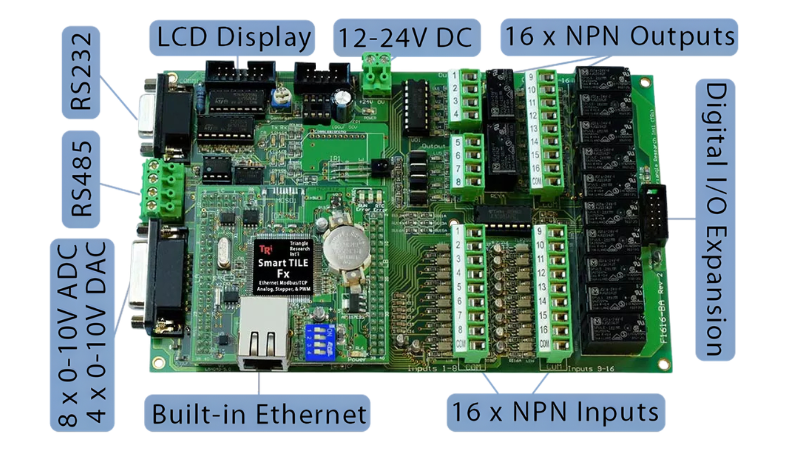
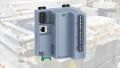
The FX1616-BA PLC includes 32 digital I/Os and built-in Ethernet. Image used courtesy of Triangle Research International
Surface-Mount vs Through-Hole Mounting
There are a couple of options for mounting chips on a circuit board (PCB): through-hole and surface-mount. The latest technology for creating small, compact electronics is surface-mounting chips on the PCB. Each chip is placed on the PCB and soldered directly to the connection points.
Through-hole mounting requires drilling holes in the PCB and inserting the chip terminals through them. This process can be time-consuming and is not well automated. Surface mounting, on the other hand, not only facilitates compact-sized electronics but also helps future-proof designs as chip manufacturers phase out terminal-style versions.
Long-Term Component Availability
Control systems need to support the lifespan of machinery, which can range from 10 to 30 years — you would be hard-pressed to find new components for a 25-year-old desktop computer. TRi PLC is switching to surface-mount technology for its ICs on the FX1616-BA to continue supporting its existing product well into the future.
While the mounting of the ICs on the PCB differs, all other features of the controller remain the same. The SKU, the I/O, the communication technology, and even the physical size will all remain the same. The change affects only the internal mounting of the integrated chips, enabling a direct bolt-on replacement for legacy FX1616-BA models.