Facebook
 Google
 GitHub
 Linkedin
Baumer Unveils OT200 and OT330 Mini ToF Object Sensors
Discover Baumer’s miniature OT200 and OT330 ToF sensors, offering reliable, high-speed object detection without the need for a reflector.
Baumer has expanded its time-of-flight (ToF) sensor lineup with the compact OT200 and OT330, designed for fast, reliable object detection in tight spaces. Measuring as small as 8 x 25.1 x 15.8 mm, these sensors deliver sensing ranges up to 2.5 m without the need for a reflector, simplifying installation. Both models feature IO-Link support for diagnostics and parameterization, plus a visible red guide beam for easier alignment. Ideal for detecting hard-to-sense objects and operating in dusty or variable lighting conditions, the OT200 and OT330 offer versatile solutions for today’s demanding industrial environments.
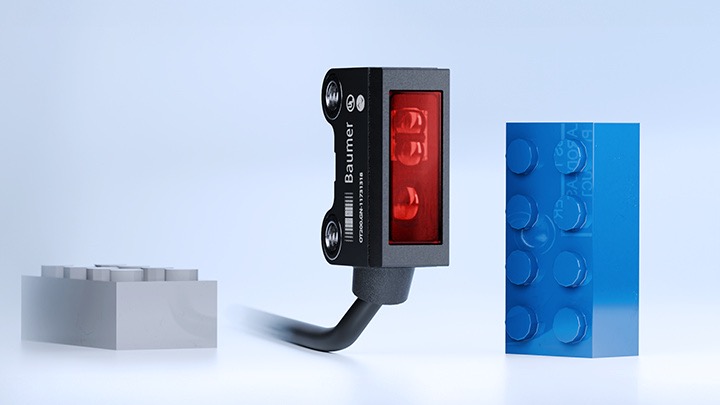
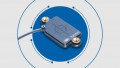
The OT200 shown next to a small building block for scale. Image used courtesy of Baumer
Object Detection
Within an automated cell, many different kinds of sensors are utilized to detect objects. The type of sensor used is typically dictated by the object shape and detection range. Reflective or through-beam sensors can detect various-shaped objects provided they can block the light beam. For situations where you can’t fit a reflector or a sending unit, a diffused or time of ToF sensor might do the trick. Recently, Baumer, a manufacturer of many different automation components, has released the smallest ToF sensor on the market.
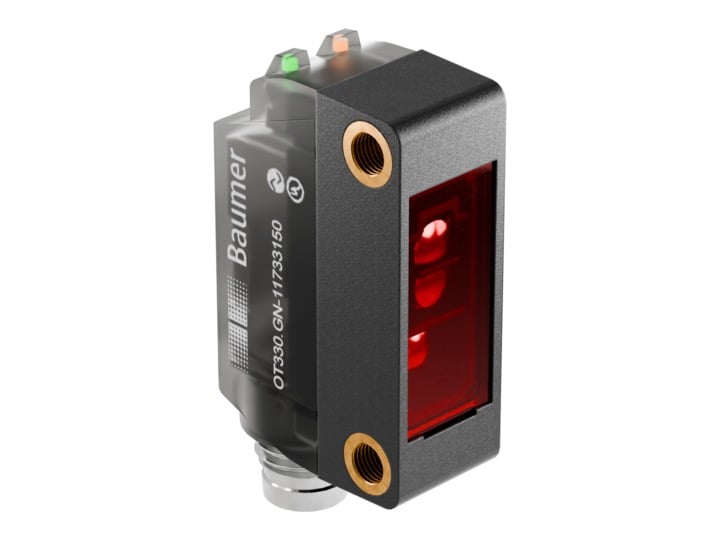
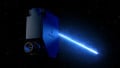
The OT330 has a maximum sensing range of 2.5m. Image used courtesy of Baumer
OT200 & OT330 Time-of-Flight Sensor
Measuring just 8 x 25.1 x 15.8 mm, the OT200 ToF sensor is compact and small enough to fit virtually anywhere. The OT330 is slightly larger at 11 x 32 x 21 mm and offers a slightly larger max measuring range, but the same response time–2m for the OT200 and 2.5m for the OT330. Both devices have a minimum response time of 25ms. Both devices also support IO-Link for diagnostics, parameterization, and monitoring values.
Detection Without A Reflector
A ToF sensor doesn’t require a reflector, which reduces installation time, and thanks to Baumer's SmartReflect versions being particularly more efficient, alignment is even easier than standard ToF sensors. To aid in alignment even further, both the OT200 and OT330 have an integrated red LED guide beam. The guide beam allows for a visible indication of where the invisible laser light will bounce off. With the ToF sensor relying on the amount of time it takes for the light to return and not the amount of light, the OT200 and OT330 can detect objects that other sensors have trouble with.
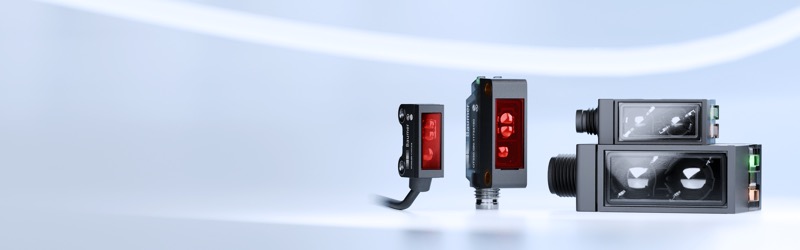
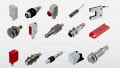
Baumer’s collection of ToF sensors. Image used courtesy of Baumer
What Is A Time-of-Flight Sensor?
Two sensors do not require a reflector or a sender and receiver: a ToF sensor and a diffused sensor. The diffused sensor measures the amount of light returned to the sensor, so if you are detecting thin parts or using a wide beam and want to measure thickness, a diffused sensor is your best bet. A ToF sensor measures the time it takes for some light to return to the sensor. If some of the light is absorbed by the object, the sensor can still determine how far away the object is. When you have material that absorbs light, such as a tire or solar cell, you might want to use a ToF sensor. The surface color, structure, or even dusty and smoky environments do not affect ToF sensors as much as a diffused sensor.
Sensor Selection
There are many different kinds of sensors on the market today, and choosing the right one for your application can be daunting. Many factors go into selecting the correct sensor, such as sensing range, environment, and object surface. The new OT200 and OT330 offer great sensing ranges in a compact housing that could work on many different surfaces in many different environments.