Facebook
 Google
 GitHub
 Linkedin
Baumer Releases OM60 Precision-Focused Laser Distance Sensor
Baumer has released the OM60 laser distance sensor, a highly accurate and adjustable laser distance sensor for use in inspection, measurement, and position control applications.
When your application requires distance measurements, accuracy is one specification you will likely not want to overlook. Baumer’s new OM60 laser distance sensor offers high accuracy and an adjustable spot shape to provide users with precise distance measurement, regardless of surface finish and temperature.

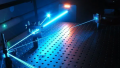
Baumer’s OM60 laser distance sensor is designed to deliver precise measurements up to 1000 mm distances. Image used courtesy of Baumer
OM60 Laser Distance Sensor
A laser distance sensor uses laser light at a very specific light frequency to measure an object’s distance from the sensor head. While this technology is not new, there are common issues that occur with this style of sensor, including measurement accuracy, the ability to read different surface finishes, and the impact of temperature.
Baumer’s new OM60 laser distance sensor offers an accuracy of up to ± 3 µm linear deviation and a repeatability of 0.12 µm within a measuring distance of 20 to 30 mm. The surface finish of a material can affect how much of the light is sent back to the sensor, which results in false readings. The beam shape on the OM60 is fine enough that a typically hard-to-read surface is simple for the OM60. Due to the advanced optics and overall design, the OM60 has a very high-temperature stability, which allows for a bright laser light even as temperatures rise.
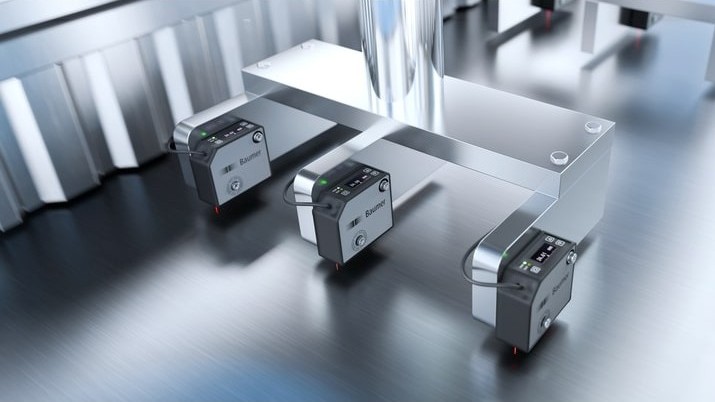
Three OM60s being used in series to measure the thickness of material. Image used courtesy of Baumer
Communication and Parameterization
Creating sensors for automation at the cutting edge of technology is one way to stay competitive, but it is as important to support older technology. The OM60 is offered with IO-Link communication or Modbus RTU, which can be used for reading and setting parameters, reading real-time values, and diagnosing issues. For integration into older or simple systems, the OM60 can be ordered with analog outputs, and RS485 options are also available. If the IO-Link or Modbus RTU models are chosen, the Baumer sensor suite software can be used to parameterize the OM60 sensor with a graphical and intuitive interface.
Measuring Range and Precision
Distance sensors are sold by the maximum measuring range, and as this range increases, the accuracy will decrease. The OM60 is offered in five ranges: 20 to 30 mm, 40 to 60 mm, 65 to 135 mm, 160 to 450 mm, and 200 to 1000 mm. The shortest range sensor has an accuracy of 0.12 µm, and the largest range sensor has an accuracy of 20 µm. To ensure users achieve this level of accuracy, Baumer has added the ability to change the beam shape from a spot to a line, which offers more light to bounce off the object.
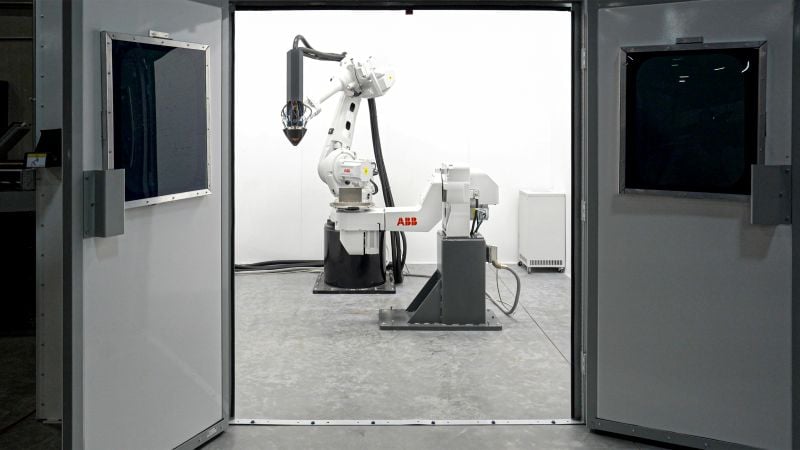
Robots being used for 3D printing applications: z-axis measurements ensure proper application of material in the 3D space. Image used courtesy of Unsplash
Distance Measuring Applications
Object detection in automation is a common practice that tells the controller that the object is present, but when you have thin objects, and you want to make sure you only have one, a distance sensor can help you determine how many parts you are holding. By zeroing the sensor on one part, a reading over zero will indicate multiple parts. With the ability to receive a live reading from the sensor, limits can be placed within the control program to allow for some deviation. Vision-guided robots are a great way to update robot paths, but a 2D vision system will only provide offsets in x and y. Adding a distance sensor to the end of arm tooling will provide a z offset as well.