Facebook
 Google
 GitHub
 Linkedin
Sensopart Unleashes 3D Object Detection in a Compact Envelope
Introducing 3D object detection without the need for a smart camera. Thanks to lasers and stereo vision, the new DTECT Object 3D sensor offers volume, orientation, and geometry validation detection.
Many sensors on the market can detect objects in a defined range, but Sensopart’s new DTECT Object 3D sensor uses patented stereo structured light technology that provides inspections that only 3D cameras are typically capable of. This includes inspections such as volume information, hard-to-detect present checks, and feature detection.
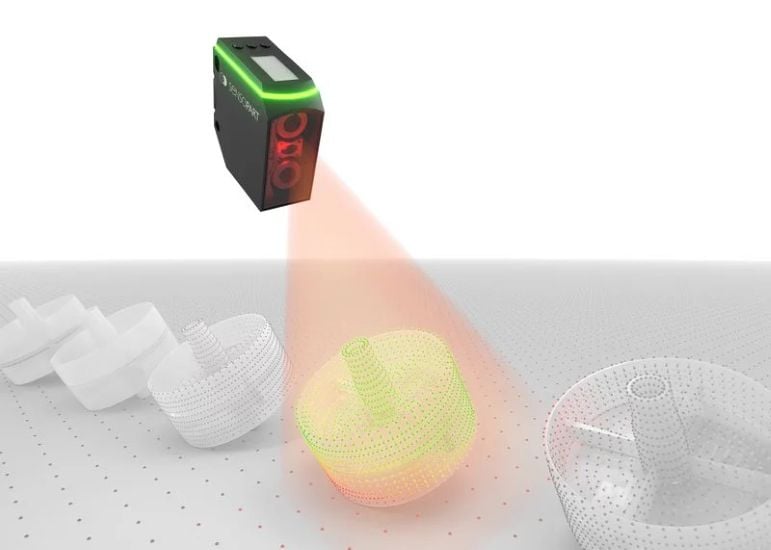
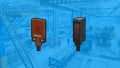
Sensopart’s new DTECT 3D Object sensor delivers 3D object detection in a compact housing. Image used courtesy of Sensopart
DTECT Object 3D Sensor
Sensopart’s new DTECT Object 3D sensor delivers 3D vision inspection technology in a compact housing, offering position and completeness detection. Sensopart offers two versions of its new sensor solution: a close-range version for detection up to 200 mm and a long-range version for sensing up to 500 mm.
The sensor’s compact housing includes a bright indicator ring and an intuitive color display. For connection, the device features a standard M12 5-pin connector. The DTECT can inspect parts without the need for additional software or advanced vision knowledge, thanks to a few simple configuration settings featured in its built-in LCD screen.
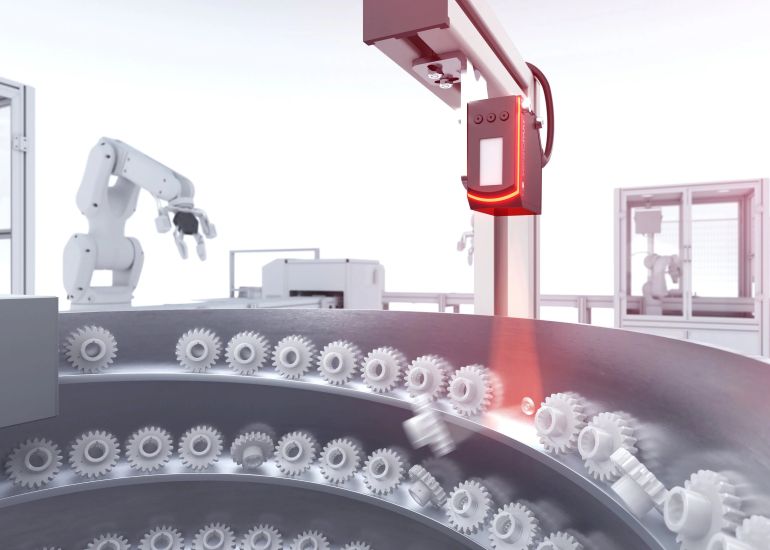
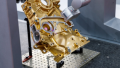
The DTECT being used on a bowl feeder to detect part orientation. Image used courtesy of Sensopart
Active Stereo Vision Technology
The DTECT sensor utilizes infrared laser light and dual vision chipsets. An infrared laser shines a point cloud of light onto an object. With the light being infrared, the sensor is not susceptible to ambient light. The two vision chips then convert the point cloud into an image of the object.
The onboard firmware enables inspections to be taught similarly to how users might teach a photoelectric sensor. While teaching the sensor, the sensing range is illuminated with red light to aid in positioning and spatial orientation.
Vibratory Bowl Feeders
A common tool for sorting and orienting parts into a machine is via a bowl feeder. A large bowl with baffles and barriers will vibrate and cause parts to travel up the baffles and make their way into the inline section of the feeder. In some situations, the part needs to be in a specific orientation, lying down vs standing up. A vision sensor is often used to determine the orientation of the part, but these sensors can be quite complex and often have problems with background noise or ambient light issues.
Sensopart’s DTECT is taught just like a retroreflective sensor; simply place the part in the orientation you want and press a button on the device. The DTECT sensor will only accept parts in that orientation; all other parts can be blown off the track with an air blast.
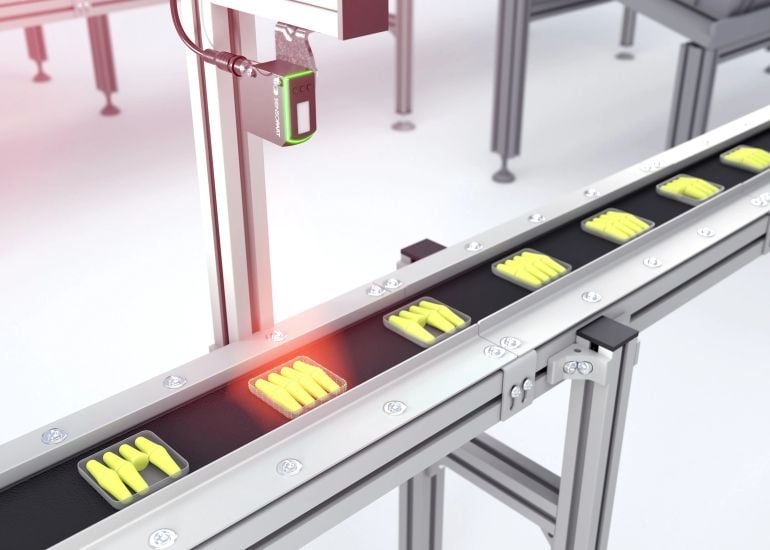
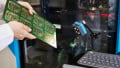
The DTECT sensor measuring geometry to determine a complete package. Image used courtesy of Sensopart
Geometry Evaluation
Any vision system can evaluate the geometry of a part and determine if the part is scrap or if the container is missing components, but these systems can be prone to failure in dusty environments and require existing knowledge to program.
With infrared stereo light technology, the DTECT sensor scans and compares the geometry of each container to the taught image. If a deviation is detected, the sensor flags the container for further investigation.