Facebook
 Google
 GitHub
 Linkedin
Banner Delivers Compact Detection With Miniature Slot Sensor
The new BCS1 miniature slot sensor from Banner Engineering delivers fast and accurate position and motion detection in a compact and cost-efficient form factor.
Banner Engineering has released the BCS1 miniature slot sensor, which promises to occupy little space. This newest sensor is available in several housing styles to ensure that it can be deployed in virtually any automation system, whether fitted for a new system or retrofitting an old one. Additionally, the sensor has a high sampling rate of 3 kHz to ensure fast and accurate detection.
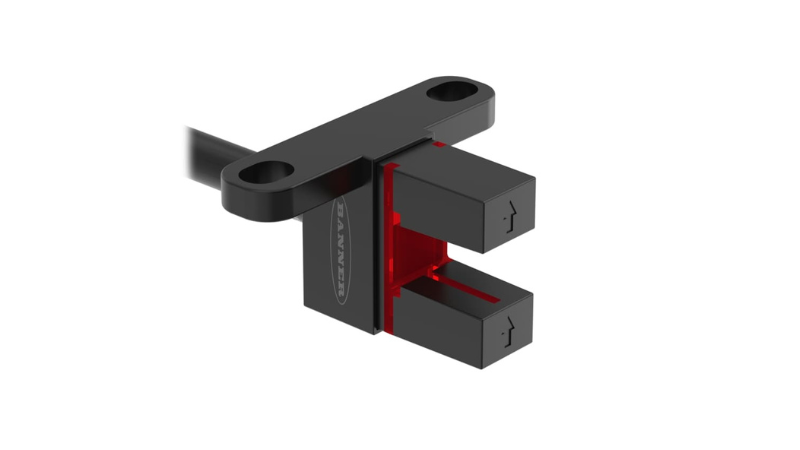
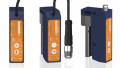
Banner Engineering’s BCS1 miniature slot sensors feature a slot width of 5 mm and are available in different housing shapes. Image used courtesy of Banner Engineering
What Is a Slot Sensor?
Many machine builders and automation system designers use slot sensors to detect the position of sliding components. They are shaped like a "C" and activated when a thin object passes through the open end. Depending on the configuration, they can be set up to send a control signal to start or stop a production line: a normally open or normally closed condition.
Most slot sensors emit a beam of light from one side of the "C" and detect it on the other. When an object passes through, it interrupts the beam. Slot sensors are robust and virtually maintenance-free. They require only a few wires to install and very little power. The catch is that for high-speed production lines, the slot sensor must be able to sample quickly.
One of the neat features of slot sensors is their versatility. These sensors are commonly used as proximity sensors. For example, two slot sensors, placed a known distance apart, can measure the speed of a passing trolley. Groups of them can be used to dictate stronger control options; perhaps one is a warning sensor that indicates the trolley is approaching the limit of its travel so that it can be slowed down gently. A second or third one can indicate overshoot and apply more severe braking of the trolley.
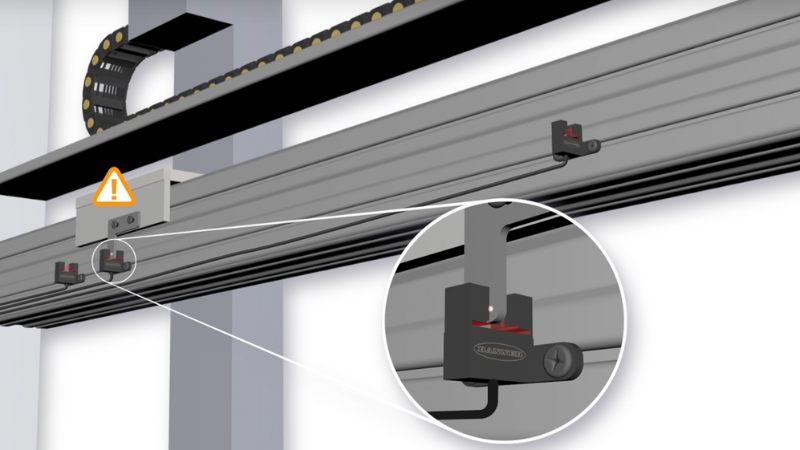
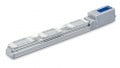
As the slide moves along the track, the slot sensors can determine its position, speed, and other relevant properties. Image used courtesy of Banner Engineering
BCS1 Miniature Slot Sensor
Banner's new BCS1 miniature slot sensor samples at 3 kHz, meaning it can detect objects quickly, even in a fast-paced production line. When the beam is broken, the BCS1 outputs a control signal and illuminates a red LED, visible from different sides, to indicate detection.
The BCS1 is available in multiple housing styles, all with a 5 mm slot width. The compact size of this sensor allows it to be placed unobtrusively along tracks, assembly lines, and other such automation equipment.
Designed for the environmental challenges of the plant floor, the BCS1 is rated to IP64. This rating protects the sensor from dust and liquid splashes. Preventative routine maintenance includes wiping the sensor's inside with a cloth to remove any debris that might signal a "false positive" hit. The BCS1 is also shock and vibration-resistant and has built-in circuit protection to prevent damage during commissioning.
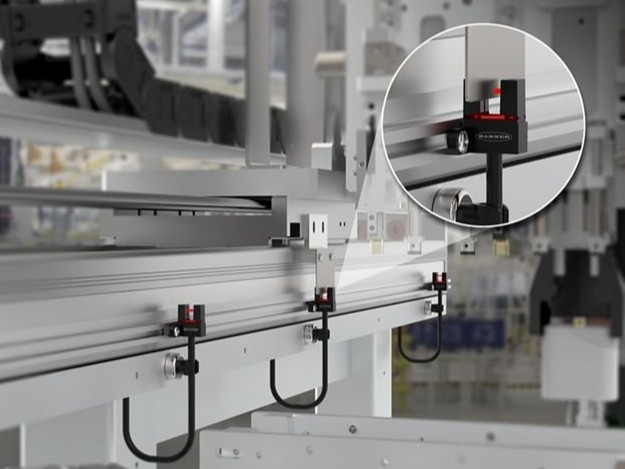
The BCS1 sensors are IP64 rated and vibration and shock-proof for use in a variety of industrial environments. Image used courtesy of Banner Engineering
Compact, Cost-Efficient Detection
Banner's BCS1 miniature slot sensors can be used in machine building and automation system design and retrofitting. They are designed to be simple to install and to require virtually no maintenance. The sensor’s compact size and fast sampling rates make it a good fit for high-speed manufacturing operations.
In particular, Banner has targeted the electric vehicle (EV) market as a potential end-user for this sensor. The ability to accurately detect position will help ensure components are precisely aligned during assembly steps, boosting throughput.