Facebook
 Google
 GitHub
 Linkedin
Sonair Secures Funding for 3D Ultrasonic Object Detection in AMRs
In a cost-saving shakeup of the AMR industry, Sonair raised $6.8M to advance the sensing capabilities of mobile robots from 2D LiDAR and vision to a 3D array of acoustic sensors.
Norwegian tech company Sonair recently announced a funding milestone in pursuing a more cost-effective and comprehensive solution to object sensing for AMRs. The company raised $6.8M while also launching an early access program for adopters of the 3D “acoustic detection and ranging” (ADAR) concept that provides greater resolution and immunity to varying light conditions for the five-meter sensing range surrounding a mobile robot.
The Control.com engineering team was fortunate enough to meet with Sonair to learn more about the background of ADAR and gain some insight into the advantages, opportunities, and forecasts of this innovative technology.
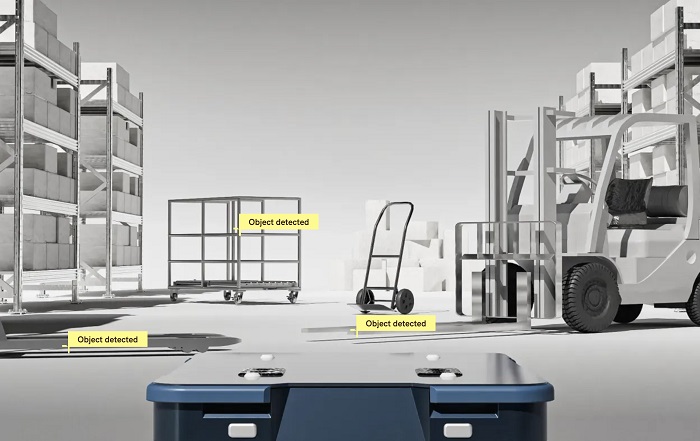
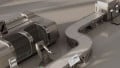
The success of AMRs relies on object detection for the safety of workers and the robot itself. Image used courtesy of Sonair
Object Detection: Safety for AMRs
It’s no secret that safety is paramount in any sort of mobile machine. For AMRs particularly, many mobile applications must traverse walkways shared with humans, and they certainly must be able to detect obstacles like boxes, frames, and other robots. Detecting these objects, both fixed and mobile has traditionally been the job of light-based sensing, predominantly LiDAR, with camera technology emerging as a viable candidate as image processing technology improves.
These techniques, both based on light, demand a good deal of processing time and power, and the sensors demand a lot of power themselves. This drains battery life, increases cooling needs, and requires high-level skills to integrate the processing with the management software to ensure that detection is timely so that navigation decisions are swiftly sent to the device before collisions can occur.
Sonair is flipping the script with the development that includes an array of sound sensors that provide an entire fractional sphere of coverage, up to 180 degrees vertically and horizontally across the robot’s path. The array can pinpoint multiple objects with varying distances up to 5 meters from the sensor. This concept allows a truly 3D view of the surrounding environment in the robot's path, contrasting with the 2D field of view afforded by common LiDAR technology. Stepping into the world of 3D detection has long been a difficult and costly barrier.
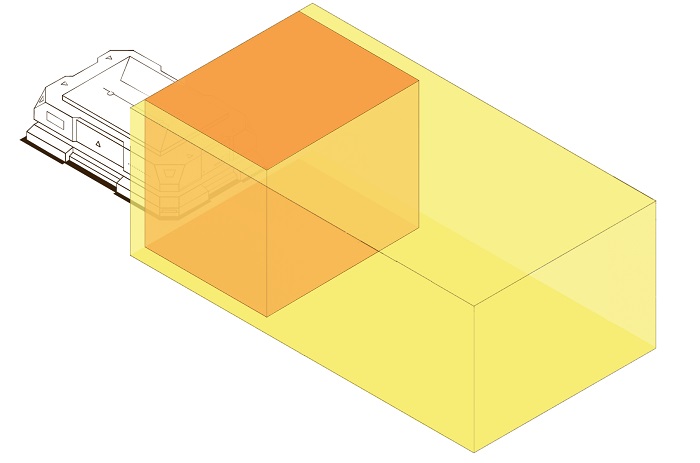
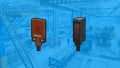
The key detection zone for an AMR is across the front of the path, with a vertical field of view to detect overhanging objects, especially when considering a tall payload. Image used courtesy of Sonair
Ultrasonic Sensing and Object Detection
In my conversation with Dag Wang, the CTO of Sonair, I learned a bit more about the specific technical details behind the ultrasonic technology that drives the ADAR sensors.
All ultrasonic sensors use a series of rapid pulses of high-frequency sound. The frequency of these sensors is higher than that of most ultrasonic sensors (like industrial discrete and analog sensors), which provide greater resolution but face the cost of a more limited range. However, this “limitation” is actually an advantage in facilities where multiple bots are working in close proximity.
The frequency (around 80 kHz) is beyond human hearing range, but the volume falls below the danger threshold, making it both safe and quiet enough for workers with sharp hearing. For many people, especially with younger ears, ultrasonic sensors can create a very irritating environment with a constant whine or clicking sound, and this high frequency avoids the problem.
The frequencies and pulse patterns can also be coded to avoid interference between adjacent robots. Software tied with a fleet manager can configure the codes dynamically based on the path of the robot and projected proximity to other bots.
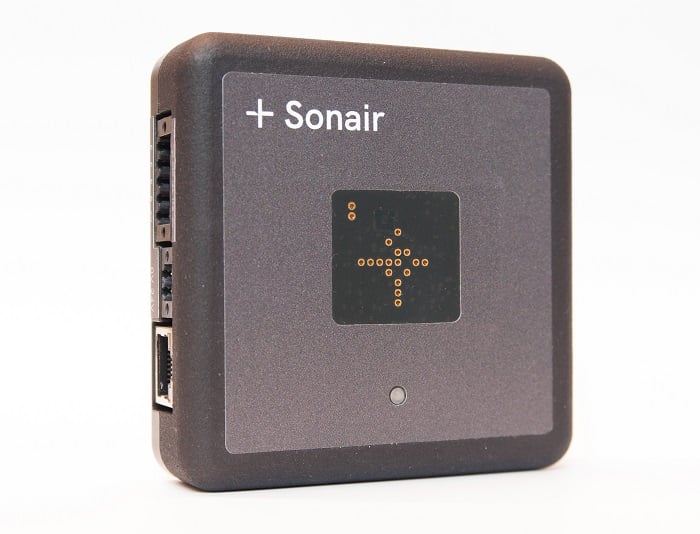
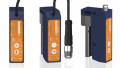
The ADAR sensor from Sonair. Image used courtesy of Sonair
Uses of Ultrasonic Sensors for AMRs
Target applications are mainly industrial facilities like warehouses and logistic centers, which are the poster child of AMR integration. However, since the sensor package is suitable for nearly any environment, adoption seems likely for service industries, such as healthcare (hospitals), restaurants, hotels, and others.
The early access program provides a path for engineers to integrate these innovative sensor packages early in the design stage and forge a path for success with this tired-and-true technology, now being elevated onto the 3D sensing stage, primed to accelerate safety and sensing through the future workplace.
Related Content