Facebook
 Google
 GitHub
 Linkedin
Cognex Dataman 290 and Dataman 390 Barcode Scanners
The Dataman 290 and Dataman 390 from Cognex offer quick, AI-enhanced barcode measurements.
Cognex's new scanners are set to improve the barcode reading process. Instead of struggling to read barcodes with a handheld scanner, these two new models can be mounted along conveyor or assembly lines and automatically read codes. They also use AI to help them interpret barcodes that may have been damaged, faintly printed, or otherwise difficult to scan by traditional methods.
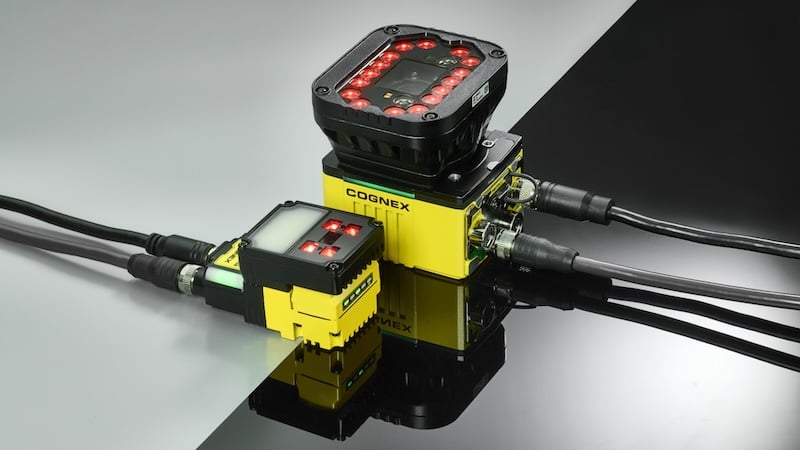
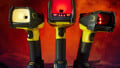
The Cognex Dataman 290 (lower) and Cognex Dataman 390 (upper) barcode scanners. Image used courtesy of Cognex
Barcodes and Challenges
Now that self-checkouts are commonplace, nearly everyone has had the experience of trying to scan an item with a damaged barcode. Whether the label has faded, been damaged, folded up on itself, or otherwise hard-to-read, traditional handheld barcode readers fail. Most people take this frustration for granted; it’s the status quo for barcode reading.
Other common challenges with barcodes are reading codes in low lighting conditions, reflective surfaces, barcodes at an oblique angle, and many more. Also, just like the grocery store lines, a high detection and reading rate is often required.
Dataman 290 and Dataman 390
Cognex decided there was a way to fix this issue and remove the frustration from barcode reading. Using AI, they taught the barcode readers how to interpret damaged barcodes based on known inventory and other proprietary algorithmic inputs. This improved throughput on an assembly line where reading barcodes is necessary, and hard-to-read ones throw error codes or stop production.
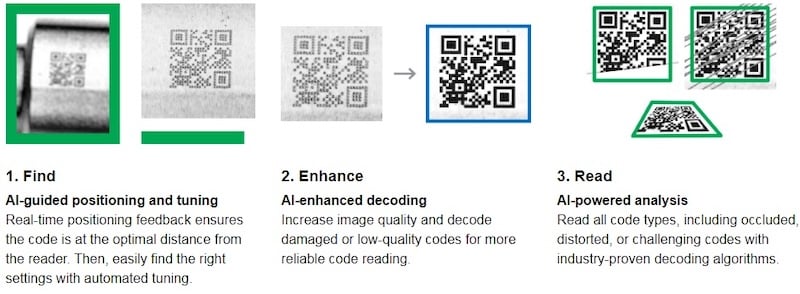
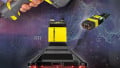
Find, enhance, and read: Guided by AI, these steps are used to perform accurate part tracking during assembly line processing, shipping, or inventory tracking. Image used courtesy of Cognex
Both models feature a built-in light to remove some lighting concerns that can fool barcode scanners that rely on ambient light alone. Not only does this allow for faster, more accurate scanning, but it also simplifies setup. Instead of relying on complex alignment between system components, the sensor is mounted and quickly calibrated through a series of simple, web-based training pages. Moving from unboxing to reading barcodes only takes minutes.
The primary difference between the Dataman 290 and the Dataman 390 is the resolution. The Dataman 290 can accomplish most tasks, but the Dataman 390 has a higher-resolution scanning module. This allows for smaller barcodes, wider scanning areas, multi-code scanning, and other more complex tasks.
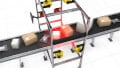
Multi-code scanning can make a major difference in throughput during shipping operations. In multi-code scanning, an entire box or crate of items with barcodes can be scanned in one step.
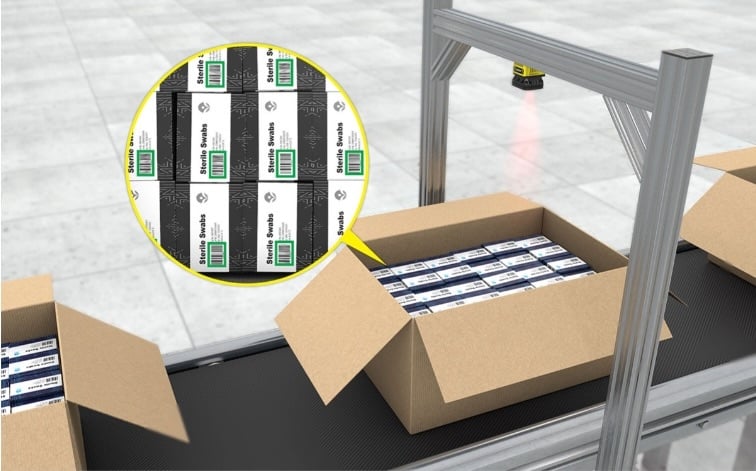
Multi-code scanning drastically speeds up shipping operations. Image used courtesy of Cognex
Industrial Applications
Barcode readers have numerous purposes in manufacturing, most of which involve inventory tracking and specific process parameters of a product as it moves through assembly. The Dataman 290, with its versatile platform, and the Dataman 390, with its high-resolution capabilities, help automate the barcode scanning process for tracking purposes. From parts counting during assembly to ensuring the proper finished goods are picked, packed, and shipped, Cognex’s newest readers can expedite and simplify tracking.