Facebook
 Google
 GitHub
 Linkedin
Compact Redex DG-Block Adds PID Control, Simulation, and Safety
The Redex DG-Block controller offers PID algorithms, simulation capabilities, emergency stop control, and modular hardware for fast integration.
Redex’s new DG-Block controller brings closed-loop control, simulation capabilities, and built-in safety functions together in a compact, modular package. Designed for both process applications and test stands, the DG-Block offers integrated PID algorithms, direct brake control, and intuitive DG-BlockSoft programming. With DIN-rail mounting, rear connector stacking, and flexible I/O, engineers can simplify wiring, reduce footprint, and streamline system setup while gaining precise control and valuable diagnostic insight.
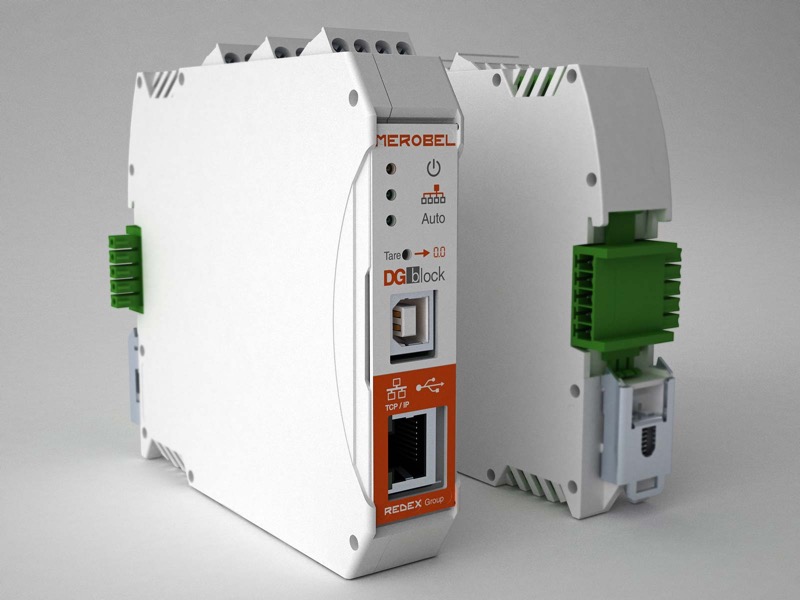
The DG-Block: compact size and easy to configure. Image used courtesy of Redex
DG-Block Logic
The DG-Block has two logical inputs and a sensor measurement input. The sensor data is compared to the setpoint. That error signal is amplified and can be used to activate a brake directly. There is also an alarm condition activated by an out-of-bounds measurement directly.
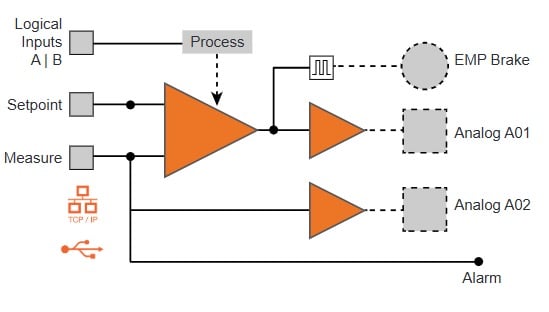
A schematic illustrating the logic behind the DG-Block. Image used courtesy of Redex
DG-Block Hardware Features
The DG-Block occupies only a small footprint and can be DIN-rail mounted, making it easy to physically integrate with existing hardware. It features a USB-B connection on the front for simple test bench connections, and an Ethernet jack for ModBUS TCP/IP connections. The back of the controller features a rear-mounted set of connections so that controllers and function blocks can be snapped together.
Each controller is equipped with a power LED, a “leader” LED to indicate whether a particular controller is the leader, and an “Auto mode” LED to indicate that the controller is regulated automatically. There is also a recessed “Tare” button on the front, which helps establish starting conditions, eliminating offset error. The button can be activated by a small screwdriver or paperclip, but is unlikely to be activated by brushing up against the controller accidentally.
The “Leader” feature is a way to set one controller in charge of all other controllers, should multiple units be strung together. They can use a shared set of input data and output conditions, but the controller with the blue “Leader” LED illuminated is the one that runs the process. Thanks to the connectors on the back of each controller, this configuration can be realized without additional wiring.
The DG-Block can output a DC voltage from -10 V to 10 V, with a maximum output current of 1.5 A. This module can directly apply current to the brakes of a motor at 1.5 A, which is unusual for such a small control module. Along those lines, should an emergency condition be triggered, the stopping torque is relative to the setpoint. On the input side, the DG-Block can read input signals from 1 mV to 10 V.
DG-Block Software
The DG-Block comes with an intuitive programming package called DG-BlockSoft that can be run from a PC with a Windows operating system. This software includes simulation capabilities, built-in PID algorithms, and other unique programming features that can be used in both operation and testing.
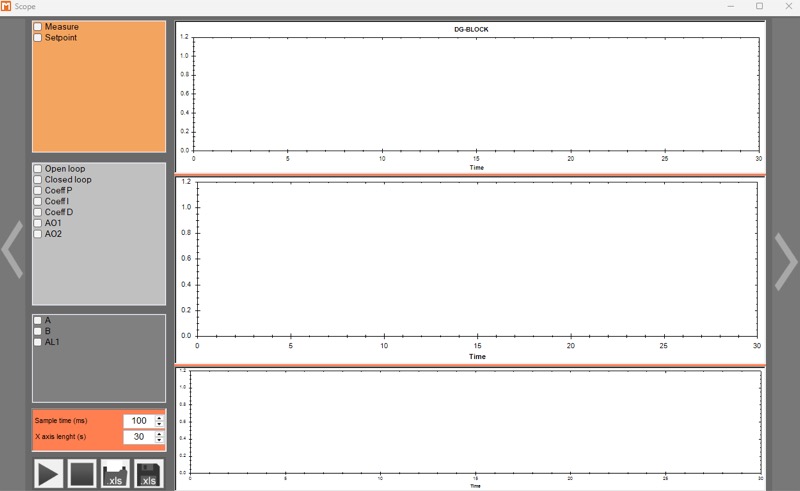
DG-BlockSoft allows setpoints and measurements to be compared under different operating conditions. Image used courtesy of Redex
One important software feature is the progressive start or programmable controlled ramp feature. This allows the user to slowly change a process variable, providing controlled motor speed to reach a setpoint, versus having the motor accelerate as quickly as it can.
Applications
The DG-Block’s blend of compact hardware, built-in safety, and advanced simulation capabilities makes it well-suited for a wide range of industrial tasks. Test stand developers can use its precise setpoint control and progressive ramping to validate motors, brakes, and mechanical assemblies. Machine builders can deploy it for tensioning, load control, and web handling, while labs and R&D teams can leverage its simulation tools for rapid prototyping. With its modular design and versatile I/O, the DG-Block offers a flexible control solution for both production and experimentation environments.
Related Content