Facebook
 Google
 GitHub
 Linkedin
Curtin Partners with Uncharted AI for Robotic Mars Missions
Using AI, LiDAR, and radar tech, Curtin and Uncharted AI are pioneering autonomous systems for coordinated Mars missions and terrestrial applications.
Curtin University signed a memorandum of understanding (MoU) and a statement of strategic intent to establish and progress the development of LifeSpringsMars Working Group. The program leverages the strength of international collaboration between academic researchers and robotics and automation engineers to advance research and technological development. Curtin University signed the MoU with space technology-focused company, Uncharted AI, and the statement of intent at the 75th International Astronomical Congress (Sydney, Australia).
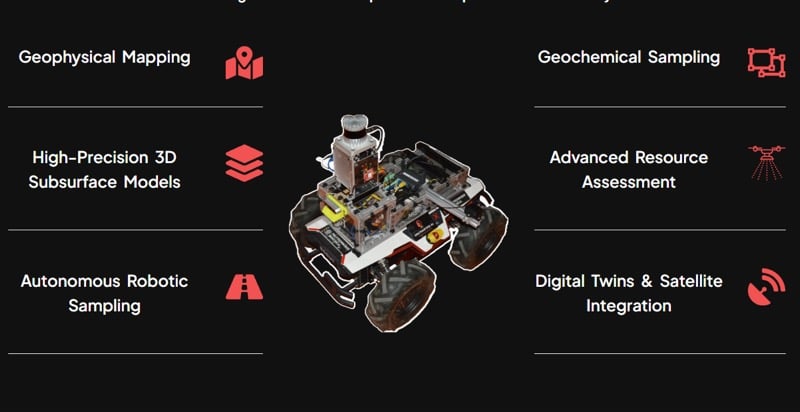
Uncharted AI’s TRACE platform could be used for defense, space, and mining operations. Image used courtesy of Uncharted AI
Technology
The key area of focus and development for future space exploration is multi-asset coordination, which must also be well coordinated to execute successful space missions and projects. The varied assets under question include drone and satellite technologies, rover vehicles, and key surface infrastructure.
Uncharted AI, headquartered in Bangalore, India, offers CU its TRACE platform, uniting multi-sensor mapping and navigation, machine learning-guided planning, perception, and decision-making, and decentralized communication to support coordinated multi-asset deployment on space missions and terrestrial missions on Earth for mineral resources.
Part of TRACE’s core capabilities includes using light detection and ranging (LiDAR) along with SLAM algorithms to generate point clouds, map the surrounding area, and recognize and add key features to define a robot’s position relative to its surroundings. This technology is critical for unmanned space missions requiring autonomous navigation without signals from Earth’s Global Navigation Satellite System (GNSS).
Other sensor technologies integrated within the TRACE system include an inertial measurement unit (IMU), advanced cameras, and Ground Penetrating Radar (GPR). The latter radar technology is a geophysical technique that uses radar pulses to detect objects and changes in terrain at the subsurface level. Scientists and engineers can glean what kind of materials or spaces they are traveling through, depending on how the radar waves respond to the subsurface materials they encounter.
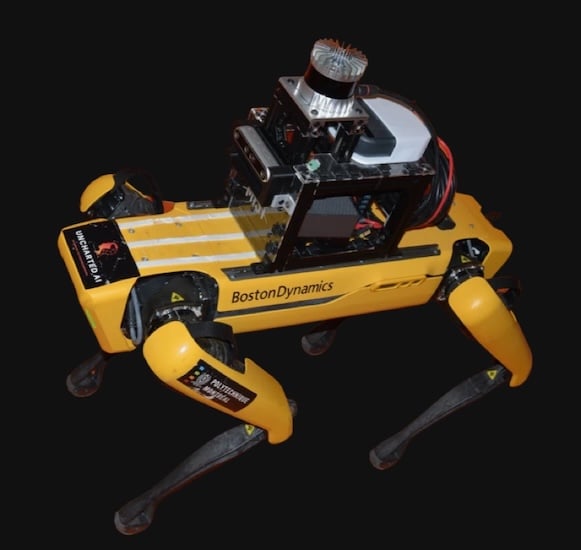
Uncharted AI’s LiDAR and SLAM technology enables autonomous navigation in unstructured environments. Image used courtesy of Uncharted AI
Identifying subsurface chasms during rover missions is important for avoiding dangerous hazards and scoping out areas for mining materials or creating habitable environments. GPR is also important for detecting water/ice within the Martian subsurface. One example is the MARSIS (Mars Advanced Radar for Subsurface and Ionosphere Sounding) subsurface radar used to detect liquid water beneath layers of ice and dust at Mars’s south pole.
Uncharted AI’s engineering team and CU researchers will work together to advance planetary exploration, astrobiology, and defense and mining activities. Such activities may be as simple as fieldwork at the geologically rich sites in Australia, where fossilized remains of early life can be found, or they might be directly on Mars or in quarries, where human safety is on the line. Fully self-navigatable intelligent autonomous systems help reduce risk to humans in unstructured environments and help aid repeatable data/resource collection.
Supporting STEM Through Space and Planetary Science
The Spirit rover found nodular opaline silica deposits near Home Plate on Mars. These deposits are a great place to look for life on other planets because Earth analogues show that signatures of ancient microbial life can be preserved. What could we find on Mars or other planets?
For students undertaking or thinking of undertaking CU’s Space and Planetary Science Major, the research of Professor Martin Van Kranendonk brings attention to the truly interdisciplinary nature of astrobiology. The research emphasizes the importance of studying ancient microbial life recorded in the Pilbara region of Western Australia in informing ways of studying potential life on other planets, such as Mars. Astrobiologists and engineers, such as those developing the pioneering technologies from Uncharted AI, could help bring such fundamental extraterrestrial research home.