Facebook
 Google
 GitHub
 Linkedin
NVIDIA Ecosystem Accelerates Real-World Physical AI Deployment
From simulation to deployment, NVIDIA’s ecosystem is reshaping robotics with AI, data, and real-time control.
NVIDIA’s presence at GTC 2026 highlighted a shift from theoretical AI to real-world industrial deployment. Through collaborations with companies like FANUC, Universal Robots, and Infineon, its ecosystem is connecting simulation, training data, and hardware into unified workflows. These developments aim to close the gap between lab-based models and factory-floor performance, enabling robots to be trained, validated, and deployed more efficiently while adapting to real-world variability and operational constraints.
FANUC’s Connecting Simulation to Real Robots
FANUC’s collaboration with Nvidia aims to link simulation directly to real-world execution. By connecting Roboguide with Nvidia Isaac Sim and Omniverse, manufacturers will be able to model entire production lines, validate robot behavior in a virtual environment, and then carry those results into systems that are running on their factory floor. The overall goal is to reduce the gap between what’s tested in simulation and what happens on the floor, reducing commissioning time and rework.
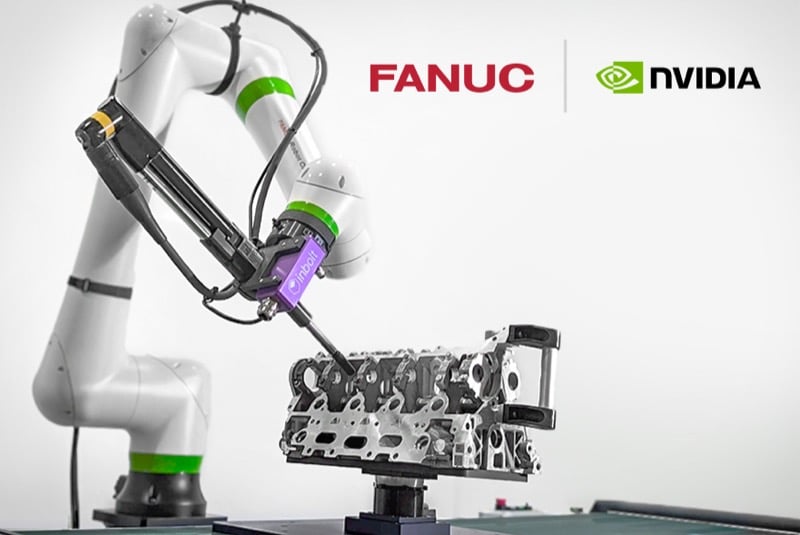
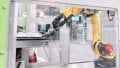
FANUC robot using AI-driven control and simulation integration to execute precision tasks. Image used courtesy of FANUC
The technical stack matters here. FANUC is combining Jetson edge modules with simulation tools to enable real-time inference on deployed robots, while also supporting ROS 2 and Python across its platform. That combination opens the door for AI-driven applications without locking users into proprietary development environments.
There’s also a shift in how robots are programmed. Instead of relying entirely on predefined paths, FANUC is working toward systems that can interpret inputs like voice commands and generate code automatically. That’s less about convenience and more about reducing setup time and lowering the barrier to making changes on the floor.
Universal Robots Is Fixing the Data Problem
Universal Robots took a different angle by focusing on one of the biggest bottlenecks in physical AI: training data. The UR AI Trainer, developed with Scale AI, is built around a leader-follower setup in which an operator physically guides one robot while another robot mirrors its motion. During that process, the system captures synchronized motion, force, and vision data. That dataset is what feeds Vision-Language-Action models.
What stands out is that the data is collected on production-grade hardware rather than lab systems. That eliminates a common issue where models trained in controlled environments don’t transfer well to real-world applications.
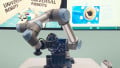
Universal Robots demonstrated the imitation learning on UR cobots, capturing synchronized motion, force, and vision data to train AI models. Image used courtesy of Universal Robots
Nvidia shows up here again through Isaac Sim and Omniverse, which are used to generate synthetic data and simulate tasks like bi-manual assembly. Combined with real-world data capture, this creates a feedback loop that enables models to be trained, validated, and redeployed quickly.
Building the Hardware Stack Behind Physical AI With Infineon.
While FANUC and UR focus on how robots are trained and used, Infineon is working at the hardware level. Its collaboration with Nvidia is centered on building reference architectures for humanoid robots, combining Infineon’s microcontrollers, motor control, and power systems with platforms like Nvidia Jetson Thor to define how these systems are actually built and deployed.
A key piece is the use of digital twins for components like actuators and sensors. These are modeled in Isaac Sim so developers can test motion control and perception systems before hardware is finalized. That reduces integration risk and shortens development cycles, especially for more complex systems like humanoids.
Security and safety are also baked into the hardware. Infineon is contributing TPM modules, secure boot support, and post-quantum cryptography capabilities, and participating in Nvidia’s Halos AI safety framework. That reflects a broader shift where AI systems are expected to meet stricter functional safety and cybersecurity requirements from the start.
Quick Hits With Other Nvidia Ecosystem Moves
A few other announcements from GTC point in the same direction, each covering a different part of the stack beyond core robotics development:
- KUKA introduced KUKA AMP, a software layer designed to standardize how AI interacts with robots and automation systems.
- Eaton focused on infrastructure, integrating power and cooling into Nvidia’s AI factory reference designs.
- Techman Robot demonstrated motion capture-driven training for humanoid systems using wearable sensors.
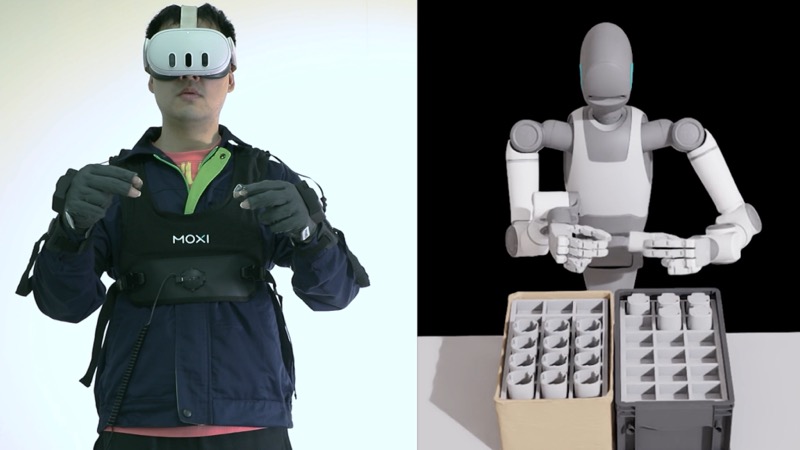
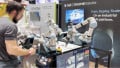
Techman demonstrated a capture-driven training system that translates real human movements into humanoid robot operation. Image used courtesy of Techman Robot
Nvidia’s role here goes beyond just providing the components for computation to actually starting to look more like the foundation on which everything else is built, spanning simulation, data, hardware, and deployment. For example, FANUC is linking simulation to real production, Universal Robots is focused on how training data is actually captured and used, and Infineon is working on the hardware and safety side that makes it all viable. Put together, it points to a shift away from fixed automation and toward systems that can be trained, adjusted, and scaled based on what’s happening in the real world.