Facebook
 Google
 GitHub
 Linkedin
Elmo EASIII Unifies Motion Tuning and Machine Diagnostics
Designed for robotics and automation, Elmo EASIII unifies motion programming, analysis, and tuning across the company’s full hardware ecosystem.
Motion control hardware keeps getting faster and more capable. The software used to configure and tune those systems has had to evolve with it. That’s the focus behind Elmo Motion Control’s latest release, the third generation of its Elmo Application Studio platform, now called EASIII. The new version is designed to simplify motion programming and machine setup while giving engineers deeper access to tuning, diagnostics, and system analysis tools. At the same time, Elmo is trying to reduce one of the more common friction points in motion control systems—the time required to commission and optimize machines once the hardware is in place.
Elmo’s EASIII platform combines motion configuration, tuning, diagnostics, and system analysis in a unified software environment. Image used courtesy of Elmo
One Environment Across the Entire Product Line
One of the bigger changes in EASIII is that the platform now supports the full Elmo ecosystem from a single environment. That includes SimplIQ, Gold, Platinum, and Titanium product families. Instead of switching between separate tools or workflows based on the hardware, engineers can configure, tune, program, and monitor systems from a single interface. The platform is also fully compatible with Elmo’s servo drives and Maestro motion controllers, enabling real-time communication and coordinated motion control across single- and multi-axis systems. That unified structure matters more as machines become more complex. Multi-axis systems, EtherCAT networks, and synchronized motion setups can become difficult to manage when software environments feel fragmented.
Reducing the Complexity of Motion Tuning
A large part of EASIII focuses on tuning and optimization. The platform includes updated auto-tuning tools designed to speed up commissioning while improving motion accuracy. Elmo also added advanced system identification tools, graphical Bode and Nichols analysis, FFT analysis, and advanced filtering controls to help engineers push servo performance further without relying entirely on manual tuning. The software supports MIMO-based automatic tuning for gantry and planar systems, along with dual-loop sensor configurations and calibration tools for a wider range of feedback devices. At the same time, Elmo is clearly trying to make these features more approachable. EASIII uses a wizard-based structure with guided setup flows and updated interface layouts that walk users through configuration, diagnostics, and system integration tasks step by step. The goal is not just adding more tools. It’s reducing the amount of expertise required to use them effectively.
Programming and Real-Time Analysis
EASIII also expands the platform's development side. The software now includes a Python-based engineering environment with real-time debugging and thread analysis. That gives developers more flexibility when building custom motion behavior or troubleshooting machine logic during runtime. Real-time monitoring tools are another major part of the release. Engineers can record live system data, analyze performance, and monitor network behavior directly inside the platform. High-speed recording and analysis features are built in, which help identify issues that are harder to catch during standard testing. EtherCAT configuration and diagnostics are also integrated directly into the software, along with tools for Functional Safety setup and validation.
Built Around Scalability
One thing that stands out in EASIII is how much emphasis Elmo is placing on scalability. The platform is designed to support everything from smaller single-axis systems to larger synchronized machine architectures. That includes support for ECAM configuration, external reference processing, and coordinated motion applications that require multiple drives and controllers to work together in real time. Instead of treating commissioning, programming, and diagnostics as separate stages, EASIII aims to bring them together into a single workflow.
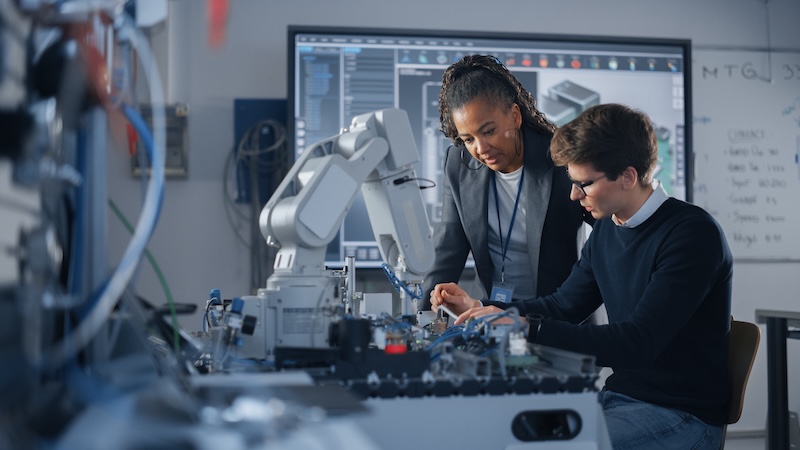
Motion software platforms like EASIII help engineers configure, tune, and optimize robotic and automation systems more efficiently. Image used courtesy of Adobe Stock
Where It Fits
The software is clearly aimed at machine builders and automation engineers working on systems where motion precision and responsiveness matter. That includes industrial automation, robotics, packaging systems, semiconductor equipment, and other applications that rely heavily on coordinated servo control. As motion systems become increasingly distributed and software-driven, tools like EASIII become more important. Hardware performance still matters, but the ability to configure, tune, and optimize those systems efficiently is becoming just as critical.
A Push Toward Faster Development Cycles
The bigger theme behind EASIII is reducing engineering overhead. Elmo is trying to shorten setup time, simplify tuning, and centralize system management without stripping away the deeper analysis tools advanced users still need.
That balance is difficult to get right in motion control software. EASIII is clearly aimed at making those systems easier to work with as machine architectures continue getting more complex.