Facebook
 Google
 GitHub
 Linkedin
Energy-Efficient SMA Gripper Revolutionizes Industrial Robotics
Saarland University’s SMA-based gripper cuts energy use by 90%, offering a sustainable alternative to pneumatic grippers for automation and manufacturing.
Saarland University and the Saarbrücken Center for Mechatronics and Automation Technology (ZeMA) have recently developed a new robot gripper technology designed from a lightweight shape memory alloy (SMAs). Built to offer efficiency and sustainability, the sensor-free gripper promises a 90% reduction in energy consumption compared to conventional pneumatic grippers. The research team, led by Professors Paul Motzki and Stefan Seelecke, will demonstrate their innovative technology at the upcoming Hannover Messe event. The gripper innovation not only addresses the industrial challenge of high production costs resulting from electrical consumption but also aims to contribute to environmental sustainability.
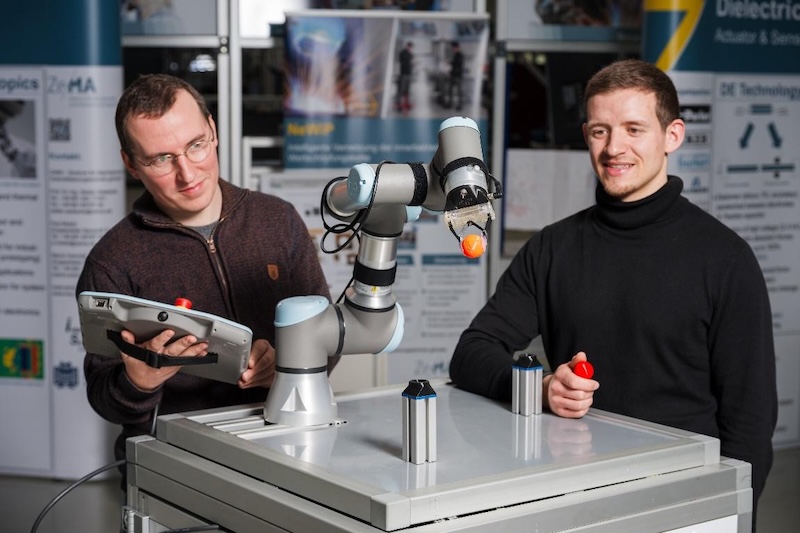
PhD research student Tom Gorges (left) and Master's student Philipp Göddel (right) are part of the team developing the smart gripper technology for industrial applications. Image used courtesy of Oliver Dietze
The Innovative Gripper Technology
The new Saarbrücken gripper technology is a fully electric gripper that does not rely on air compressors, often associated with energy losses, thus ensuring the consumption of less electrical power compared to pneumatic grippers. Built from Nickel-Titanium (NiTi) shape memory alloys and smart polymers, the gripper is compact and can adjust its length and shape in response to temperature or electrical input.
The gripper features a bundle of ultrafine strands of the SMA material, which, when short pulses of electrical current are passed through them, heat up and shorten. When the current is switched off, the material reverts to its original shape. Although each strand in the bundle of ultrafine wire measures just 0.025 mm, 20 strands are capable of exerting a force of 5 Newtons. These strands of wire can change their crystal lattice structures at a frequency of up to 200 Hz. This ensures rapid response times, enabling the grippers to change between closed and opened states in milliseconds.
Using the SMA material, the research team has developed a prototype jaw gripper that can exert a force of 4 Newton and directly conform to the shape of the workpiece. The sensor-free adaptive grip is achieved to reduce the need for external sensors, and the SMA material acts as a nerve that provides a semiconductor chip and an AI system with essential deformation data that relates to external resistance. This, together with the data-trained neural networks, ensures accuracy regardless of any disruptive influence on the gripper.
Another prototype that will make its debut at the Hannover Messe show is a vacuum gripper that also uses the SMA material and vacuum suction cups to hold onto a workpiece. The suction is achieved by applying electrical pulses to the ultrafine wire that pulls a rubber membrane to create a vacuum between the tips of the gripper and the surface of the workpiece.
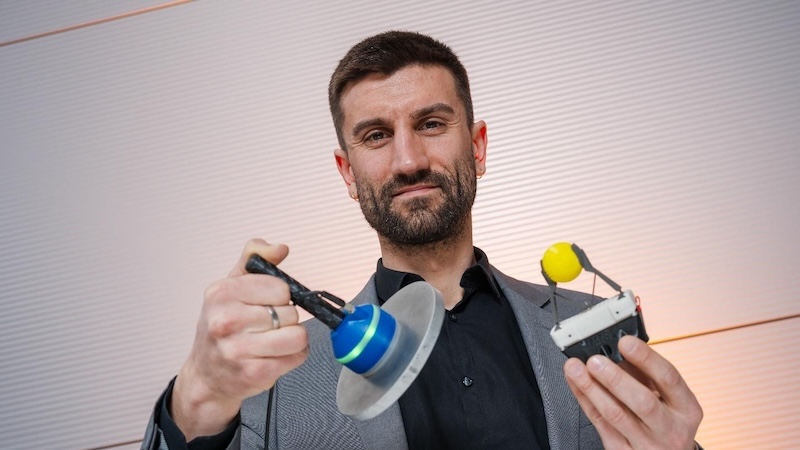
Professor Paul Motzki holding the vacuum gripper (left, holding a steel plate) and jaw grippers (right, with a ball) prototypes of the innovative robotic gripper systems. Image used courtesy of Oliver Dietze
A Smarter, Greener Future for Industrial Robots
The new gripper technology has the potential to be used in industrial sectors such as automation assembly, electronic manufacturing, material handling and packaging, medical manufacturing, and aerospace for complex assembly tasks that require less energy consumption.
As energy costs continue to rise and environmental concerns intensify, Saarland University's energy-efficient robot grippers mark a significant growth toward achieving sustainable automation. By using less power than traditional pneumatic grippers, the new innovative solution saves costs in industries that are seeking a balance of efficiency, cost, and sustainability. This, together with its advanced features, gives the new gripper technology the potential to make automation not only smart and efficient but also more environmentally responsible.
Related Content