Facebook
 Google
 GitHub
 Linkedin
Flexiv Robotics Elements Series 3: No-Code Robotic Design and Testing
The release of Flexiv’s new Elements Series 3 control system with an intuitive motion bar and simulation-enabled design and testing is set to enhance robotic applications across industries.
Flexiv Robotics announced the launch of its latest control system for logic-based programming and deployment of industrial robots, featuring 3D simulation application design and testing and a redesigned Motion Bar with features facilitating Freedive (hand-guide), switching, and Jogging control.
The new upgrade from Flexiv, a deep tech company that provides general adaptive robotics solutions for intelligent automation in the manufacturing industry, is customer-focused, incorporating previous feedback to advance user-friendly robotic programming, deployment, and ongoing operation.
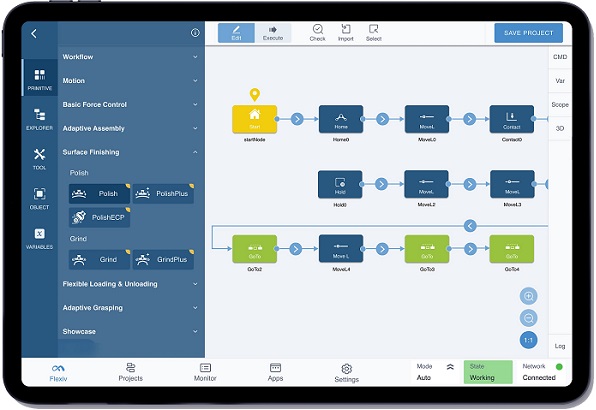
Flexiv Elements software provides a drag-and-drop user interface for intuitive, flow-chart-based programming. Image used courtesy of Flexiv
Flexiv Elements
The graphical user interface of the Elements software is designed to help all employees with varying degrees of programming experience, employing a no-code, drag-and-drop approach to application setup. Having such a user-friendly interface empowers existing operators and developers and also supports training staff seeking to add essential practical knowledge to their robotics and automation skills.
Customers can delve into curating their tailored robotic application workflows by selecting a repertoire of primitives, which are actions or skills that a robot employs to carry out tasks. Primitives can be thought of as separate modules that can be combined or reconfigured to create a sequence that, when run, allows a robot to carry out a dynamic task. For instance, a typical motion primitive, MoveL, controls a robot tool center point (TCP) to move to a target position in a linear fashion. Using MoveC would move the robot in a circular or arc motion to a desired position in Cartesian space.
The drag-and-drop maneuverability of primitives comes with a GIF feature that allows users to see how the robot will move when the workflow node is in operation. Users can also modify path trajectory through an editing function, visualize and troubleshoot robot program data, troubleshoot operational faults, and optimize program performance.
An overview of the Elements Series 3 software and hardware. Video used courtesy of Flexiv
Elements Series 3
Users of the Elements Series 3 can employ a wide range of primitives for developing workflows, fine-tuning motion paths, exacting or advanced basic force control, undertaking dynamic handling, surface finishing, and more. The use of primitives and the act of combining them in a sequence as part of a desired workflow reduces programming time and so speeds up time to deployment.
The newly released hardware component of the Series 3, the Motion Bar, comes with specific buttons for hand-guided control, Jogging, and mode switching. It also incorporates a light for indicating status and can be used stand-alone or connected with the Teach Pendant. The Elements Series 3 software can be connected up to robots through WiFi and disconnected for offline programming.
All Flexiv robots, including the Moonlight Adaptive Parallel Robot, are completely compatible with Elements Series 3. With programming, customization, and integration features, it provides the tools and user interface required to design and implement robotic operations. With features intended to reduce implementation times and guarantee consistent performance, the platform supports complex production lines and jobs requiring a high degree of precision. Because of its cross-platform support and plug-and-play capabilities, developers can design, test, and deploy robotic solutions for a variety of sectors.
Application areas include surface treatment, product testing, research and development, education, automation assembly, and more.