Facebook
 Google
 GitHub
 Linkedin
HMS Anybus Wireless Bolt 5G Enhances Mobility with RBMS
With RBMS, the Anybus Wireless Bolt 5G ensures stable IP addresses for mobile devices, reducing conflicts and downtime in industrial 5G environments.
The HMS Anybus Wireless Bolt 5G now features Routing Behind Mobile Station (RBMS). RBMS enables each device connected to the Anybus Wireless Bolt 5G to keep a stable, local IP address, even as they move between different 5G coverage areas. This prevents conflicts and reduces the need for reprogramming. Last year, HMS developed and tested this feature, and now it is standard on all new Anybus Wireless Bolt 5G devices.
What is Routing Behind Mobile Station (RBMS)?
HMS developed a first-in-industry method for addressing devices. RBMS is a way to improve how messages are transmitted over 5G networks in an environment with lots of mobile devices, such as robots or vehicles. As devices connect and disconnect from any particular part of a 5G network, they are assigned an IP address. If a device has multiple 5G devices onboard a moving robot, it is possible for IP addresses on some of the subsystems to conflict. This is because of how 5G routes messages and decides which network devices are most favorable for a solid connection.
With an RBMS-enabled Anybus Wireless Bolt 5G, the Anybus acts as a router, meaning addresses can be assigned to subsystems that are local to the device. When the robot moves through the workspace, only the Anybus Wireless Bolt 5G must perform the updates. This is particularly useful for connecting to PLCs and other devices that are a nuisance when reprograming with new IP addresses.
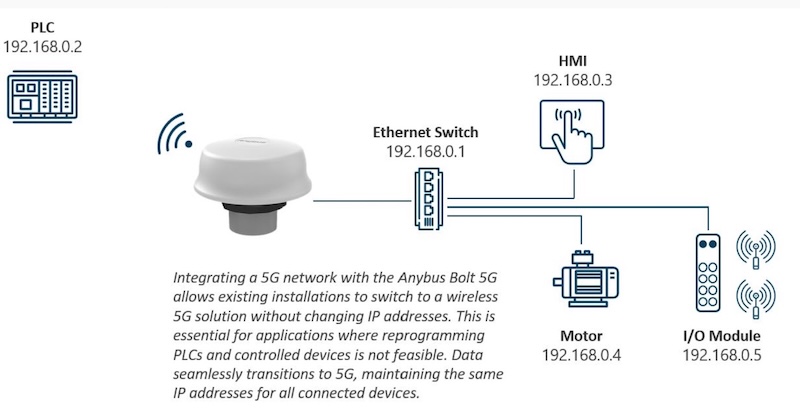
Anybus Wireless Bolt 5G in action. Image used courtesy of HMS
Consider an Autonomous Mobile Robot (AMR) navigating through a factory with multiple tracked components as its payload. If each item has its own unique IP address, assigning new ones as the AMR transverses the factory floor and connects to new 5G devices could be a programming nightmare. However, if the AMR is connected to an RBMS-enabled Bolt, the IP addresses are tied to the AMR instead of the network as a whole. There is less opportunity for dropped packets and other problems with miscommunication.
Anybus Wireless Bolt 5G
RBMS comes standard with new Anybus Wireless Bolt 5G devices. The Anybus Wireless Bolt 5G is a networking device that can be bolted onto virtually any machine, allowing it to be connected over a 5G network. Communication can be established via PROFINET, Ethernet/IP, or Modbus TCP through this device. The new, upgraded models work seamlessly with other Anybus devices, including the tunnel gateway released last summer.
In other words, this device allows for low latency and high reliability, leading to safer conditions and higher throughput from the factory floor. This is all transparent to the user, as they do not need to reprogram IP addresses or configurations. These devices are suitable for industrial use. They are sealed to IP67 standards and are designed to be bolted onto existing structures.
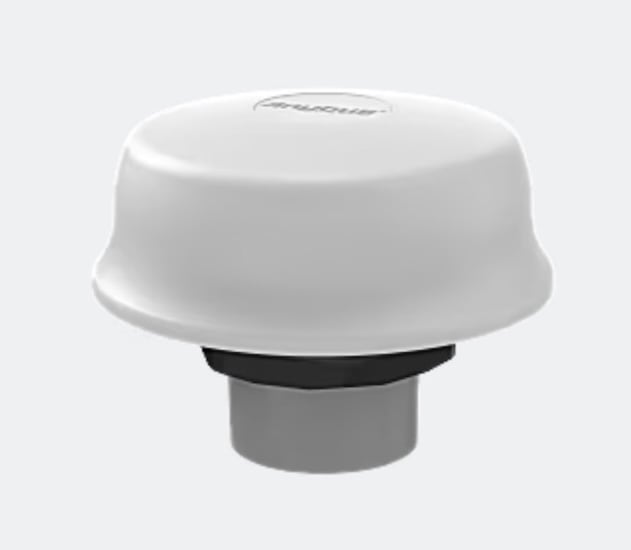
The Anybus Wireless Bolt 5G. Image used courtesy of HMS
Industrial Applications
The upgraded HMS Anybus Wireless Bolt 5G will be used in robots, AMRs, and vehicles in the warehousing, manufacturing, and transportation industries. In all of these cases, items move between 5G devices many times over, making conditions ripe for miscommunication between devices. Based on this premise, faster, more reliable communication, as well as the ability for moving devices to adapt to their new 5G network without extensive downtime, make this a worthwhile upgrade.
Featured image used courtesy of HMS