Facebook
 Google
 GitHub
 Linkedin
Keyence LJ Developer Simplifies 3D Vision Code Creation
LJ Developer enables faster 3D inspection setup using a graphical interface and auto-generated source code for manufacturing systems.
Keyence’s LJ Developer software streamlines the development of 3D machine vision applications by combining an intuitive interface with automatic source code generation. Engineers can configure inspection parameters visually and convert them into deployable code with minimal manual programming. Supported by a library of built-in 3D inspection tools, the platform enables accurate measurement, defect detection, and alignment correction. By reducing complexity and accelerating setup, LJ Developer helps manufacturers integrate reliable 3D inspection into automated production systems more efficiently.
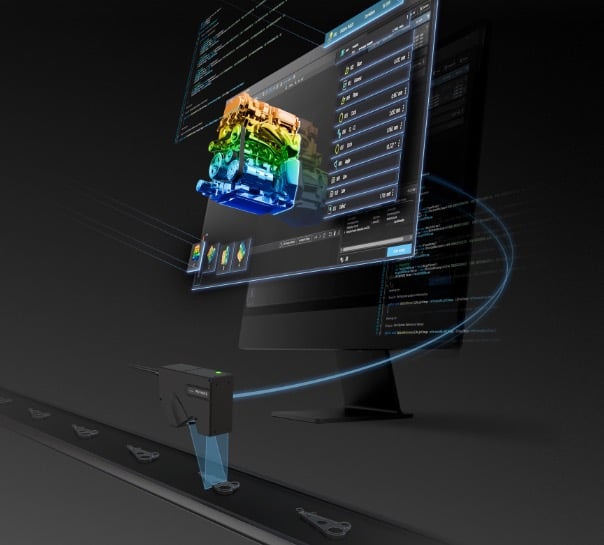
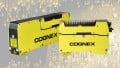
The new LJ Developer software offers fast deployment of complex machine vision applications. Image used courtesy of Keyence
Automatic Source Code Generation
LJ Developer includes automatic source code generation, turning configured inspection settings into usable program code and making it easier to move from setup to deployment. Engineers can set inspection parameters and mark areas of interest on 3D images using the graphical interface. After finalizing the settings, the software generates the source code with one command. This code can then be added to user applications to run inspection functions, helping to speed up deployment, lower programming complexity, and make it easier to add 3D inspection to automated production systems.
Built-In 3D Inspection Tools
LJ Developer comes with a full library of preconfigured 3D inspection tools to handle many measurement and inspection tasks using height data and 3D imaging, so there is no need for custom algorithms. It provides tools for accurate dimensional checks, including height, distance, and surface profile measurements. For surface defects, users can use detection tools to find scratches, dents, or warping by analyzing 3D height changes. The software also includes position-correction tools to fix minor misalignments and noise filters to clean up 3D scan data for improved quality. LJ Developer also allows deeper analysis by merging multiple image sets and showing results in detailed 3D visuals.
Inspection Capabilities for Manufacturing
LJ Developer’s inspection tools are designed for common manufacturing quality control tasks, using 3D imaging to find issues that 2D systems might miss. Manufacturers use it to detect surface defects and check that components meet required tolerances. The software also has special tools for inspecting adhesive and sealant beads during assembly, measuring their width, height, and continuity across complex shapes to ensure proper installation. Because 3D imaging captures the real shape of objects, it is less affected by lighting, reflections, or surface patterns, making inspections more reliable and accurate even in tough environments.
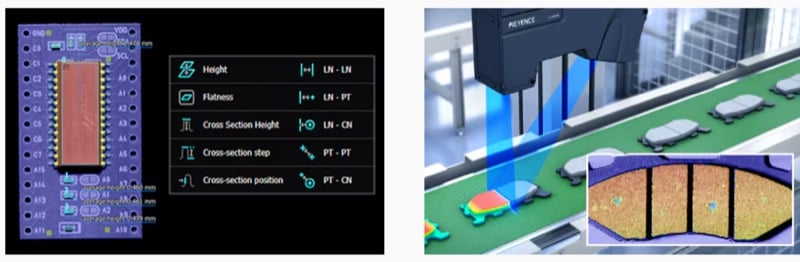
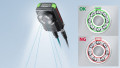
The intuitive user interface works well with electronic dimensional measurement and scratch defect detection. Image used courtesy of Keyence
In electronics manufacturing, machine vision systems are used to inspect small components, PCBs, and connectors. Height analysis helps detect problems such as misaligned parts or faulty solder joints. The software supports automated quality control stations that scan production lines to identify defects and maintain consistent product quality.
Simplifying 3D Machine Vision Development
Building applications for 3D machine vision systems often requires significant expertise and programming to develop specialized algorithms for measurement and feature detection, which can slow deployment. As demand for simpler, faster solutions grows, LJ Developer offers a possible answer. Its graphical setup environment makes it easier to configure inspection tasks without writing complex image-processing algorithms.