Facebook
 Google
 GitHub
 Linkedin
Banner Engineering Combines IO-Link and Edge Processing in One Device
The DXMR190 IO-Link master combines eight-port connectivity with edge processing to stream data directly to cloud systems and web servers without an edge PC.
Remote I/O is a term used when putting inputs and outputs next to the devices using these signals. These I/O blocks are often IP-rated and use industry-standard M8 or M12 connectors. IO-Link is a protocol often used with remote I/O because of its flexibility in being able to connect virtually any input or output.
Recently, Banner Engineering released the DXMR190, a new kind of IO-Link master with the ability to push data to web servers directly from the I/O block.
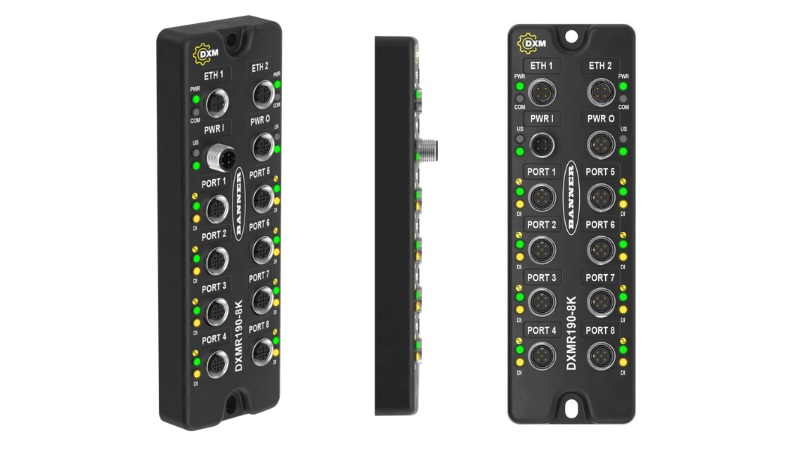
Banner’s DXMR190 IO-Link master with onboard edge processing. Image courtesy of Banner Engineering
I/O and Data Processing in One Device
An IO-Link master allows for sensors and actuators to be connected to one block that communicates to control systems over an industrial protocol. This topology allows for diagnostic information to be monitored and parameters to be set by the control system, all through a single connector.
Banner’s new DXMR190 IO-Link master is adding another layer of communication by being able to push data to web servers and cloud applications via REST APIs and MQTT. This reduces the need for an edge PC to collect and send data to cloud infrastructures. With the DXMR190, data can be sent from where it is created.
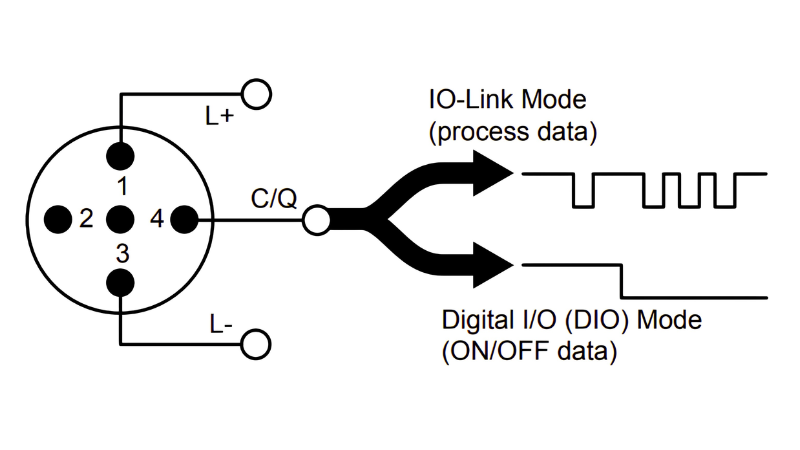
DXMR190 IO-Link pin assignments. Image courtesy of Banner Engineering
The DXMR190 IO-Link Master
Offered in eight-port models, the DXMR190 is capable of communicating with up to eight IO-Link devices, including hubs and other masters. Each port can utilize either pin 2 or 4 for discrete signals, either input or output, and the L-code M12 power ports share 8 A on their respective pins. The IO-Link ports use the standard 5-pin M12 connector, while the Ethernet ports use a D-Code 4-pin M12 connector.
The DXMR190 can be ordered with EtherNet/IP, PROFINET, or Modbus/TCP. With the DXMR190 using standard connectors and communication protocols, it can be used with new equipment or to replace existing IO-Link masters.
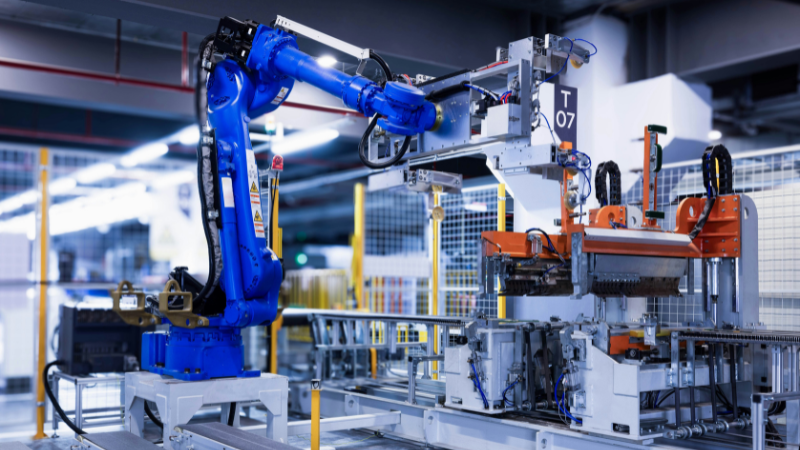
Industrial robots use remote I/O because of the I/O density, with only Ethernet and power being required. Image courtesy of Unsplash
Industrial Data and Cloud Connectivity
Automated assembly equipment often uses IO-Link for actuating pneumatic cylinders and for part detection. OEMs will use an IO-Link block because it is faster and easier to wire an IO-Link master than to install and wire a remote I/O rack.
In a traditional system, if you wanted to count the cycles of the pneumatic cylinder or the number of parts passing a sensor, logic would need to be written in the PLC, then pushed to a database or edge PC. With the DXMR190, this data can be pushed directly to a server or a cloud system. Once the data is received and processed, it can be easily stored in an on-premises or cloud database.
Process automation installations are often large and take up a lot of real estate. With the DXMR190, not only can you send temperature and pressure readings back to a control system to maintain the process, but the same data can be sent to an AWS application or a web server.
The DXMR190 can reduce the number of complex systems residing on the factory floor and increase the ability for data collection from devices, all while still functioning as an IO-Link master.