Facebook
 Google
 GitHub
 Linkedin
IDEC Launches Industrial Iot-Ready HG1J Series HMI With 4.3 inch Display
IDEC has released a new 4.3-inch PCAP display HMI that is compact enough for limited-space applications yet ready for the IIoT world with industry-leading protocol support and remote connection capability.
Since 1945, IDEC has been a global supplier of automation devices and components. Today, IDEC’s catalog includes PLCs, HMIs, and safety devices. Recently, IDEC expanded its line of compact HMIs with the HG1J series. This HMI has many new features over existing models and offers advanced technology to enhance user experience.
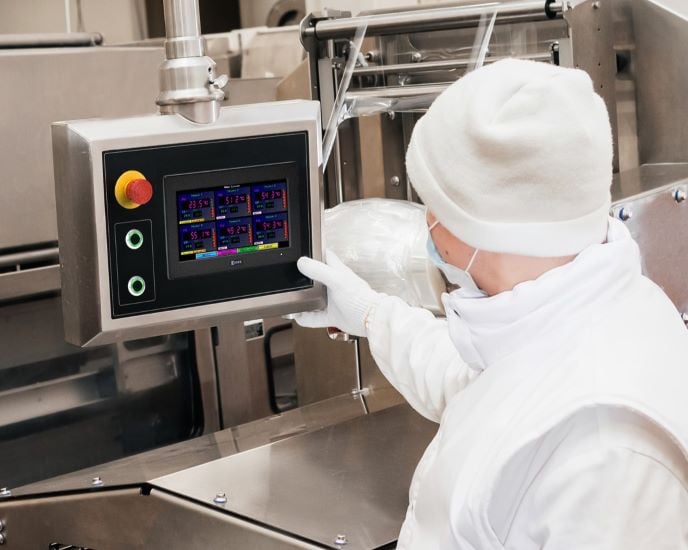
With its 4.3-inch display, the HG1J is suitable for use in industrial applications limited in space. Image used courtesy of IDEC
The Compact HG1J HMI
HMIs enable operators and maintenance staff to interact with equipment, so the look and feel of the HMI are important. IDEC’s new HG1J HMI uses projected capacitive touch (PCAP) technology — the same technology used in smartphones and tablets. By using PCAP screens, IDEC offers an HMI that is not susceptible to water droplets and yet still responsive with gloved fingers.
The HG1J’s display is 4.3 inches, has a resolution of 480x272, and supports up to 16 million colors. The new HMI uses 12 to 24 V DC and can operate in temperature ranges from -20 to 55 °C. For machine builders, the front bezel is unbranded, making the HG1J an excellent candidate for a standard product. The touchscreen is made up of a glass top and has a 50,000-hour rated backlight, making it robust and wear-resistant. The HG1J HMI is IP66 and IP67 rated, making the HMI suitable for wash-down environments.

The HG1J HMI features a PCAP touch panel and a durable, water- and scratch-resistant design. Image used courtesy of IDEC
Industrial IoT Connectivity and Communication
Today’s industry is all about connectivity and industrial protocols, mostly for IIoT. The HG1J offers a wide variety of connection ports and supported protocols to meet this need. Each display model provides two USB-A ports, popular for data transfers and data logging, as well as connecting third-party dongles like Bluetooth or WiFi. An embedded Ethernet port is provided for networking and industrial protocols such as Modbus and EtherNet/IP. Nonindustrial protocols such as MQTT TCP/IP and BACnet IP are also supported. Each model has built-in RS232C and RS422/485 serial ports. The serial ports also support Modbus RTU and can communicate with up to 15 other IDEC HMIs.
Communicating to the HG1J is easy, thanks to all the protocols it supports. The HMI can be configured as an FTP server or client for transferring project files or log data. The HG1J can be configured as a web server that allows remote monitoring and control of the HMI. No additional software or hardware is required for remote monitoring. Emails can be sent directly from the HMI and include live HMI or PLC tag values. The email can also include alarm logs, operation logs, and screenshots.
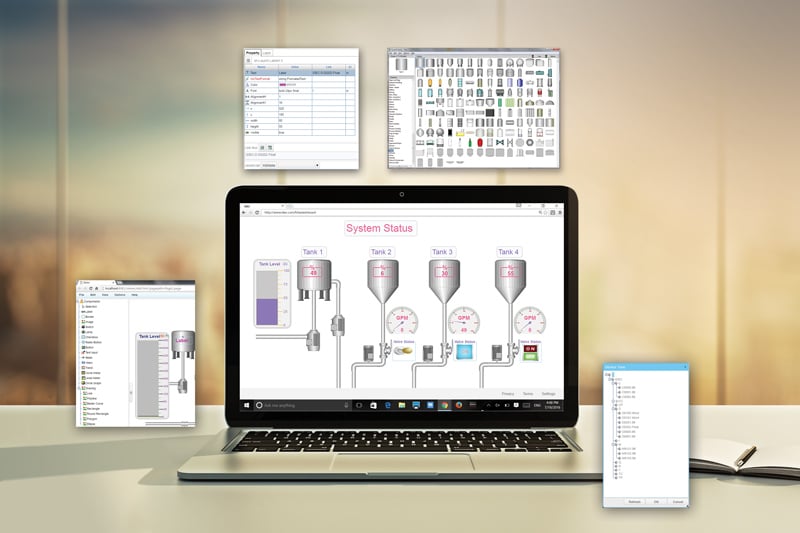
The HG1J utilizes the WindOI NV4 software for quick and simple programming. Image used courtesy of IDEC
Configuration and Commissioning
Just like any other HMI on the market, the HG1J will need to be configured and programmed out of the box. IDEC provides software to simplify this process. The WindOI-NV4 software utilizes a drag-and-drop interface and an image library to enable quick configuration and programming of the HMI. If converting an older project or downsizing an existing project, the WindOI-NV4 software will automatically resize it to fit the 4.3-inch screen. The HG1J supports many features seen on other IDEC HMIs, including script programming, multilingual screens, securities, trends, data logs, and alarm logs.
Small But Powerful
HMIs are used to interface with equipment, but they don’t always need to be 20-inch touch screens. Simple machines can often benefit from smaller HMIs but still maintain the same functionality. By using an HMI like the HG1J, users can scale existing projects down to the smaller HMI and save money on the overall cost of the equipment. Smaller HMIs are often less confusing and easier to use, resulting in a more user-friendly machine.
Related Content