Facebook
 Google
 GitHub
 Linkedin
Learn, Adapt, Perform: NEURA Robotics Leaps with NVIDIA Cosmos
NEURA Robotics is enhancing its AI capabilities by leveraging NVIDIA’s Cosmos platform. This platform combines synthetic and real-world data, enabling robots to learn and adapt faster.
One of the more significant challenges in AI-enabled robotics has been the slow and costly process of training these models to perform complex tasks. Traditional methods often fail to acquire the necessary data and environments for effective learning. NEURA has begun addressing these issues by adopting the NVIDIA Cosmos platform. This technology accelerates the training process through photorealistic synthetic data and advanced video-to-action capabilities. This enables the NEURA robots to learn, adapt, and perform efficiently and accurately.
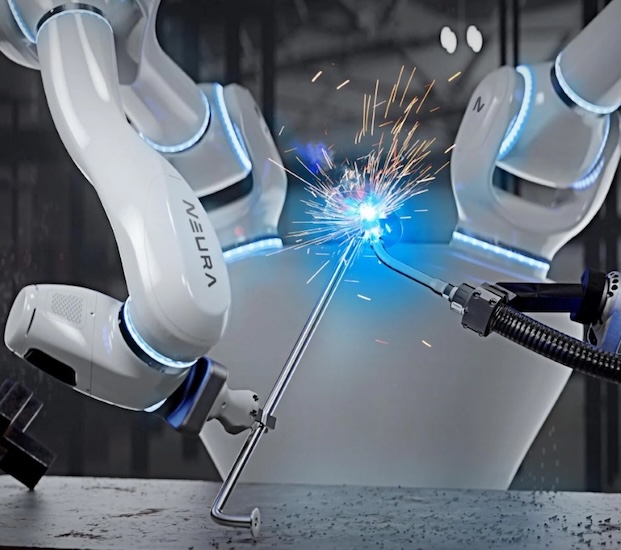
Two NEURA robots collaborating to complete a welding project. Image used courtesy of NEURA
Monkey See, Monkey Do
NEURA is striving to completely transform the robotics industry through artificial intelligence. They offer several different robot models designed for various purposes, including the 4NE-1 humanoid robot, the MiPA service robot, and the industrial MAiRA robots. Despite their differences, all these robots share a common ability: they can comprehend and replicate complex tasks with ease.
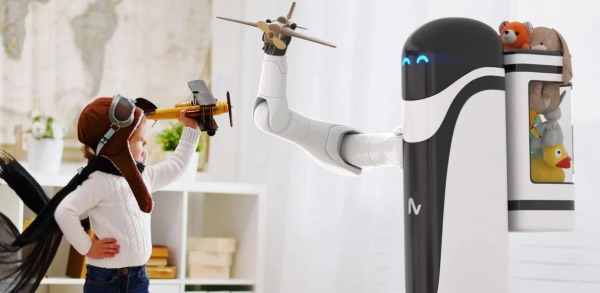
NEURA’s MiPA robot adapting and learning how to play with a child. Image used courtesy of NEURA
The concept is simple: monkey see, monkey do. Whether emptying a dishwasher to free up time for households, dispensing medications in healthcare, or performing welding tasks in industrial settings, NEURA robots are engineered to learn by observation. This means that when a robot watches you perform a task, it learns how to do it and then can take over those responsibilities.
Listen Up. It’s Time to Work
One of the most interesting features of NEURA robots is their ability to recognize human-like voices. Depending on the model, NEURA robots are equipped with a 360-degree microphone array powered by AI. This allows the robot to understand your commands, significantly enhancing the user experience. Imagine telling a robot to perform a quality check on a part, and it completes the task without any intervention. Or consider saying, “Hey robot, it's time for full production; let’s keep this machine running all night,” and the robot carries out the instruction. NEURA Robotics is truly on the brink of ushering in a new era of robotic technology.
The Power of the Cosmos
NVIDIA Cosmos is a platform designed to enhance AI systems, particularly for robots and autonomous vehicles. It provides a comprehensive toolkit for creating intelligent, adaptable machines. One of Cosmos’ main features is the generative World Foundation Model (WFM). The WFM feature enables pre-trained AI models to generate realistic videos and simulations, helping robots understand and predict real-world scenarios by producing photorealistic data that accelerates AI model training while reducing costs.
Another massive benefit of the NVIDIA collaboration is the ability to use the Neuraverse platform. The Neuraverse consists of thousands of NEURA robots consistently collecting data to help each other progress and learn new skills at a quicker pace. This collective learning environment enhances the overall capabilities of NEURA’s robots. Cosmos’ video-to-action technology allows robots to learn tasks by watching videos and mimicking the actions, similar to learning from a tutorial on YouTube. Cosmos also offers physics-aware training environments, ensuring that simulations are realistic and practical for real-world applications. NVIDIA’s platform then converts the visual data into a format that AI models can process quickly.
The benefits of using Cosmos include accelerated development, cost efficiency, and enhanced learning and adaptability for robots. Robots trained with Cosmos can quickly learn and adapt to new tasks, continuously improving through virtual simulations and real-world interactions.