Facebook
 Google
 GitHub
 Linkedin
New 50 mm EHMD Grippers Bring More Power to Laboratory Automation
Festo expands its EHMD rotary gripper line with a 50 mm option and Z-compensation, enhancing lab automation in biotech, pharma, and diagnostics applications.
Festo announced the expansion of its EHMD Series of rotary grippers, which now includes an optional 50 mm-sized gripper. A key feature of EHMD grippers is the optional setup with Z-compensation, which adjusts for vial/cover thread pitch without modifying the Z axis. This article will provide an overview of the EHMD and other Festo technologies that are evolving the landscape of laboratory automation procedures across research, biotech, medical, and pharmaceutical fields.
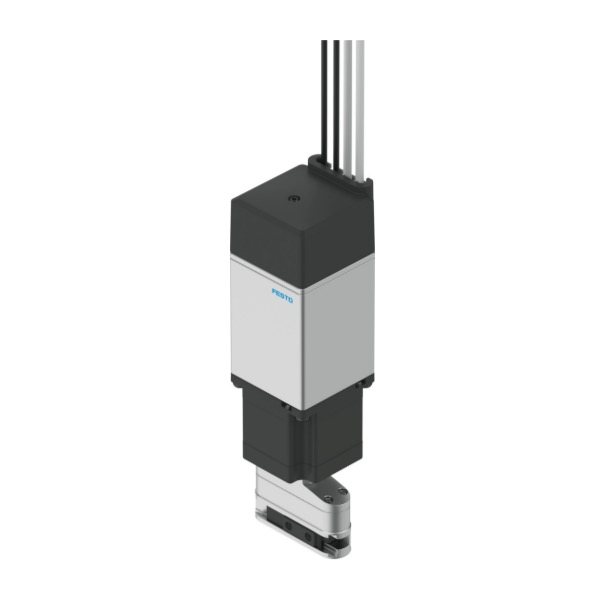
The EHMD rotary gripper module for gripping and placing laboratory equipment (such as well plates and vials) or electrical components within the electronics industry. Image used courtesy of Festo
Controlling Automated Air Pressure
At the heart of all medical, pharmaceutical, and research laboratory procedures is protocol repeatability, sterility to deter contamination, and precise handling and dispensing of biological/chemical substances. Unfortunately, human researchers, technicians, and assisting staff are prone to fatigue when faced with manually demanding protocols. Humans can make errors when pipetting, mislabel samples, and introduce contamination when tired or distracted. Pipetting volumes can differ per well, reducing assay reproducibility and skewing results of processed data, which high-throughput screening is especially sensitive to.
The PGVA-1 pressure/vacuum supply ensures steady liquid circulation throughout dispensing by offering a consistent and tunable air pressure/vacuum source. Cross-contamination is avoided, and the VTOE and VTOI dispense heads' careful control of liquid quantities decreases variability. Concurrently, the VAEM valve control unit times and controls valve opening for every dispense cycle, enabling reproducible, coordinated dispensing across numerous wells. When combined, these elements automate the microplate loading procedure, reducing human error, boosting productivity, and guaranteeing reliable, consistent outcomes in lab operations.
The DNA/RNA extraction solutions provider for molecular biology, MolGen, uses the PGVA-1 in the PurePrep TTR, handling 320 patient samples every hour. The system executes high-throughput transfer of patient samples from vials to Deep Well microwell plates.
Pipetting, Dispensing, and Sample Handling
Fast MDx provides high-throughput molecular diagnostics to healthcare providers worldwide. The company created a point-of-care testing system for detecting pathogens (such as Influenza A/B, Covid-19, and RSV-A/B in patient samples in one to two hours, so that healthcare practitioners can provide immediate and tailored treatment.
CEO of Fast MDx, Richard Lewis, provides an overview of the capabilities and benefits of the Fast MDx diagnostic test platform. Video used courtesy of Festo
The Fast MDx diagnostic platform uses several Festo automation components. The system starts preparing once the user sets up the pipette tips, chemical substances, microwell plate, and patient samples, each of which is identified by a traceable barcode. Moving in both X and Y directions is a Festo EXCM flat surface gantry, and optical sensors beneath it scan and confirm each of the 92 samples.
The DHOE pipetting head and DHAO disposable syringe ejector, which aspirate and discharge liquids at varying speeds up to 10 ml/s, are mounted on the Z-axis. The pipetting head transfers samples into the microwell plate containing the master mix by puncturing the sample closures with throwaway tips. To prevent cross-contamination, every single tip is utilized just once. The full plate is moved to the heat sealer, subsequently to the RT block for RNA-to-cDNA conversion, and finally, to the PCR (polymer chain reaction) step, to identify target sequences using a different EXCM-30 gantry equipped with an EHPS-16 electric gripper. The system standardizes crucial phases during pathogen diagnosis and reduces the need for human intervention.
Festo broadens size options for its EHMD Grippers
The EHMD rotary gripper module is suitable for laboratory automation applications, including the preparation, analysis, and quality inspection of samples within pharmaceutical development, medical diagnostics, cell/genome research, and biotech research. Customers can choose between a pneumatic or fully electric gripper and add a compensating module for vial cap thread pitch (of up to 10 mm during rotation) with no time lost during changeover. Users can integrate the compact EHMD with the CMMO-ST or CMMT-ST motor controller in force mode.
The EHMD gripper twists off and twists on vial caps and moves vials to the next step in laboratory procedures. Video used courtesy of Festo
EHMD grippers are available in 40 and 50 mm sizes. Customers can add a camera and a three-dimensional gantry to the EHMD to execute quality inspections, register print labels, and barcodes.
Featured image used courtesy of Festo
Related Content