Facebook
 Google
 GitHub
 Linkedin
New Roboze-Comau Partnership Promotes Agile Manufacturing
Comau and Roboze join to deliver speedier, more flexible, accessible, and sustainable automation solutions for on-demand, just-in-time production.
Roboze and Comau are collaborating to improve on-demand manufacturing with cost-effective, flexible, and responsive automation solutions. The partnership aims to optimize just-in-time (JIT) production in sectors such as automotive, aerospace, and energy by combining Roboze's innovative 3D printing technology with Comau's established robotics expertise.
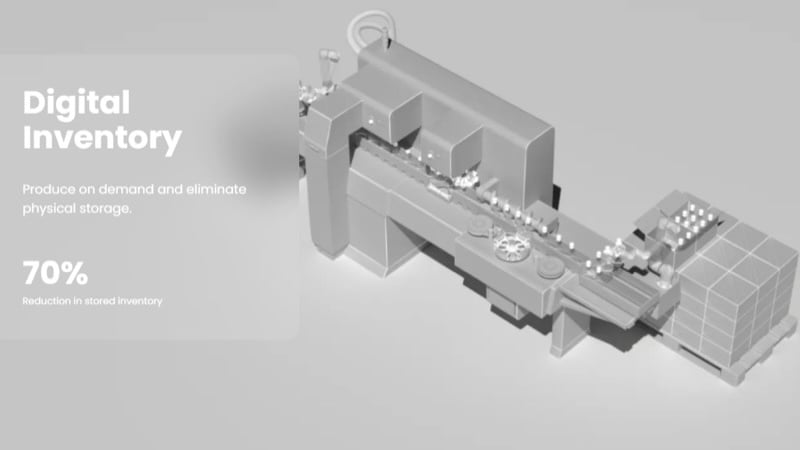
According to Roboze, establishing digital inventories and producing parts on demand can help businesses reduce inventories by 70%. Image used courtesy of Roboze
Just-in-Time Production
Toyota Motor Corporation is credited for proposing and implementing the JIT concept, which works in conjunction with the jidoka concept (automation with a human touch). These two concepts form the basis of the Toyota Production System.
One of the upsides of adopting JIT production is the capacity to respond quickly to changing production demands. The concept involves creating the right number of parts (or only what is needed) on time, without excess. Manifesting this concept during manufacturing can help businesses save time, reduce production costs and inventory costs, and reduce waste. Providing only what is needed equates to minimal inventories, which can also mean more streamlined inventory management.
Another element of JIT is the transit of small, regular deliveries of parts, components, or materials for the production line from suppliers, rather than larger deliveries, which can become impeded by supply disruptions and incur a higher cost for production. Smaller and more regular JIT supplies also allow for greater flexibility, allowing manufacturers to scale up or down part volumes in response to production demand and key output goals. Processes can also be refined to reduce waste and further optimize workflows and efficiencies, thereby enhancing production and customer value.
While JIT can indeed improve production flexibility, revenue flow, and sustainability, it remains vulnerable to supply chain disruptions, where a delay in the delivery of just one part can halt production entirely.
Roboze is dedicated to developing more sustainable manufacturing processes through its innovative additive manufacturing (AM) technologies and high-performance print materials. Video used courtesy of Roboze
Roboze and Comau
This collaboration provides accessibility to flexible, cost-effective, advanced manufacturing solutions by enabling the on-demand fabrication of intricate, customizable parts. It boosts reshoring initiatives, reduces waste, and addresses the growing demand for minimally disruptive, sustainable production techniques. Ultimately, by pushing the limits of conventional production, this partnership enables companies to build customized components more precisely and efficiently.
Roboze and Comau Academies
In addition to the culmination of Comau’s digital factory automation knowledge and Roboze’s expertise in 3D-printed part production, the two companies are fostering the growth and development of future automation engineers through their respective academies.
Comau boasts an online Web Academy available to over 10,000 registered users, more than 150 companies, and over 200 schools. The Web Academy features versatile training tools through its interactive LMS platform, including theoretical content, video tutorials, practical, and hands-on learning activities.
Comau’s e.DO robot and e.DO Cube provides students with a physical and remote means of learning robotic movements and controls. Students can use activity cards, DidAPPs, and tailored training packages to teach specific groups of students across different ages, as well as adult learners. e.DO Experiences (which are activities that can be used in conjunction with e.DO robot and e.DO Cube facilitates learning and development across STEM (Science, Technology, Engineering, and Mathematics) subjects, as well as robotics and coding.
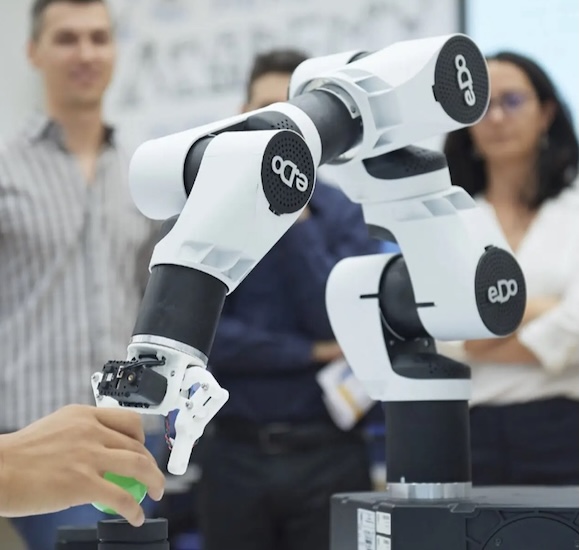
Comau’s 6-axis, 1kg e.DO robot is capable of object manipulation, pick-and-place tasks, moving, and more complex tasks, which makes it an ideal learning tool for budding engineers. Image used courtesy of Comau
Roboze Academy provides specialized training to educational institutions to promote sustainable additive manufacturing (AM) and materials science research. Participants learn how to design experimental investigations, model the behavior of materials, and apply environmentally responsible additive manufacturing (AM) techniques. To strengthen the link between academia and industry innovation, the Academy also assists universities in incorporating unique AM modules into their curricula and promotes co-development initiatives.
Roboze Academy provides practical training to accelerate material creation and prototyping for businesses and research institutes. Students gain proficiency in rapid prototype creation, polymer selection, and scaling concepts from concept to production. The program focuses on the practical incorporation of AM into distribution networks and R&D processes through sophisticated workshops and scenario-based exercises. The Academy has provided over 10,000 training hours and continues to promote industry-academia engagement through partnerships with more than 30 academic and tech institutions.
Collaboration and Innovation
For Comau and Roboze, the collaboration represents a positive disruption in industrial automation across various industries, combining the agility of additive manufacturing with the efficiencies of robotics and automation to transform production. The companies’ respective training academies facilitate the development of the next generation of engineers, priming the future workforce for enhanced, more sustainable, and automated JIT production.
Related Content