Facebook
 Google
 GitHub
 Linkedin
NVIDIA’s AI Innovations Power the Future of Robotics
NVIDIA advances robotics in healthcare, logistics, and manufacturing with AI, machine vision, and digital twins, enabling precision, efficiency, and automation.
Machine learning, machine vision, digital twin technology, and robotics hardware are evolving and becoming integrated to produce more efficient, accurate, and safe human-compatible automated machines. How is NVIDIA collaborating with and supporting its industry partners to innovate and pioneer new robotic solutions in healthcare provision, warehousing and logistics, and manufacturing?
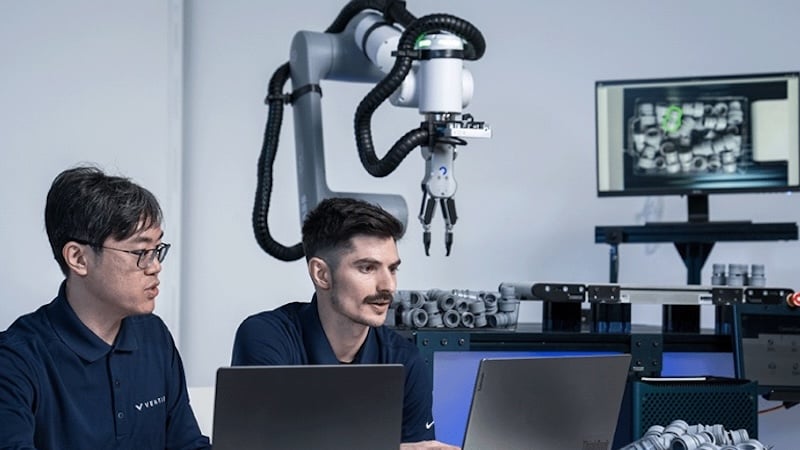
Vention is using NVIDIA’s innovative AI know-how to supercharge its robotic bin-picking capabilities. Image used courtesy of Vention
Alleviating Challenges Across Healthcare and Logistics
Innovative robotics technologies are changing the trajectory of medical practice, warehousing, and logistics operations. To understand the importance of such burgeoning technologies, we’ll explore the challenges and needs facing these industries.
So why might manufacturing companies like McAlpine & Co. seek to optimize processes such as robotic bin picking? Well, speed, accuracy, and efficiency. Integrating tireless, 24/7 operable machinery can significantly drive productivity and mitigate unnecessary downtime. Further, intricate and advanced machine learning algorithms integrated into robotic bin-picking machine vision systems are designed to pick and place items repeatedly and with accuracy. Such machine vision systems can incorporate cameras with three-dimensional stereoscopic vision (with the ability to view objects from different angles), depth perception, color, size, and shape detection for tackling a variety of complex pick-and-place applications. Human error is minimized, and product throughput is increased. Additionally, such minimal-error systems reduce operational costs and enhance quality control.
The integration of robotic systems into healthcare settings is another interesting area of development that is set to revolutionize patient treatment. Healthcare robots can offer efficient, hands-free sanitation services across surgical wards and regions. Other specialized surgical robotic machinery can help add precision, stability, and 24/7 on-call operation.
Humanoid robotics requires physically adept, highly perceptive, AI-enabled robotic technology. The focus is on dynamic movement and action and highly attuned perception to adapt to different processes and task complexities. This is where AI model training, simulation, and testing become the key determinants of effective humanoid robot functioning.
Vention AI-Driven Bin-Picking
Vention unveiled its advanced AI-driven bin-picking solution at NVIDIA’s AI GPU Technology Conference (GTC) 2025. Vention's solution is designed to eradicate the need for intricate and expensive bespoke programming. The system uses a MachineMotion AI controller, a vision-enhanced ABB GoFa CRB 15000 bot, and finger grippers to automatically identify, pick, and arrange items based on a CAD file. This improves speed and accuracy and is made possible by sophisticated AI foundation models—AI neural networks that train on large, diverse datasets to execute tasks from sorting warehouse products in pick-and-place applications or sorting through and analyzing medical images.
The solution goes beyond simple identification by incorporating NVIDIA's AI technology. It adds intelligence and structure to cut down on integration expenses and development time, increasing automation's affordability and accessibility for manufacturers.
A visual display of the capabilities of Vention’s robotic bin-picking solution. Video used courtesy of Vention
Vention is continuing its collaborative development project with McAlpine & Co. to deliver an automated machine-loading and bin-picking solution that eliminates repetitive and labor-intensive tasks for human workers. Integrating AI into Vention’s robotic bin-picking solution is the key to unlocking productivity goals and further process optimization in warehousing, logistics, and manufacturing settings.
The NVIDIA Jetson Orin platform powers Vention's MachineMotion AI controller, supporting real-time processing and enhancing the scalability of autonomous bin picking. It provides improved capabilities and quicker deployment than conventional PLC-based automation. Manufacturers can leverage AI advancements by using NVIDIA's CUDA-accelerated AI libraries, such as FoundationPose. By prioritizing integration, new AI models can be more swiftly adopted, maintaining the flexibility and competitiveness of production systems.
Stereotaxis
Stereotaxis received acknowledgment from NVIDIA at its GTC conference for its pioneering endovascular robotics technologies and was accepted into NVIDIA’s Connect program.
One of Stereotaxis’ standout technologies includes the Genesis RMN (Robotic Magnetic Navigation) system. The Genesis RMN system is intended for accurate, low-risk cardiac ablation techniques. It navigates intricate cardiac architecture more precisely and safely by using magnetically controlled catheters. The MAGiC catheter provides accurate, flexible movement for improved procedural results, while Synchrony software allows for AI-guided, real-time control. When combined, these developments increase patient safety, decrease radiation exposure, and boost efficiency.
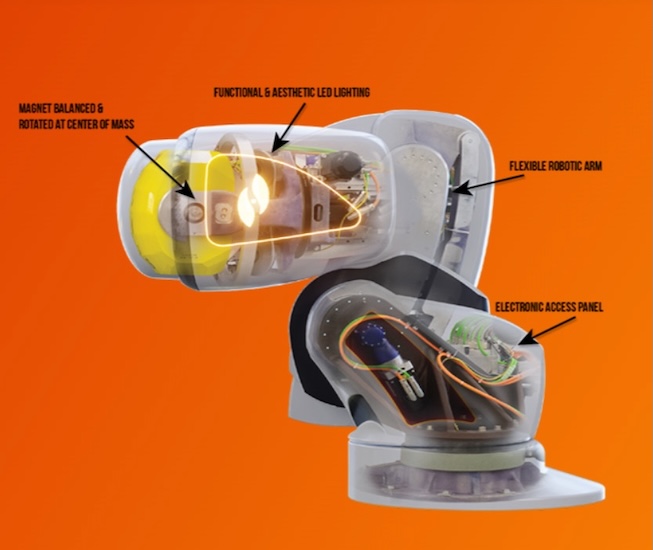
A labeled schematic of the physical components of the Genesis RMN system. Image used courtesy of Stereotaxis
With NVIDIA’s support and active participation through its Connect program, Stereotaxis seeks to enhance its endovascular robotic technologies to pioneer AI-assisted surgeries. The Connect program provides Stereotaxis with toolkits, frameworks, and development resources to carry out its goal. Stereotaxis plans to leverage AI to automate aspects of medical treatment and data integration and enhance decision-making. Overall, the collaboration will serve to boost the efficiency, safety, and precision of endovascular robotics conducting minimally invasive procedures.
Agility Robotics
Also at GTC, Agility Robotics and NVIDIA are extending their partnership to continue building the skill library of Digit, an advanced humanoid robot. Agility uses NVIDIA Isaac Sim and Isaac Lab to train Digit in simulated conditions to enhance abilities like steadiness and instantaneous decision-making. Additionally, Agility processes sensor data and allows Digit to adapt to continuous changes in its environment by utilizing NVIDIA's AI acceleration engine.
Agility is also given early access to NVIDIA Cosmos and the Mega Omniverse Blueprint, which allow for substantial robot fleet planning and simulation using digital twins. Automaker Schaeffler is already using this collaboration to assist with warehouse automation planning. At GTC, Agility will showcase Digit's autonomous capacities and discuss how it's advancing industrial digitalization and the field of robotics as we know it today.