Facebook
 Google
 GitHub
 Linkedin
On Track at Automate 2025: Güdel Rolls Out 7th-Axis Linear Track for Cobots
Güdel has expanded its existing line of 7th-axis linear tracks, this time including one for collaborative and small industrial robots. The new Cobomover gives robots an additional 5 m of working range.
When referring to a 7th axis in robotics, we typically mean adding a sliding axis to the base of the robot. This 7th axis increases the range of motion for the robot. A common application is for storage and retrieval systems where the robot picks objects from an incoming conveyor and distributes them in a storage array.
Güdel Inc., a global robotic automation products supplier, has added a 7th-axis linear track for collaborative and lightweight industrial robots to its product offerings. The company also released a 7th axis that utilizes air bearings for heavy-payload industrial robots. Both solutions were unveiled at Automate 2025 in Detroit this week.

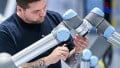
Güdel’s Cobomover 7-th axis linear track provides collaborative robots and lightweight industrial robots with an additional 5 m of working range. Image used courtesy of Güdel
Cobomover 7th-Axis Linear Track
Adding a 7th axis to a robot is a great way to expand its working range. Güdel has expanded the collaborative robot industry by manufacturing an axis slide designed specifically for cobots. The company’s new Cobomover 7th-axis linear track is compatible with over 60 different robot manufacturers and can be mounted at 0° and 180°. The track’s maximum payload is 78 kg and has a maximum speed of 2 m/s with an acceleration of 2 m/s2. The axis uses a toothed belt and gearbox with available strokes of 1000, 2000, 3000, 4000, and 5000 mm and a repeatability of ±0.05 mm.

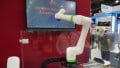
A FANUC cobot mounted on Güdel’s Cobomover 7th-axis linear track at Automate 2025. Image used courtesy of Control.com
TMF-4B Track With Air Bearings
Friction is nobody’s friend when it comes to moving robots from point A to point B. This is why Güdel has expanded its robot track line to include the TMF-4B for high payloads. The track uses air bearings to transport heavy payloads on a “cushion of air,” thus reducing the friction to zero. The air-bearing technology uses 5 psi of air, lifting the 3,800 lbs TMF-4B track half an inch off the surface.
The track was originally designed for painting robots in the aircraft industry but is also well-suited for heavy-duty applications in the automotive industry. With the track specifically designed, there is less guesswork when designing a new paint or welding line. The TMF-4B ranges in length from 3000 to 30,000 mm and is compatible with ABB, FANUC, and KUKA robots.
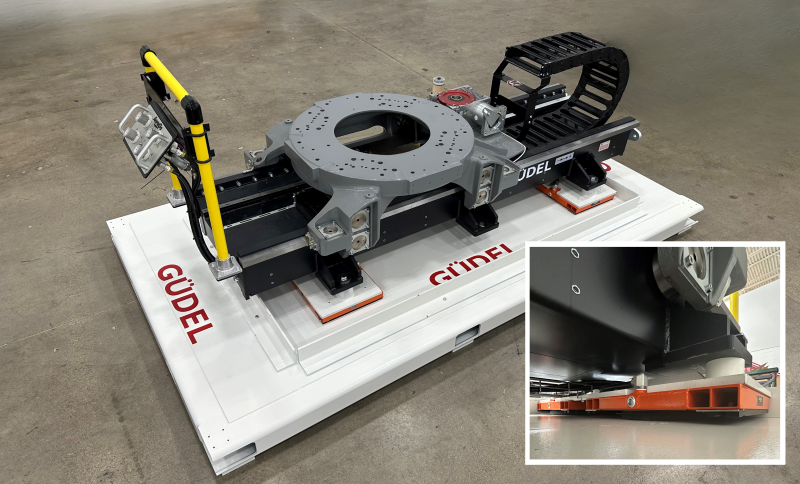
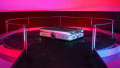
Demo version of the TMF-4B track being lifted off the ground with the use of air bearings. Image used courtesy of Güdel
Linear Track Solutions
Expanding the working area of a robot can save time and money. Collaborative robots are often used for machine tending, but if the machines are close enough, by adding a 7th axis, such as with Güdel’s Cobomover, one robot would be able to service multiple machines at once.
Additionally, paint and welding robots will often move around the vehicle as it is being painted or spot-welded. In order for the robot to maintain its accuracy and repeatability, the robot can utilize a servo-driven slide positioner (7th axis). With its use of air-bearing technology, Güdel’s TMF-4B track can bring precision and mobility to these types of high-payload applications.