Facebook
 Google
 GitHub
 Linkedin
ABB Rolls Out AI-Powered Mobile Robotics at Automatica 2025
ABB debuted its new AI-powered Flexley Mover P603 AMR at Germany's Automatica 2025. The AMR is part of the company's Autonomous Versatile Robotics vision, which is focused on AI-enabled mobile robotics.
Artificial intelligence (AI) has been used in factories for quite a few years now. Typically, it is used in vision applications to learn defects and make vision inspection tools more accurate. The advantage of using an AI tool in a vision application is a reduction in operators passing or failing parts manually. The AI tools will learn to detect defects without hours of teaching.
AI in robotics has a similar advantage, especially when used with autonomous mobile robots (AMRs). An AMR needs to have its route programmed into the fleet manager software, which takes time to integrate. The programming time can be reduced by using AI and providing the AMR with enough sensors. Recently, ABB integrated AI tools with its latest AMR, the Flexley Mover P603, which debuted at Automatica 2025 in Munich, Germany.
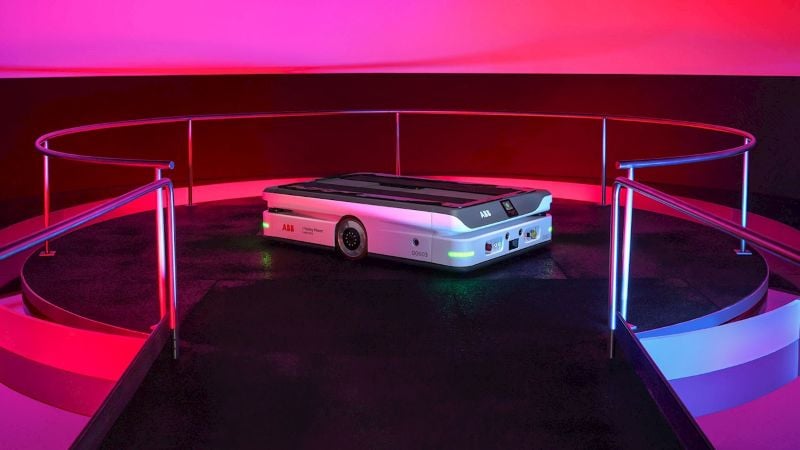
The AI-powered Flexley Mover P603 on display at Automatica 2025. Image used courtesy of ABB
The Flexley Mover P603 AMR
An AMR looks like a platform on wheels and moves around the factory floor, often shuttling finished parts to packing lines or unfinished parts to assembly machines. These robots do not require a specific path marked with barcode tape or special paint. They are controlled by a fleet manager software where programmers can write code for the AMR to execute and develop maps of the factory floor, which the AMR will follow. ABB's latest AMR model is the Flexley Mover P603, a powerful AMR with a payload capacity of 1,500 kg, a max speed of 2 m/s, and a positioning accuracy of ±5 mm.
Tight spaces and uneven flooring with large loads require a robust drive and suspension system. The P603 uses a bidirectional drive system to manage tight spaces in a warehouse or factory and features a suspension system to support non-ideal flooring. ABB's key highlight of its new P603 AMR is that it is AI-powered, which is part of ABB's new AI-powered Autonomous Versatile Robotics vision.
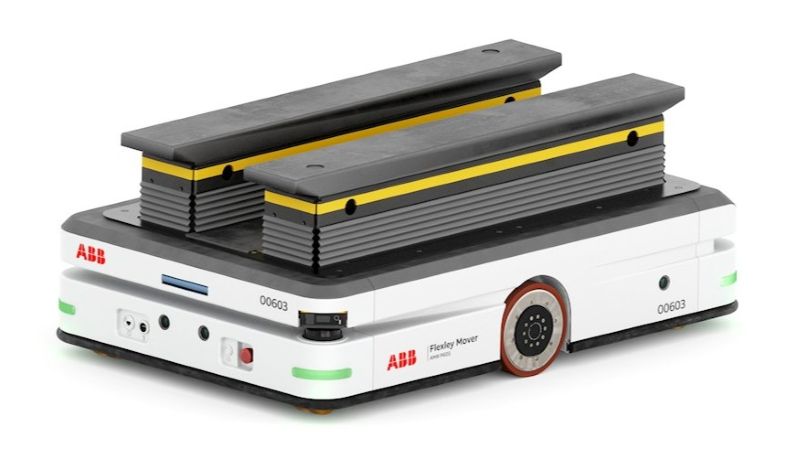
The Flexley Mover P603 utilizes AI-driven Visual SLAM navigation and ABB’s AMR Studio software for easy setup and operation. Image used courtesy of ABB
AI-Powered Mobile Robotics
A major feature for any AMR is navigation: the robot must be able to navigate complex environments and not disrupt people walking by. AMRs do this with advanced software and a lot of sensors. ABB’s P603 AMR uses the company’s Visual SLAM navigation software that is powered by AI. The SLAM navigation software enables the robot to switch tasks on its own in real time.
Detecting the center of gravity when moving a load is often done by visual clues and feel with forklift operators. The P603 has been designed with sensors and AI to determine dynamically where the center of gravity is to ensure safety.
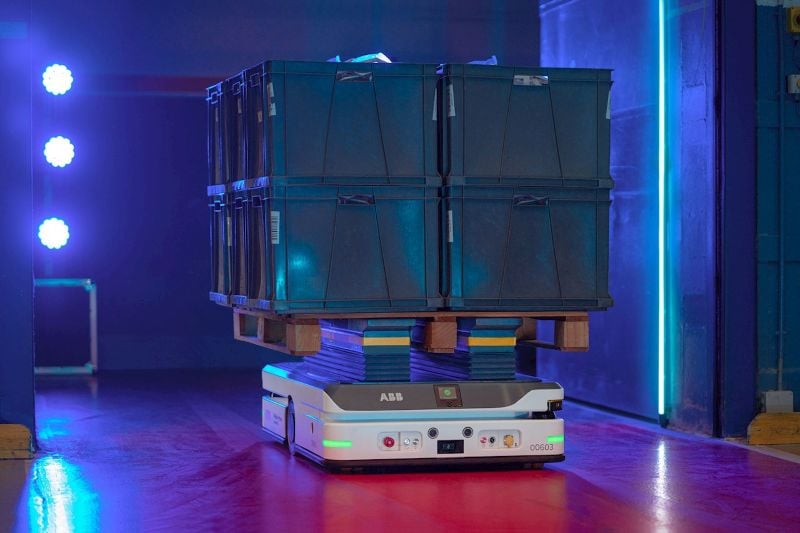
The Flexley Mover P603 features a high payload of 1,500 kg. Image used courtesy of ABB
ABB's Autonomous Versatile Robotics
The Flexley Mover P603 AMR is part of ABB’s Autonomous Versatile Robotics vision. In this vision, ABB outlines six core capabilities for autonomous, versatile robots. This includes robot-human interaction, which emphasizes reduced or simplified coding. Sensing and perception are another core focus: by giving robots the ability to sense their environment, AI can use this to direct the robot.
Next is autonomous reasoning, or giving the robot the ability to make decisions, either with software commands, sensors, or by reducing the required coding. Motion control and safety are another focus: upgrading autonomous decision-making requires a higher level of safety.
Then there is localization, mapping, and navigation, which ABB already does with its visual SLAM navigation, featured on the P603. Finally, dexterity, which focuses on allowing a robot to manipulate complex components and learn new ways of handling objects.
ABB plans to focus on these six core capabilities to bring autonomous robots to market, and the P603 AMR has been designed to align with this vision.