Facebook
 Google
 GitHub
 Linkedin
OnLogic Launches the Axial AX300 Server for Powerful Edge Computing
The new Axial AX300 edge server from OnLogic is designed to provide businesses of all sizes with powerful, secure, and easily deployed on-site AI and edge capabilities.
OnLogic has introduced the Axial AX300, an edge server designed to bring AI capabilities directly to the source of data generation. The Axial AX300 enables businesses of all sizes to move computing resources on-site, reducing latency, improving efficiency, and unlocking the potential of AI/ML applications. With its robust design, advanced security features, and support for high-performance processors and GPUs, the Axial AX300 is designed to empower organizations to leverage on-site data for real-time insights, predictive maintenance, and improved operations while offering a cost-effective alternative to cloud-centric data management.
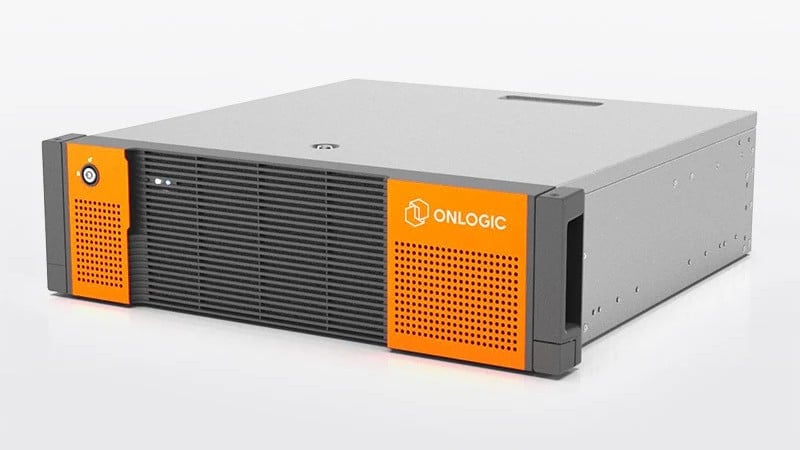
OnLogic's Axial AX300 server is built to meet the edge computing needs of businesses of all sizes. Image used courtesy of OnLogic
Simplifying AI Deployment
Deploying AI solutions at the edge can often be highly complex, requiring the management of diverse hardware and software components across multiple locations. Traditionally, this might involve setting up and maintaining separate servers for different tasks, leading to increased costs and operational overhead. OnLogic’s new Axial AX300 edge server, however, is designed to enhance this process through its virtualization capabilities.
With virtualization, OnLogic aims for businesses to be able to simplify deployment and management by consolidating multiple workloads onto a single server. This means that AI inference, data analytics, and other edge applications can coexist on the same hardware, optimizing resource utilization and reducing the solution's footprint. Virtualization enables easier software updates and patching and simplified backup and recovery procedures. This centralized approach lowers the overall cost of AI deployment and accelerates the time-to-value, allowing businesses to implement and scale their AI initiatives at the edge rapidly.
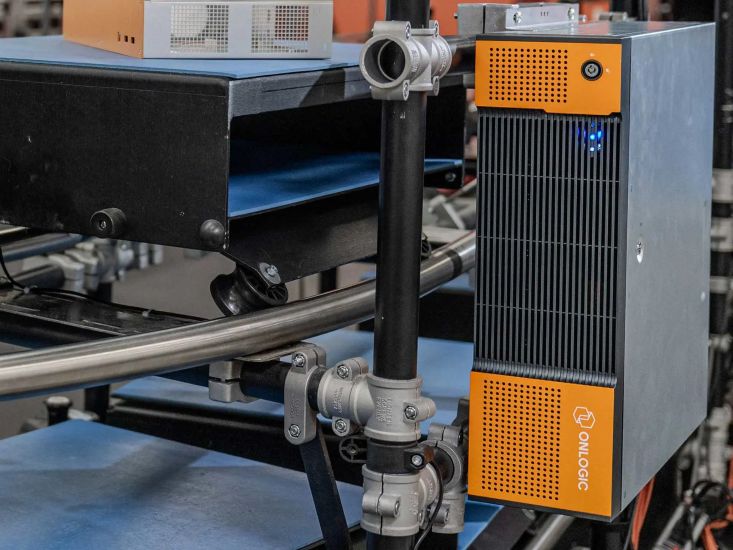
OnLogic’s Axial AX300 edge server features scalability features, including the ability to be configured with up to seven single-slot or four dual-slot GPUs. Image used courtesy of OnLogic
Axial AX300 Edge Server
OnLogic’s Axial AX300 edge server is built to tackle intensive AI and data workloads. Its engine consists of up to two 5th Generation Intel Xeon Scalable processors explicitly engineered for AI applications. These processors outpace prior generations: according to OnLogic, they deliver up to 14 times the AI training and inference capability of 3rd Gen Xeon CPUs.
To boost AI performance, the Axial AX300 offers adaptable GPU configurations. Users can install up to seven single-slot or four dual-slot GPUs, achieving up to 5864 TOPS of AI performance. This processing power is critical for complex AI models and real-time data analysis.
The Axial AX300 also offers various memory and storage choices. This adaptability enables companies to customize the server for their data management and analytics demands, whether handling large datasets, running applications requiring significant memory, or storing extensive amounts of data at the edge.

The Axial AX300 features built-in physical security measures, such as a lockable front bezel. Image used courtesy of OnLogic
Secure Edge Computing
For businesses deploying edge AI, security is non-negotiable. The Axial AX300 addresses this with a focus on both physical and digital protection. Imagine a remote site where the server might be accessible to unauthorized personnel. OnLogic has included features like a locking front bezel that requires a key to open and port-blocking attachments that prevent someone from simply plugging in a USB drive.
Beyond physical safeguards, the Axial AX300 meets FIPS 140-2 security standards, which are essential for industries dealing with sensitive data, like healthcare or finance. For those using virtualization, Intel TDX creates isolated environments for virtual machines, ensuring that even if one virtual machine is compromised, others remain secure.
For applications requiring the highest level of data protection, Intel SGX allows for secure enclaves, where data is encrypted even during processing.