Facebook
 Google
 GitHub
 Linkedin
Oriental Motor Announces Mobile Robot Controller for AMRs and AGVs
The MVC01 controller combines onboard kinematics modeling with built-in IMU gyro odometry to enhance AMR and AGV navigation.
Oriental Motor has released its newest mobile robot controller. The MVC01 is designed to be implemented in autonomous mobile robots (AMRs) and automated guided vehicles (AGVs), featuring a small physical footprint, dedicated control software for setup and configuration, enhanced kinematics modeling, and many other features.
This control module is specifically engineered to be paired with Oriental Motor’s BLV Series R Type brushless DC motors and drivers.
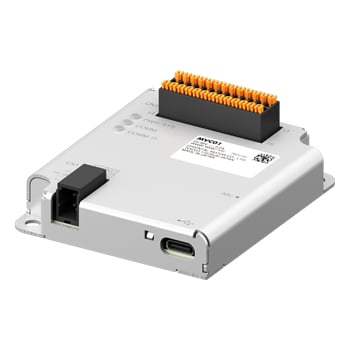
Oriental Motor’s MVC01 mobile robot controller for AMR and AGV applications. Image courtesy of Oriental Motor
The MVC01 Mobile Robot Controller
The MVC01 is more than just a motor controller. It is a device that can take real-world measurements and convert them into an action plan. It has a built-in inertial measurement unit (IMU) that can detect how the robot is already moving and how much inertia must be accounted for to perform additional movements.
The IMU relies on gyroscopic odometry, which uses an internal gyroscope to determine where the robot will track. Motor encoder data supplements the odometry. Changes in heading can be calculated onboard, and the robot’s motion can be much more accurately controlled.
Motion control is governed by this data and then translated to forward speed and rotational speed commands. For some robots, such as those with Mecanum wheels, lateral speed commands can be used as well. The controller can be used as a self-navigating module, a line-tracing module, or a manual drive module, depending on the application.
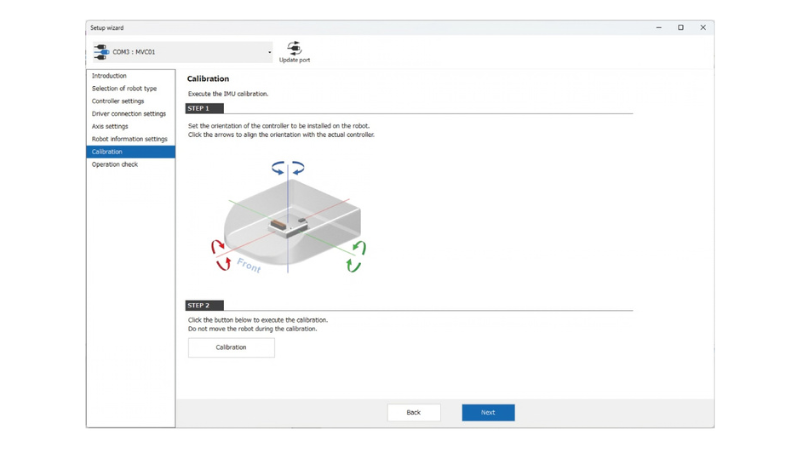
With MVC Studio, users can set up the MVC01 via a wizard menu. Image courtesy of Oriental Motor
Simplified and Compact Integration
Beyond enhanced modeling and motion control, the MVC01 is easily configured from dedicated PC software. MVC Studio features a step-by-step wizard that walks the user through selecting the proper configuration and command structure. Through proper configuration, the software can reduce Robot Operating System (ROS) nodes that can bog down performance and lead to slower, less predictable motions, or simply cause more headaches for troubleshooting.
The controller occupies only a small physical space, measuring 75 mm x 65 mm x 24.2 mm, with a mass of only 60 g before cabling. This is 5 mm thinner and half the mass of the previous BLV series motor controller. It will fit on the smallest of AMRs or AGVs, but can also provide the outputs for any robot using the BLV Series R Type motors of any size. Standard 24 V DC to 48 V DC power and RS-485 network connections make it easy to install, without the need for proprietary connectors or cables.
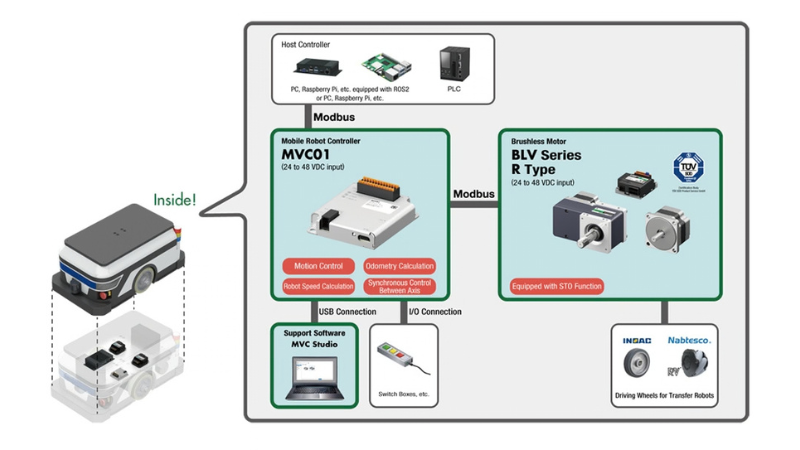
System configuration of the MVC01. Image courtesy of Oriental Motor
Mobile Robot Applications
The AMR and AGV market continues to grow and will likely expand even more over the next decade. As AI and ML improve collision avoidance routines, the size, speed, and complexity of these robots will also increase. A collision between small, slow-moving robots is a nuisance; a collision between large or fast-moving robots can be catastrophic.
The MVC01 is well-positioned to take advantage of this market sector’s growth. The kinematics modeling intends to make controlling larger robots much simpler and safer than trying to scale up less advanced controllers.