Facebook
 Google
 GitHub
 Linkedin
Pneumatically Actuated Exoskeleton Aims To Reduce Workplace Injuries
Researchers from the University of Texas at Arlington have created the Pneumatically Actuated Soft Elbow Exoskeleton (PASE), reducing muscle usage by 22% during lifting activities.
Engineers at the University of Texas at Arlington (UTA) have developed a new exoskeleton component designed to reduce ergonomic and musculoskeletal injuries during lifting operations. The Pneumatically Actuated Soft Elbow Exoskeleton (PASE) fits over the elbow of a worker and helps support some of the load while padding the elbow and enforcing proper lifting.
Eshwara Prasad Sridhar, a graduate student on the project, said, “our goal was to create a preventative, assistive device that reduces muscle strain before injuries occur.”
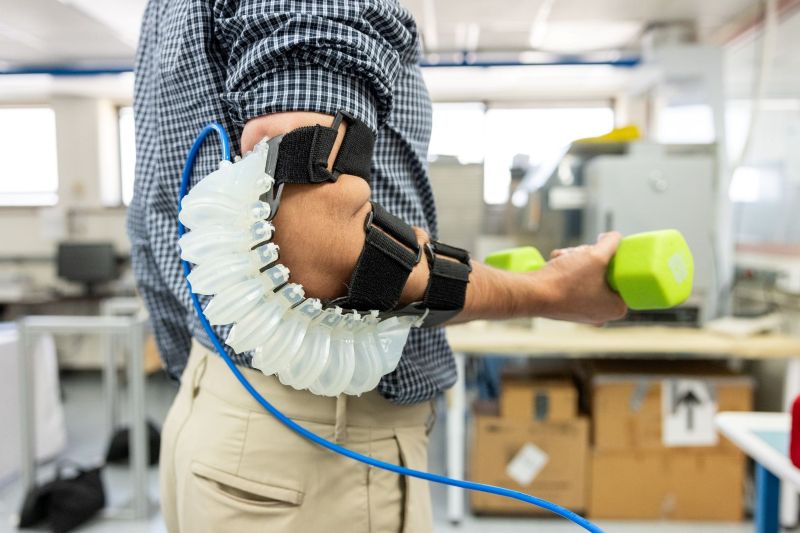
PASE testing in a laboratory. Three straps provide stability while a person lifts a dumbbell. Image used courtesy of The University of Texas at Arlington
Work-Related Musculoskeletal Injuries
Musculoskeletal injuries, particularly those from repeated motions, are painful, commonplace, and expensive for the employer who is often held responsible for the injury. According to UTA, these injuries are responsible for 30% of all injuries at the workplace and cost $45-54 billion annually in the United States.
Lifting is often one of the major sources of such injuries for several reasons. First, a worker can lift a heavy object once or twice, and in their mind, they can lift a certain weight. That is different from being able to lift the same-sized object or even a lighter object many times throughout a shift.
Also, the effects are not always known immediately. Repeated strain builds up over time and hurts later, so the worker may not even know they are being injured until it is too late. Finally, workers who are performing heavy lifting are often young and still have a tinge of invincibility and are not prone to asking for help or reporting a minor injury.
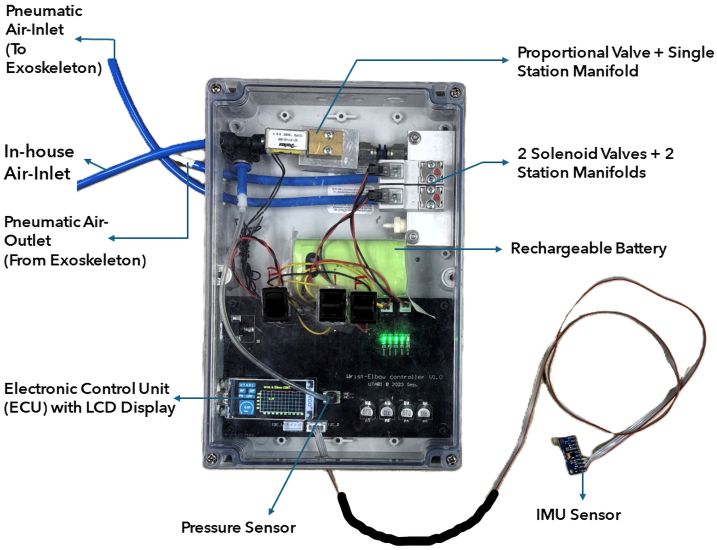
A look inside PASE’s pneumatic control system. Image used courtesy of The University of Texas at Arlington
Pneumatically Actuated Soft Elbow Exoskeleton (PASE)
UTA’s PASE device can help reduce fatigue and muscle strain by providing some of the support required to lift heavy items or perform repeated lifting tasks. It consists of a padded, sectioned, silicone bladder that supports the elbow and straps to hold the bladder in place. The system is actuated by compressed air, making it convenient to use in an industrial or manufacturing facility where compressed air lines are prevalent.
During testing, PASE was found to reduce muscle activity in the biceps and triceps by 22% during lifting activities. Using NASA’s Task Load Index, this dropped the perceived mental and physical workload index by 8-10 points.
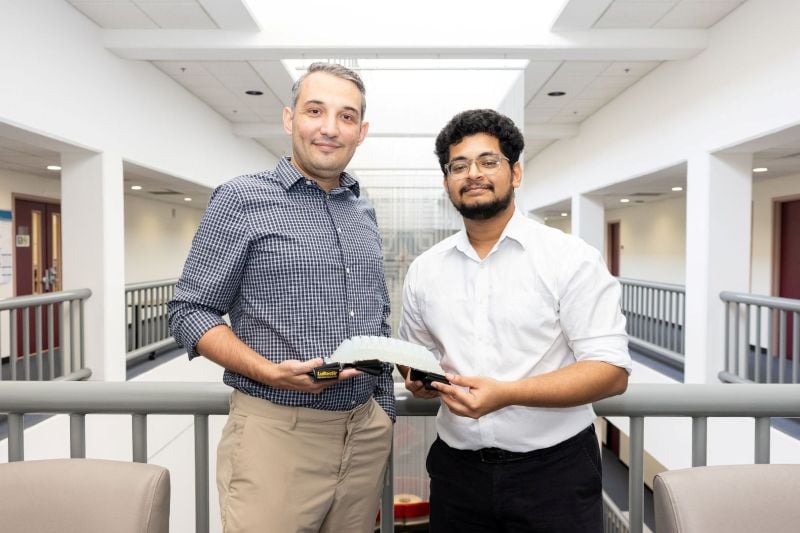
The UTA team holding PASE. Image used courtesy of The University of Texas at Arlington
Improving Worker Safety
PASE is a type of innovation that helps reduce the risk of musculoskeletal injuries in workers who must lift packages on a regular basis. It will pair nicely with automated picking and packing lines where robots do most of the heavy lifting, but workers must handle the special cases.
Outside of industry and manufacturing, it might be possible to use these with a compact, portable air tank in the residential and commercial moving sector. The moving and relocating business relies heavily on strong, young workers to move furniture, boxes, and other belongings. Often, these positions are contracted out to freelancers, but whether the freelancer buys it to protect their own body or whether they are supplied by the employer, PASE could be used to reduce fatigue and potentially speed up the moving process.