Facebook
 Google
 GitHub
 Linkedin
Precision Agriculture: Sustainability and ROI in Farming
Kelly Hills, MSU’s AAI, Topcon, Bonsai Robotics, and FFT drive innovation in precision agriculture, enhancing sustainability, efficiency, and resource management.
Kelly Hills Unmanned Systems, Mississippi State University’s Agricultural Autonomy Institute (AAI), Topcon Agriculture (TA), Bonsai Robotics (BR), and Forever Feed Technologies (FFT) have announced industry partnerships and the launch of innovative technology to enhance precision automated agricultural technology, reducing emissions, enhancing energy and resource use, promoting the growth of healthy livestock, and forging a more sustainable future as a result.
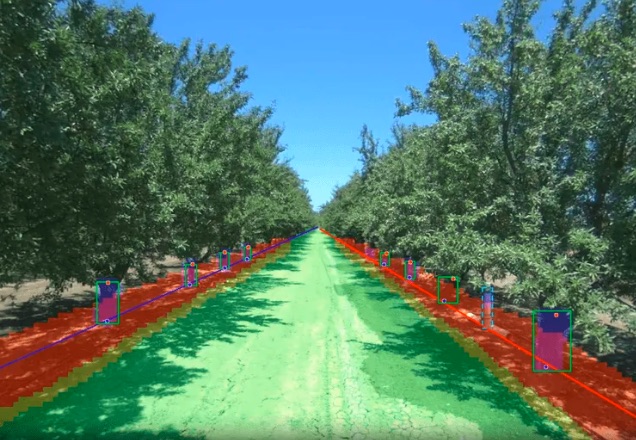
Visionsteer technology enhances orchard harvesting by keeping track of harvested and unharvested trees and providing remote-based operation and machine monitoring. Image used courtesy of BR
Reducing Resource Use and GHGs
Multiple sources of emissions result from agricultural practices, leading to water and air pollution and damaging the environment for people and animals. Methane released from cows during digestion of plant materials, nitrous oxide released from fertilizers, emissions released from growing rice, managing manure, use of fuel and energy during farming, and cutting down forests for farmland all exacerbate global warming worldwide.
According to the Agriculture and Horticulture Development Board (AHDB), achieving net zero emissions by 2050 is not only about reducing the production of greenhouse gas (GHG) emissions from their source but balancing their release with their sequestration. In addition to reforesting/re-wilding farmland areas to capture carbon emissions, farmers are adopting precision agricultural practices with the help of artificial intelligence and automation to improve resource use, reduce waste, enhance productivity, and safeguard the environment.
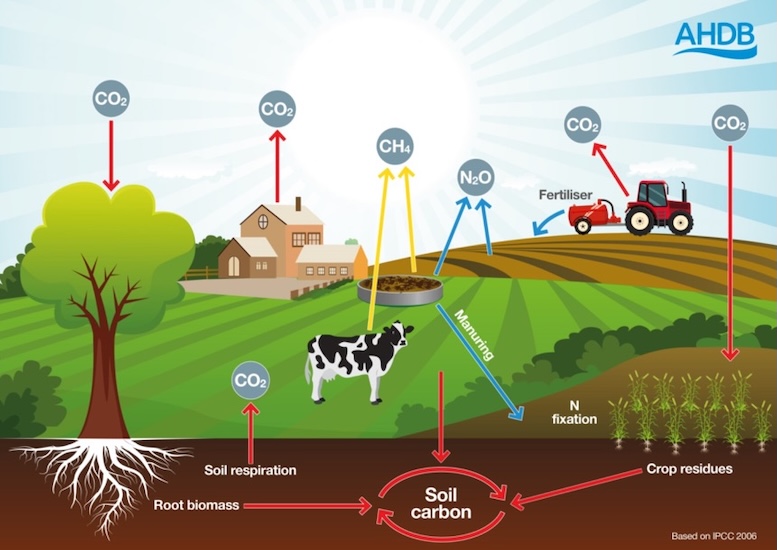
A schematic depicting the different types of emissions produced by agricultural practices and the pathways leading to emission capture/sequestration. Image used courtesy of AHDB
Kelly Hills has announced its entry into a partnership with MSU’s AAI to evolve the field of automated agricultural machinery. The business and academic duo will focus on integrating AI into aerial and terrestrial vehicles for executing soil analysis, crop monitoring, and farm management tasks. While the Kelly Hills team is poised for the commercialization of any promising technologies, the team at AAI creates new intellectual property that could well be patented and commercialized.
In the summer of last year, Kelly Hills helped pioneer precision agriculture, serving as the first customer of Pyka’s Pelican Unmanned Aircraft System (UAS), once the world's largest fixed-wing aerial spray drone. Now Kelly Hills is operating the 300 L payload Pyka Pelican 2. The drone covers 90 hectares per hour, is operable remotely via laptop, and uses rotary atomizers to optimize spray droplet size during flight to enhance chemical output, reduce waste, and minimize drift.
Pyka’s Pelican Spray was the foundation aerial spray drone that led to the development of the improved Pelican 2. Video used courtesy of Pyka
Bonsai Robotics and Topcon Agriculture
In other news, TA, a provider of precision farming technologies for precise seeding, planting, fertilizer application (and more), announced its entry into a partnership with BR to optimize automation focusing on the farming of permanent crops. BR’s Visionsteer technology provides remote operation through mobile devices, providing status updates on active farming machinery and enabling machinery to connect to designated orchard fields for automated harvesting. Visionsteer maps orchard field layouts to steer harvesting machinery to optimize the harvesting process. The technology records and updates machinery operators, informing them of trees harvested per minute, uptime and downtime, and the number of acres covered. Operators can harvest fields 24/7 and conduct data analysis in BR’s app.
The TA-BR partnership will combine Visionsteer technology with TA’s implement controls, autosteering capabilities, and telematics to engender innovative end-to-end solutions that offer growers robust, weather-resistant, labor-cutting, precision harvesting.
The FFT Innovation Center
FFT is a provider of sustainability-focused feed mill technologies. It produces automated sprouted grain (ASG) to supplement dairy cattle feed while using 95% less water than field-grown alfalfa. With higher global temperatures, the ability of farm practices and machinery to conserve water is extremely important. Further, FFT says that other benefits include reduced land use (99%) and no tractors, combines, or other machinery needed to produce ASG.
According to FFT, a study conducted by Cornell University showed that mixing sprouted grain into cattle feed increased cattle’s ability to produce milk and reduced dry matter consumption. This suggests that the sprouted grain reduces resource consumption and improves milk yield. Further, FFT says that its sprouted grain improves digestion in cattle and reduces methane emissions.
FFT announced the milestone achievement of completing the construction of the FFT Innovation Center in Hanford, California, which includes the world's largest automated sprouted grain (ASG) feed machine. This plant generates fresh ASG every day to augment cow feed while using far less water than standard field-grown alfalfa. With the potential to generate up to 50 tons of ASG per day, this is the initial stage of a bigger commercial-scale system that will support more than 2500 dairy cows and assist farms in reducing the risks associated with drought and severe weather conditions.
The feed mill, created in collaboration with JR Automation, combines innovative material handling equipment with FFT's indoor growth system. The Innovation Center will act as a trial ground for growing output, and commercial feed mills could be erected as early as 2025. FFT's purpose is to improve animal health, increase productivity, and assist farms in achieving sustainability goals by providing a consistent, year-round nutritious feed source.
Encouraging Sustainability and ROI
Together, these companies are spurring new developments in precision agriculture that prime return on investment for automated equipment, boost harvest productivity, improve crop protection, minimize resource use, reduce operational costs, and safeguard the environment.
Related Content