Facebook
 Google
 GitHub
 Linkedin
QPT Ushers in AI-Ready GaN Motor Drives to Transform Cobots
QPT introduces MicroDyno, a 1-MHz GaN motor drive platform delivering true sine wave output, precision motion, and scalable efficiency for cobots and beyond.
Although collaborative robots ("cobots") are on the rise, their motion control systems have been lagging behind. Most drives today rely on low-frequency PWM schemes that struggle with torque ripple, cogging, and electromagnetic interference. The result is bumpy motion, higher costs for external sensors, and design compromises that hold back precision in assembly, medical robotics, and other high-value applications.
QPT has developed MicroDyno, a low-voltage motor drive platform designed to showcase what’s possible with ultra-high-frequency GaN switching. Running at 1 MHz, MicroDyno uses a small filter to supply the motor with a steady sine wave.
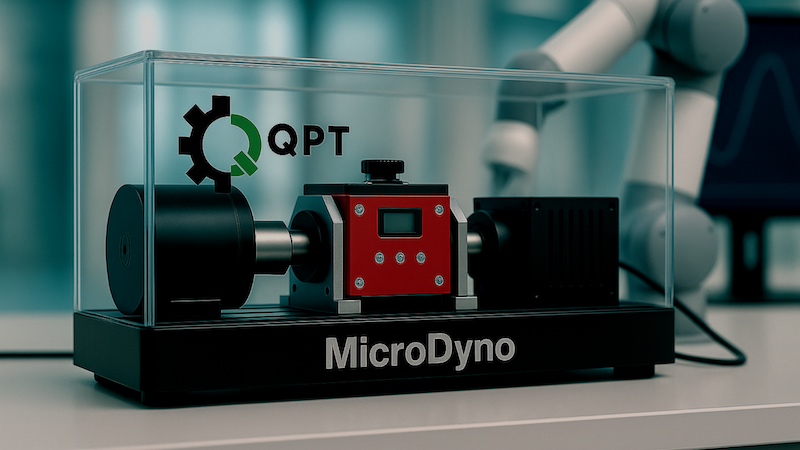
MicroDyno delivers a pure sine wave at 1 MHz, giving cobots more precise motion without the cost and complexity of extra sensors.
Instead of forcing the motor to deal with the sharp edges of standard PWM, this cleaner signal cuts down on EMI, eases stress on the bearings, and gives the system a far better signal-to-noise ratio. It was built to demonstrate how future cobots and robotic systems can achieve smoother, more precise control while also lowering cost and system complexity.
Could This Be The End Of PWM Motors?
Most robotic drives operate between 4 and 16 kHz, with a few specialist systems reaching 100 kHz. That’s nowhere near enough to enable compact filtering or a true sine output. MicroDyno breaks this limitation by pushing GaN devices to around 100 times the switching frequency of standard systems.
At these speeds, filters shrink to the point where they can be integrated into the drive itself, producing pure sine voltage at the motor. The ripple effects are significant: lower EMI, cleaner control signals, and a foundation for integrated drives that can be embedded directly into robotic joints without bulky external hardware.
Benefits for Cobots and Precision Robotics
MicroDyno’s clean sine wave allows QPT’s qSense technology to dynamically correct torque ripple and cogging in real time, which is something that static encoder-based methods simply can’t match. By delivering a clean sine wave, MicroDyno gives QPT’s qSense the ability to correct torque ripple and cogging on the fly.
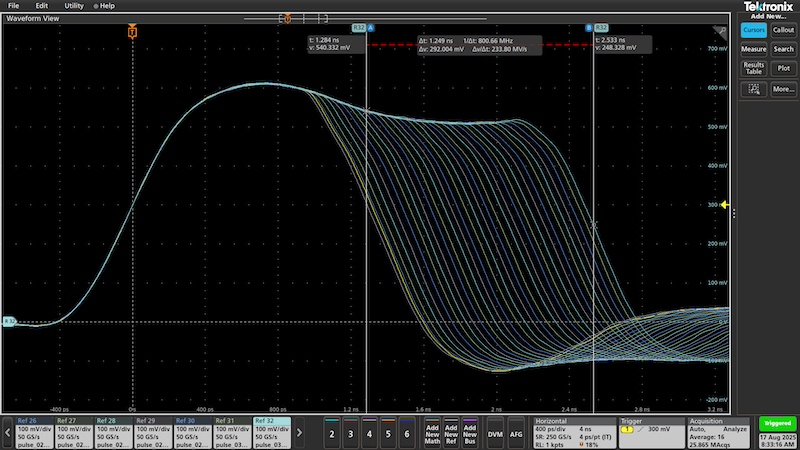
MicroDyno produces a clean sine wave at 1 MHz, letting qSense smooth torque ripple in real time and monitor vibrations without external sensors.
The result is fluid motion that’s more reliable, exactly what’s needed for delicate work like surgical tools or fine-pitch assembly. At the same time, the drive can monitor torque and vibration directly, so systems get built-in diagnostics without relying on expensive external sensors. The compact form factor also means drives can be fully integrated into lightweight robotic joints, cutting down on cabling and easing compliance with EMC requirements. For manufacturers, this translates into both higher performance and lower overall system cost.
Scalability Beyond Robotics
Although demonstrated at 48 V for cobot applications, QPT’s architecture is inherently scalable. Using its qAttach packaging, QPT can push the same high-frequency approach beyond robotics and into higher-voltage systems such as 400 V, 800 V, and beyond. That opens up opportunities in areas like industrial automation, HVAC, and even EV traction drives.
Considering that electric motors account for nearly half of global electricity use, replacing common PWM-based inefficiencies with true sine wave operation could potentially have a huge impact by cutting energy losses and reducing wear on the motors. The ability to scale also enables multiphase module designs that can deliver megawatt-level power without requiring an endless variety of drive modules.
QPT’s Next-Gen Drive Strategy
The company’s qIPM, or Intelligent Power Module, already integrates high-speed gate drivers, qFilter sine wave output stages, and qSense diagnostics into a modular package for applications up to 75 kW. MicroVFD takes the same high-frequency GaN approach and tailors it for robotics, using picosecond timing to drive motors with exceptional smoothness. MicroDyno fits right alongside it as both a test platform and a bridge into real applications.
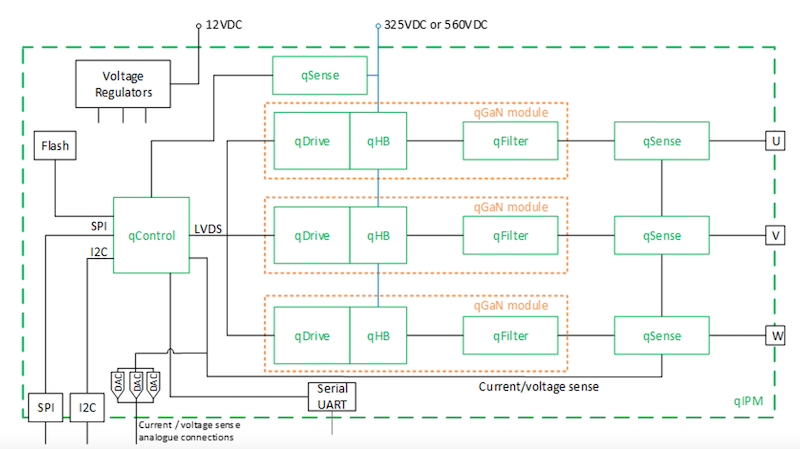
QIPM architecture.
MicroDyno signals a real shift in how motor drives are built and used. By delivering a true sine wave output at 1 MHz, it removes the compromises of PWM, cutting noise and heat while unlocking real-time torque correction and built-in diagnostics. This allows cobots to operate quietly and reliably at a lower cost. And because the design scales to higher voltages, the same benefits extend well beyond robotics, setting the stage for an AI-ready generation of motor systems.
All images used courtesy of QPT.