Facebook
 Google
 GitHub
 Linkedin
Robots Lend an Ear to Search and Rescue Operations
3DAR-equipped robots use directional sound detection to locate survivors in disaster zones, offering safer and more accurate search and rescue operations.
Robots, like the one developed by Seoul National University, offer another tool in search and rescue operations. Sending a robot around a debris field instead of more humans reduces the risk of additional injuries. The robot can go out, find survivors, and notify first responders so that they can do much more targeted rescue operations.
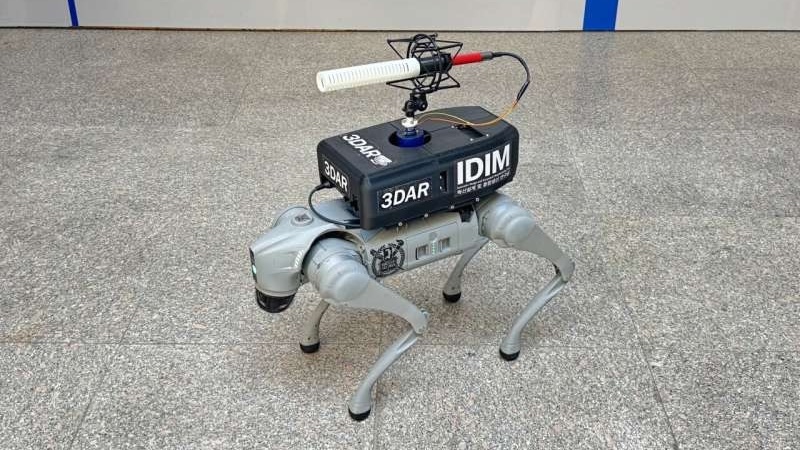
3DAR-equipped robot, ready for a search and rescue mission. Image used courtesy of TechExplore
Challenges in Search and Rescue Operations
The olden days of marching armies of people through a disaster area in hopes of finding survivors are about over. The risk to the rescuers, trampling over debris, crossing unsteady piles of rubble, broken glass, and other such hazards, is a major consideration. There is also the risk that the weight of humans climbing over debris may injure people trapped underneath. Unfortunately, the dishonest few who show up as rescuers and loot the rubble are also an issue.
In some cases, infrared cameras are used to find survivors. Drones or helicopters scan a large area, looking for the heat signatures of humans after floods, tornadoes, hurricanes, and other such disasters. However, in the case of fires, earthquakes, explosions, and others, the signatures can be obscured or have false positives due to the heat signatures from fire. Smoke and dust can fool optical sensors as well.
What is 3DAR?
In certain situations, robots with optical sensors are limited in their search capabilities. Heavy smoke, dust, and challenging lighting conditions can hinder robotic search efforts. This is where Seoul National University turned to another robotic sense: the sense of sound.
The robot is equipped with a single microphone and onboard audio processing capabilities. A standard microphone by itself would not be terribly useful, as disaster areas are often quite noisy, with shouting, creaking of debris, fires, and other such noises. The real breakthrough was the development of a 3D auditory sensor, called 3-Dimensional Acoustic Ranging (3DAR), that can listen directionally and tune out distracting noises. This system is modeled after dolphins and uses a dual-frequency (audible and inaudible) sensor. Between the two frequency bands and the processing capabilities, the robot can hear in full surround-sound and create a 3D audio fingerprint of the area. From there, it can use phase cancellation routines to pinpoint the sounds of a human calling for help, breathing heavily, or other such distinct sounds.
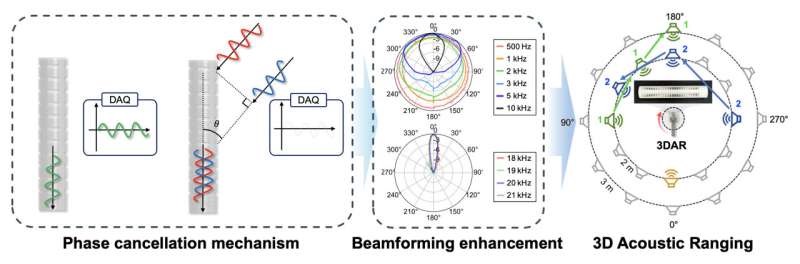
3DAR relies on phase cancellation, beamforming enhancement to provide directionality, and a ranging function. Image used courtesy of TechExplore
Use Cases in Industry Outside of Search and Rescue
Search and rescue operations are just one little piece of 3DAR’s capability. On the manufacturing floor, humans must interact with robots on a regular basis. Also, robots must interact with other robots. In all of these cases, it can be difficult to stop a current action, press buttons on a robot, or make gestures at it to perform the next task. Instead, a robot with audio processing capabilities can hear commands from workers or other robots, much like a man asking his dog to fetch his slippers.
In the noisy bustle of a modern manufacturing plant, it can be hard to hear instructions, and a robot that can tune out the background noise and hear a command has a tremendous advantage.