Facebook
 Google
 GitHub
 Linkedin
Schmalz Expands Area Gripping Flexibility With the FQE-V
Introducing the FQE-V, the newest scalable vacuum gripper system from Schmalz. The FQE-V is designed to deliver safe, precise handling of various workpieces in manufacturing and logistics applications.
As more industries embrace customized production and shorter product cycles, automation systems are under pressure to keep up. One major obstacle is the lack of flexibility in robotic grippers. Most are built to handle standard shapes and sizes, which makes processing irregular or one-off workpieces a time-consuming and inefficient task. The need for smarter, more adaptable gripping solutions has become a priority in everything from manufacturing to logistics. Schmalz has responded by expanding its FQE series with the addition of the FQE-V, a freely scalable area gripper designed for both robotic and manual systems.
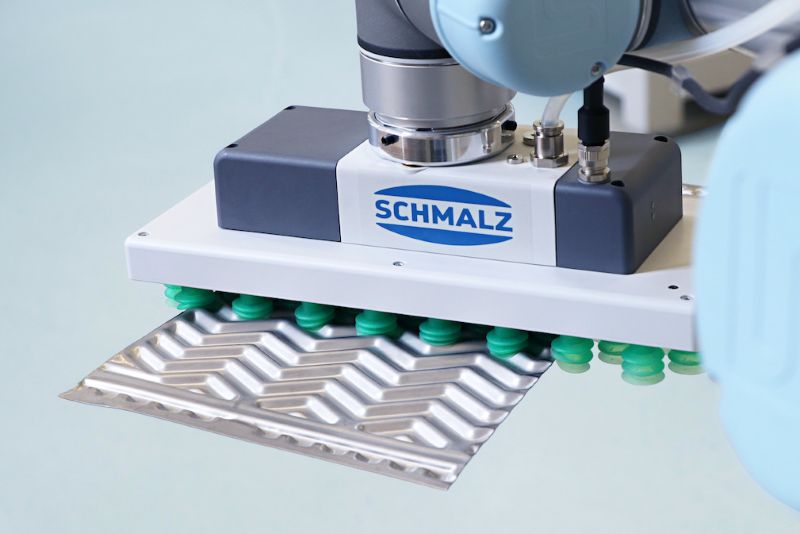
Schmalz’s FQE gripper system is designed to be flexible so as to handle objects of different sizes and shapes. Image used courtesy of Schmalz
FQE-V Gripper System
The FQE-V is the newest addition to the Schmalz’s vacuum technology portfolio, built to handle workpieces of all shapes and sizes with no tool swaps required. The system adapts to changing product formats with adjustable suction plates and a modular layout, helping manufacturers keep pace without compromising safety or efficiency.
The FQE-V is available in a range of dimensions, from 230 × 120 mm to 400 × 280 mm. Users can scale both the suction plate and the hole grid to match any shape, even irregular formats like T-shaped parts. Standard shapes like rectangles, circles, and ovals are supported, too, but the real benefit is customization. Using smart design tools, technicians can quickly reconfigure the gripper for different tasks, which drastically cuts down on planning and setup time. It also opens the door for true batch-size-one production, where each product on the line can be unique.
The gripper is designed to handle everything from delicate glass parts to sensitive electronics and automotive components, adjusting easily to varying material properties and geometries.
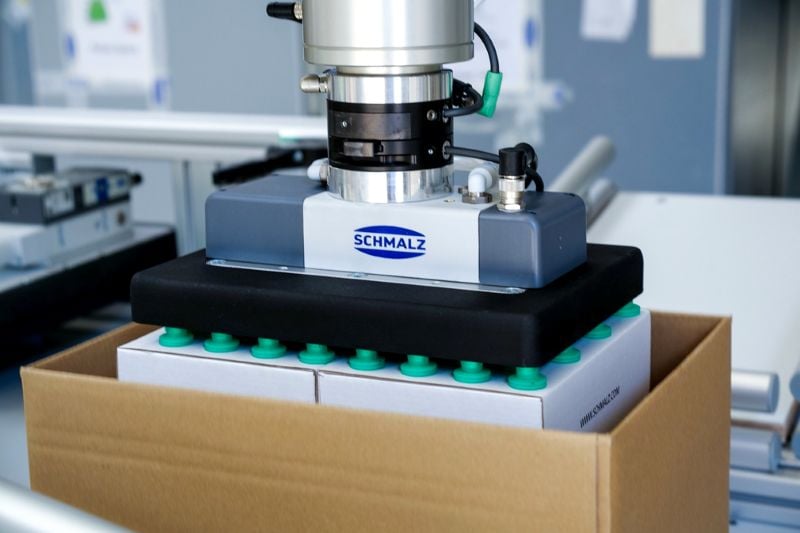
The FQE-V is the newest gripper system addition to the FQE series. Image used courtesy of Schmalz
Vacuum Gripping in Manufacturing and Logistics
To meet a range of performance needs, Schmalz offers two versions: the FQE-V-M, which uses an external vacuum generator, and the FQE-V-X, which integrates an energy-efficient generator right into the unit. Both versions feature integrated control valves and a lightweight modular design that reduces the load on robotic arms to enhance performance and energy savings. Plus, the system includes sound insulation to lower noise levels around the workspace, a small but meaningful feature for employee comfort and safety.
With its compliance with ISO TS 15066 standards, the FQE-V is also a strong option for human-robot collaboration setups. It can be used in stationary environments where robots and people work side by side, which is increasingly common in advanced manufacturing.
The gripper’s versatility doesn’t stop at manufacturing. In logistics, it’s well-suited for end-of-line packaging tasks. It can pick items from different positions, work its way through layered packaging, and even handle soft or non-rigid boxes that some traditional systems struggle with. Because it can be adjusted layer by layer, it offers an efficient method for palletizing or packaging mixed goods.
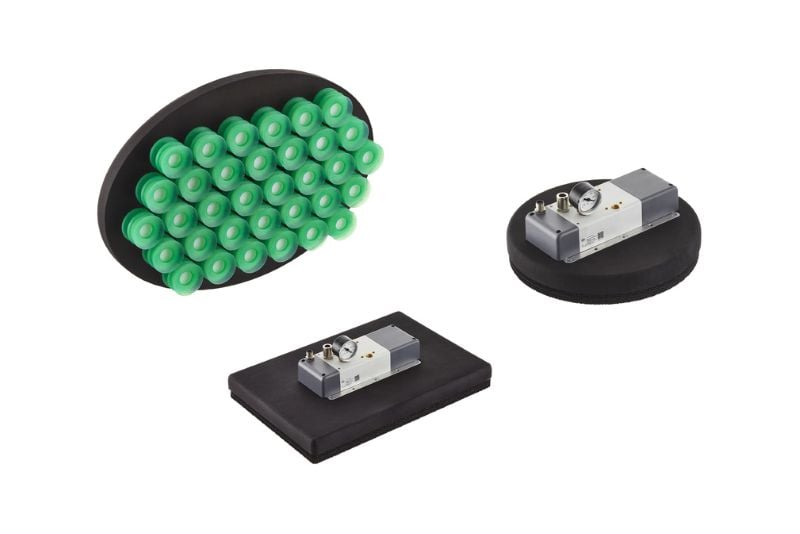
The FQE-V gripper is available in oval, rectangular, and circle forms. Image used courtesy of Schmalz
Flexible Vacuum Area Gripping
Schmalz designed the FQE-V to address a long-standing gap in automation: the need for a single gripping system that can adapt on the fly. It is designed to replace rigid hardware setups with a flexible, modular system that’s easy to plan, fast to deploy, and reliable over time. That makes it a strong match for today’s fast-paced production environments.
Production lines don’t just need speed—they need tools to keep up with constant change. The FQE-V helps solve that challenge, offering companies a smarter way to handle the unpredictable mix of products that modern automation demands.