Facebook
 Google
 GitHub
 Linkedin
Schunk Expands Robot PLUS Portfolio with Tool Changers and Sensors
Explore Schunk’s Robot PLUS portfolio, featuring CPS/CPB tool changers, AGM compensation units, and FTS sensors for next-gen automation.
Schunk is expanding its end-of-arm tooling portfolio with Robot PLUS, a modular lineup of tool changers, compensation units, and force/torque sensors designed for high repeatability and durability. Engineered to reduce downtime and improve flexibility, the CPS and CPB tool changers deliver precision across repeated swaps, while the AGM and CMS modules handle misalignment and quick manual changes. With robust FTS sensors and hardened construction, Robot PLUS equips manufacturers with reliable tools for demanding automation environments.
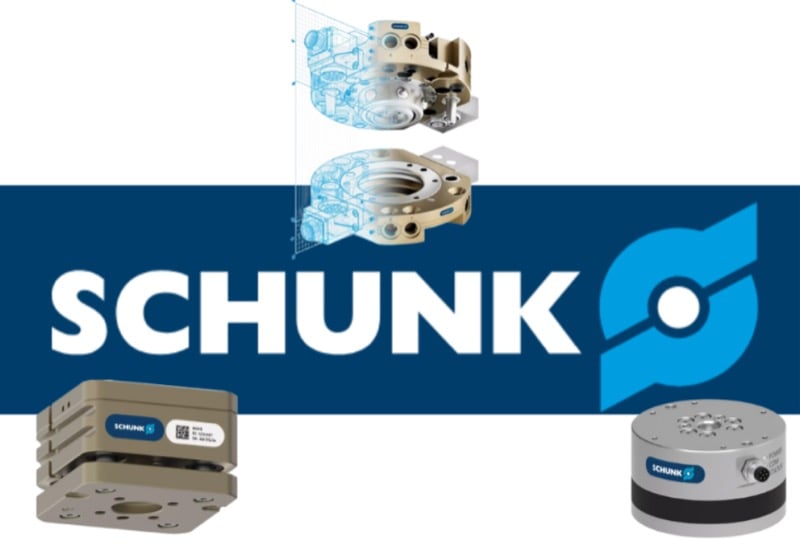
Schunk’s Robot PLUS portfolio brings tool changers, sensors, and compensation units together to reduce downtime and boost robot cell flexibility. Image used courtesy of Schunk
Schunk has recently expanded its end-of-arm tooling lineup with the Robot PLUS portfolio, which consists of a comprehensive set of tool changers, compensation units, and force/torque sensors. Designed and manufactured in Germany, the idea is simple: give users a flexible set of modules that can be configured for any number of different jobs. It also makes it easier to scale automation setups as needs grow. The main showcases are the CPS and CPB tool changers, which minimize downtime with rapid changeover while ensuring high positional accuracy across frequent tool swaps.
CPS and CPB: High Precision Tool Changing
The CPS and CPB tool changers are engineered for high positional repeatability of 0.01 mm to 0.015 mm, with angular offsets of ±1° in XY and ±2° in Z, depending on the model. This level of precision keeps production stable and consistent even when tool changes stack up across long runs, and compared to many standard automatic tool changers, Schunk’s systems deliver accuracy that better supports today’s high-throughput demands.
As Juan Lopez, Product Manager for Gripping Technology and Automation Technology at Schunk, explained, automation now drives more frequent tool changes, even within the same part flow, such as between OP10 and OP20. “That level of precision helps prevent cumulative error when tool changes stack up through a shift. With all Schunk products, especially CPS and CPB, Schunk leverages its deep application experience and field feedback during product development, so end users can trust the system to perform as expected when throughput and consistency matter most.”
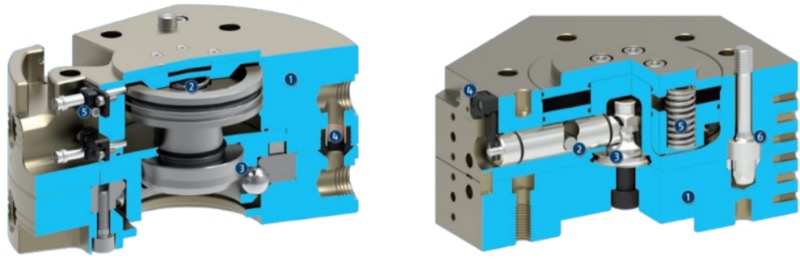
CPS (Left) uses a piston wedge and locking ball for rigid centering, while CPB (Right) applies VERO S clamping bolts to deliver repeatable, shop-floor strength. Image used courtesy of Schunk
Design plays a key role here. CPS combines a revised aluminum housing with hardened steel components, pairing mechanical centering with a piston wedge and locking ball mechanism for rigid connections that hold over high cycle counts. CPB, on the other hand, leverages the VERO S zero-point clamping technology proven in machine tables, bringing shop-floor robustness into robotic automation. Together, the CPS and CPB provide the stiffness and reliability needed for modern production cells.
CMS and AGM: Quick Changes and Smarter Compensation
For flexible setups and lower payloads, Schunk’s CMS manual change system offers a quick, lever-based lock and unlock mechanism that requires no extra tools. It can handle loads up to 58 kg and includes integrated sensors to track locking status. It gives assembly stations and light handling applications a simple, safe, and reliable option for fast tool swaps. For heavier and more complex processes, the AGM compensation unit takes on the challenge of tolerance issues in tasks like machine loading, joining, or bin picking. Available in 23 size variants, it can compensate in all directions (XYZ and WZ) and uses spring and air cartridges to balance weight reliably, even when mounted in inclined positions. CMS and AGM expand the Robot PLUS portfolio with practical solutions that reduce downtime, improve accuracy, and keep robotic workflows moving smoothly.
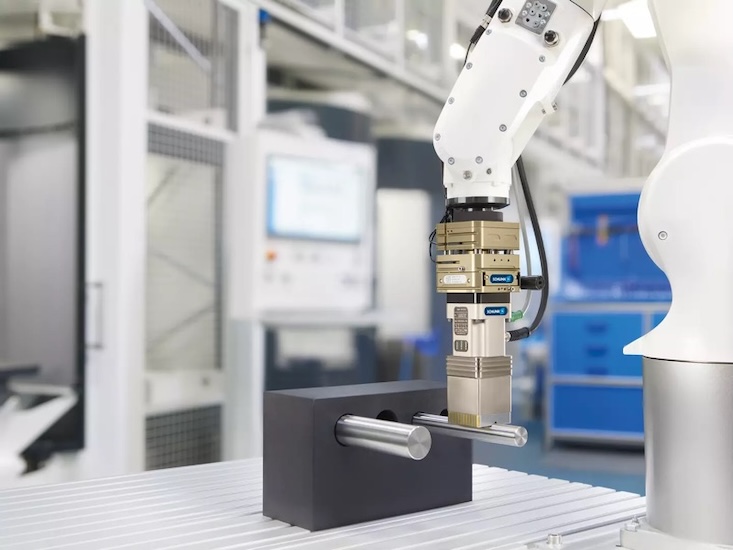
The AGM compensation unit absorbs misalignments in all directions, keeping robotic tasks stable and accurate. Image used courtesy of Schunk
FTS: Six-Axis Force/Torque Sensors
In some applications, utilizing force sensors has become critical in applications ranging from e-mobility battery assembly to connector seating to prevent unnecessary damage. Schunk’s FTS sensors can capture high-resolution data on forces and torques, enabling quality control, process monitoring, and collaborative safety. Lopez states typical uses include press-fit assembly, wiring harness connections, trim insertion, and even bin picking with force feedback.
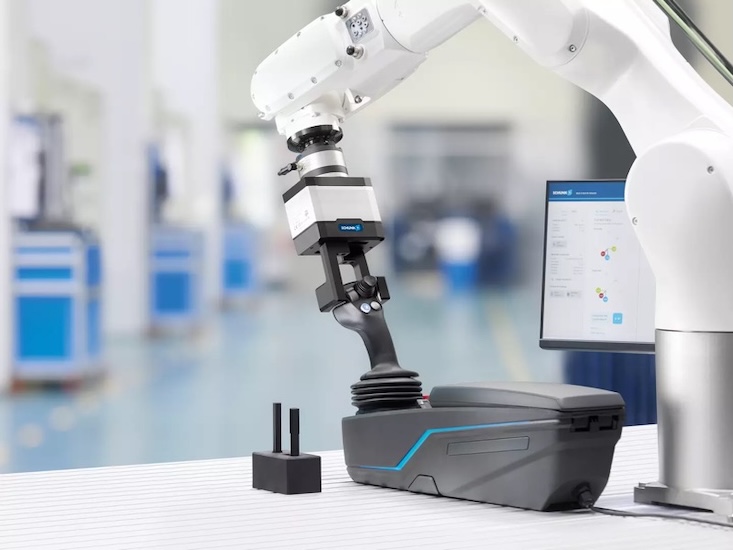
FTS sensors capture precise force and torque data for tasks typically difficult for a robot, like press-fit assembly, connector seating, and bin picking. Image used courtesy of Schunk
The sensors are factory calibrated, ship with certificates, and must only be returned to Schunk if recalibration is required. Rated at IP67, they’re built to withstand harsh manufacturing conditions, including dust, coolant, and grinding swarf.
Schunk Provides Durability Where It Matters
On a production floor, equipment has to hold up under real-world conditions ranging from dust, coolant, vibration, and the constant wear of daily cycles. To meet that reality, Schunk builds its tool changers with hardened, precision-ground steel at the contact points and seals the housings to keep contaminants out. Lopez emphasized that this durability is fundamental:
“Durability in harsh environments is built into these products from the start. Schunk’s portfolio is designed for real shop-floor conditions, and material selection is intentional to handle dust, coolant, and abrasive swarf. Hardened, precision-ground steel is used at critical interfaces to preserve surface integrity and repeatability over time, while housings and seals are specified to keep contaminants out and performance stable. This is Schunk’s bread and butter: delivering reliable performance in the environments where automation has to prove itself every day.”
Schunk has designed the CPS and CPB tool changer modules to meet IP64 when coupled, with IP54 ratings when uncoupled, ensuring long-term reliability.
By extending the Robot PLUS portfolio, Schunk offers manufacturers a way to reduce downtime, improve quality, and expand automation’s reach into more processes. With high-precision automatic tool changers to compensation units and robust force/torque sensors, the portfolio gives integrators and end users the building blocks to design flexible, reliable robotic systems. With precision repeatability, durable construction, and proven integration across environments, Schunk can provide the tools necessary for automated systems.