Facebook
 Google
 GitHub
 Linkedin
Seeing Is Believing: Balluff’s BOS 6K Sensors Shine Bright
Balluff's BOS 6K sensor line offers high-speed, optoelectronic detection options—TOF, color, contrast, and more—all with a compact, interchangeable design.
Balluff has released a new line of optoelectronic sensors that were designed for high-speed manufacturing applications. The BOS 6K sensor line includes sensors for various environments and lighting conditions, from Time of Flight (TOF) sensing to contrast detection.
Time of Flight Sensing - BOS02EK
TOF sensing is used to determine the distance between the sensor and an object. These can be used to ensure clearance of items on a conveyor line or as proximity sensors to see if an object is in the correct location or if something has entered a space it should not.
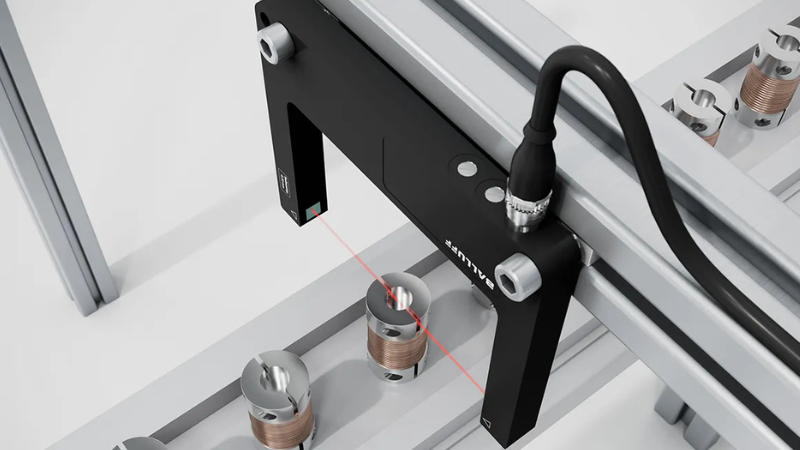
The BOS02EK TOF sensor can detect objects up to 1.5 meters away. It uses red laser light and can be used for objects of almost any color or reflectivity. This particular sensor has good background noise suppression, meaning fewer false positives and interference from other light sources.
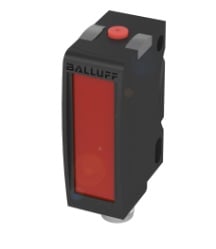
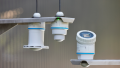
BOS02EK TOF optoelectronic sensor. Image used courtesy of Balluff
Blue Light Sensing - BOS02F8/U/W/Y/Z
Blue light is at a higher frequency than red light. This means it does not penetrate as deeply into the surface of objects and less scattering of the light beam. Blue light sensors can detect objects that are more difficult to see with red light, such as fine details on a surface. Furthermore, it also has good background noise suppression as well.
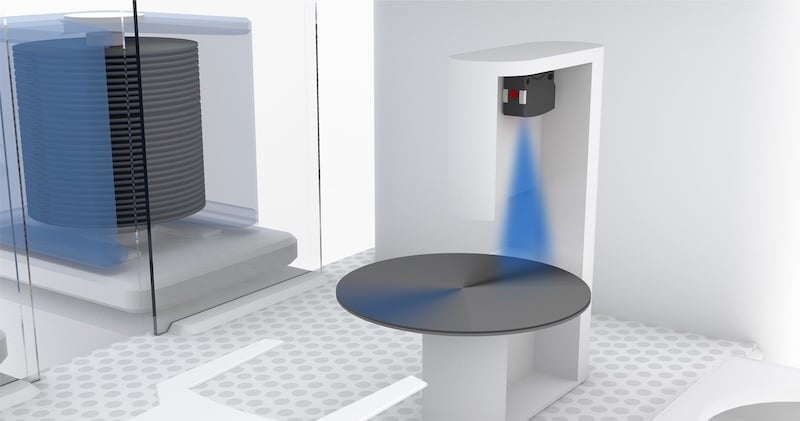
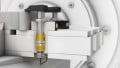
Blue light sensing of details on a semiconductor wafer. Image used courtesy of Balluff
Red Light/Laser Sensor - BOS02EF/F1/F7
Red light sensors have dominated the optoelectronic sensor field for some time. Balluff’s sensors are designed to be easily focused, making it possible to detect some fine details, such as wires. The established standard of red light sensing makes these sensors a good fit for general-purpose detection with an entry-level price point.
There is also a line of red laser sensors that use a triangulation algorithm for detection instead of a photoelectric sensor alone. This line (BOS02CL/E3 and BOS01MF) is for more precision detection applications.
Contrast Sensor - BKT Series
One clever method of object detection is to look for a change in optical contrast. The contrast at the current moment is compared to the past contrasts. In this method, edges where contrast changes drastically are located easily.
One important use of contrast sensors is for parts counting or sorting components. These sensors are operable at high speed, making them a good choice for ensuring proper part counts are sent to packaging or other such operations.
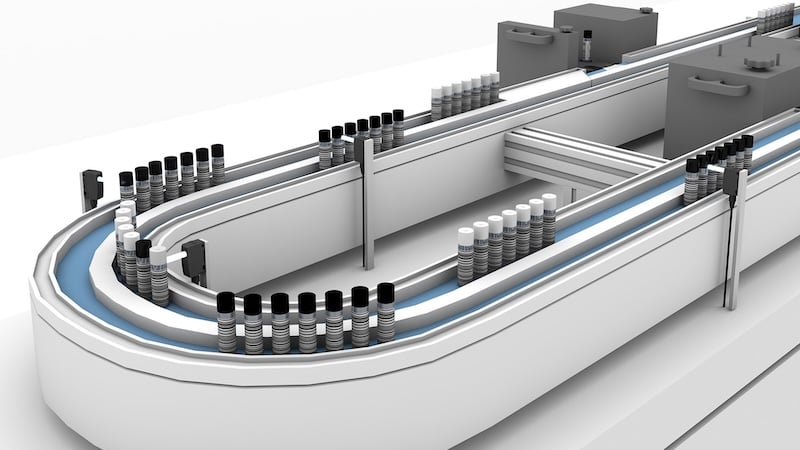
Contrast sensing on a high-speed production line. Image used courtesy of Balluff
Color Sensor - BFS Line
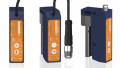
Color sensing can be used to ensure quality control or to sort objects based on color. For example, they can be used to ensure dye quality has not decreased over time by comparing each object to past ones, rejecting those that are a different hue, and alerting an operator to perform maintenance.
The BFS line of sensors performs multiple color measurements per second, ensuring that color can be quickly compared on a high-speed production line. It can provide red-green-blue (RGB) values on objects and is not fooled by different surface roughnesses and textures, giving it a leg up on other color detection schemes.
Potential Applications
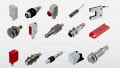
Balluff has designed the BOS 6k suite of sensors so that there is always a sensor for a particular task. The common theme between them is the high-speed capabilities and the fact that they all have the same physical footprint and I/O Link capabilities. Outside of those commonalities, different challenges will be best served by an optoelectronic sensor from this catalog. Their reasonable price points and identical packaging and interfacing mean that sensors can be swapped easily to meet production needs.