Facebook
 Google
 GitHub
 Linkedin
Siemens and Eaton Partner To Construct Modular Data Centers
Siemens Energy and Eaton are working together to accelerate data center construction run on grid-independent, clean energy to support the demands of artificial intelligence and cloud computing.
Established power management company Eaton has teamed up with Siemens Energy to build more data centers supplied by grid-independent energy to deliver scalable, sustainable data centers that support AI technology adoption while reducing emissions.
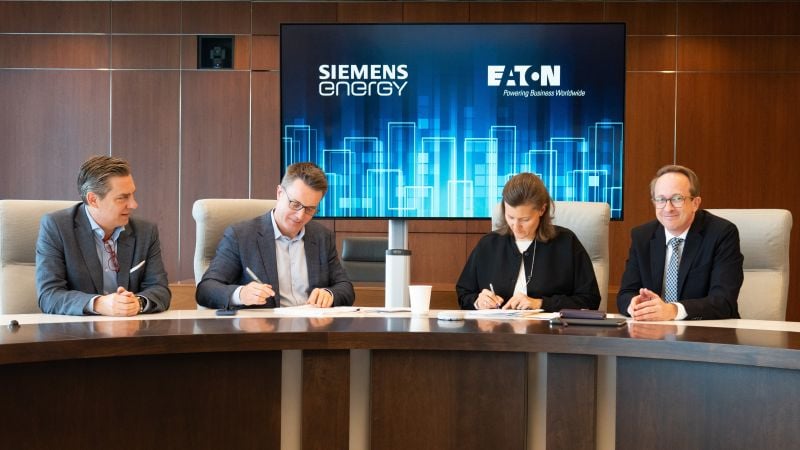
Eaton and Siemens Energy have formed a partnership to speed up the construction of data centers. Image used courtesy of Eaton
Siemens Energy and Eaton
Eaton and Siemens Energy have partnered to accelerate data center construction by integrating on-site energy generation with configurable, grid-independent power solutions. The collaboration is focused on utilizing the companies’ technology and expertise to construct modular and scalable data centers to support the growing demands of AI and cloud computing.
Siemens Energy will provide scalable power generation with its battery storage systems and gas turbines. Eaton will supply the required electrical infrastructure and support to expedite the construction process. The new data centers will be designed using Eaton’s electrical equipment, like medium- and high-voltage switchgears, and Siemens’ power generation equipment, such as the SGT-800 mid-sized industrial gas turbine with integrated battery energy storage.
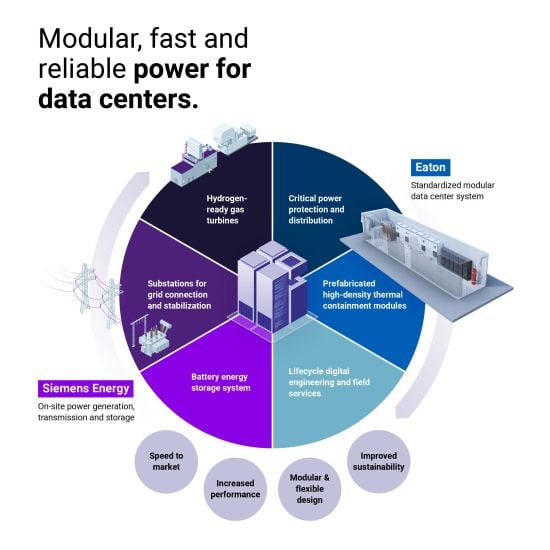
Eaton is combining its electrical equipment with Siemens Energy’s power generation to deliver modular data center construction. Image used courtesy of Eaton
Growing Demand for AI
The goal of Eaton and Siemens partnership is to support the growing demands of AI and cloud computing. The explosion of AI technology and its immense potential have made the adoption, implementation, and development of AI critical.
Like electricity, AI is becoming a key part of infrastructure. AI is being implemented across consumer technologies, within corporate strategies of major companies, and across various industries, including cybersecurity, aerospace and defense, manufacturing, energy, food and beverage, retail and e-commerce, warehousing and logistics, and more. In short, there is hardly any part of the societal infrastructure that isn’t being impacted by the emergence of AI.
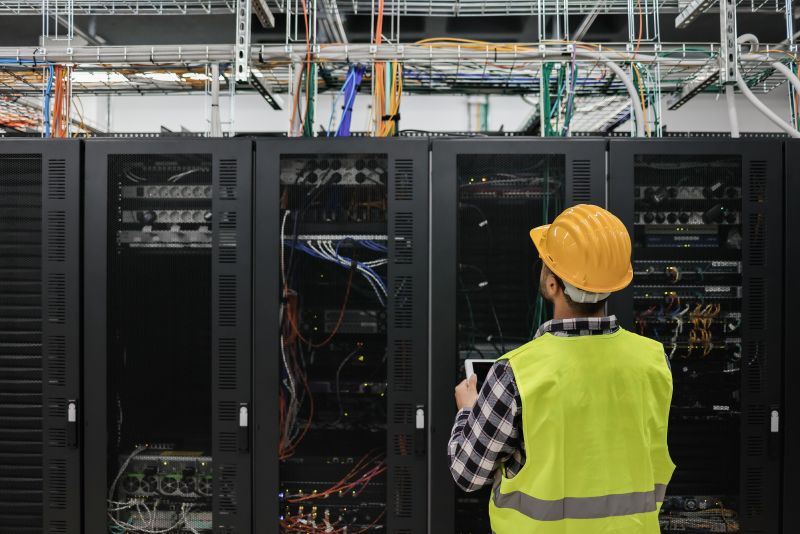
As the use of AI increases, so is the need for infrastructure that supports it. Image used courtesy of Adobe Stock
AI in Manufacturing
AI is especially playing an increasing role in manufacturing. In one example, AI-driven paint inspection in an automated automotive production line leverages AI vision systems to evaluate camera and sensor-pooled image data of car bodies in real time. Automotive businesses can then send their encrypted image data to centralized or cloud-based data centers for further processing, using advanced deep learning models trained on large image data sets to detect paint faults such as scratches, bubbling, and/or uneven coating.
Fault detection results in real-time automated rework, correction, or rejection via robot arms that correct the paint mishap or take the car off the production line completely. The AI-enabled system generates quality reports for supervisors to review and adjust processes to optimize automotive paint applications (which could be as simple as recalibrating nozzles).
The AI-enabled paint inspection saves time because of the processing speed and power of the data center, which helps speed up process improvements, improves consistency, reduces rework, and reduces the need for human inspection.