Facebook
 Google
 GitHub
 Linkedin
Siemens Acquires ASTER to Strengthen PCB Design and Testing
Siemens integrates shift-left DFT capabilities to improve PCB quality and time-to-market.
Siemens has acquired ASTER Technologies to expand its capabilities in printed circuit board design and testing. The acquisition integrates ASTER’s shift-left Design for Test approach into Siemens’ Xpedition and Valor software, enabling earlier validation of testability, reliability, and manufacturability. By combining virtual test simulation with PCB design and production workflows, Siemens aims to improve product quality, reduce rework, and accelerate time-to-market across its electronic systems portfolio.
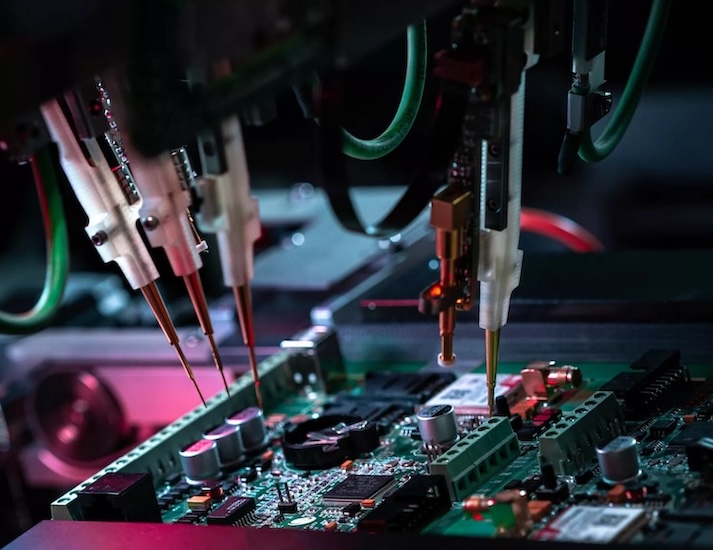
Designing high-quality electronic products and systems depends on the testability of individual components, ensuring long-term functionality, safety, and performance. Image used courtesy of ASTER
Leveraging Virtual Design for Circuit Board Testing
ASTER Technologies employs an innovative “shift-left” design principle whereby testing, reliability analysis, and quality assurance come ahead of PCB construction, typically during the conceptual design stage and during the curation of detailed, blueprint schematics. Essentially, one tests and verifies the elements of a particular electrical product on the left side of the production timeline, before physical prototype generation, validation, and full-scale production. So, design for test (DFT) and design for manufacturing (DFM) are conducted together in the early conceptual design/schematic stage.
Engineers benefit from using ASTER’s TestWay Express software to simulate the extent to which an electrical system can be tested, identifying “untestable” components, electrical rules violations, or missing test points before a PCB is produced.
TestWay Express uses theoretical models for estimating test coverage at each stage of circuit board design. For example, the TestWay software creates a digital twin (virtual representation) of a physical inspection machine or its behavioural profile, such as a solder paste inspection (SPI) machine. For the SPI, the TestWay software creates a simulation based on its capacity to measure the height and volume of the solder paste, using your computer-aided design (CAD) data. If the pad is the wrong size or the area on the circuit board is too dense for the SPI to inspect without false calls, the TestWay software alerts engineers to a testability risk.
Integrating with Siemens’ Xpedition and Valor Software
Siemens' acquisition of ASTER will integrate the latter company’s test “shift-left” DFT principle into Siemens' Xpedition and Valor software. This integration is intended to strengthen the Siemens Xcelerator portfolio, providing its customers with comprehensive DFT and DFM capabilities to create electrical products and systems of the highest quality, while improving time-to-market and reducing costly rework.
An overview of Siemens’ Xpedition Enterprise software, version 2504, for elevating and expediting PCB design. Video used courtesy of Siemens
Siemens’ Xpedition platform allows engineers to manage intricate schematic capture, setup, and complex simulation. Valor serves as the next link in the chain leading to production, offering new product introduction (NPI) resources and DFM evaluations to ensure that designs created in Xpedition can be produced and assembled on the production line to the required product quality standards. Combined, they establish a "digital thread" that ties the virtual design environment to real-world manufacturing.
For Siemens, the takeover of ASTER provides an invaluable opportunity to expand the capacity of its DFM offering and strengthen its presence in the global PCB market. For ASTER, embedding its sophisticated technology within the robust, ever-growing Siemens Xcelerator portfolio enables the company to reach a broader customer base and contribute to a shared vision of a “digital thread” that helps customers move from testing to reality.