Facebook
 Google
 GitHub
 Linkedin
Simplify I/O Junction Boxes with Banner Engineering’s I/O Block
Banner Engineering takes the complexity out of junction boxes with the new JB series I/O junction blocks, which have a number of available configurations and applications.
There are many ways to get inputs and outputs from the field back to your control system, and most of the time, industrial ethernet devices are used. In some applications, you want to hard wire multiple inputs and outputs in the field; an efficient way is to use a distribution block such as Banner's JB series top mount I/O junction block.
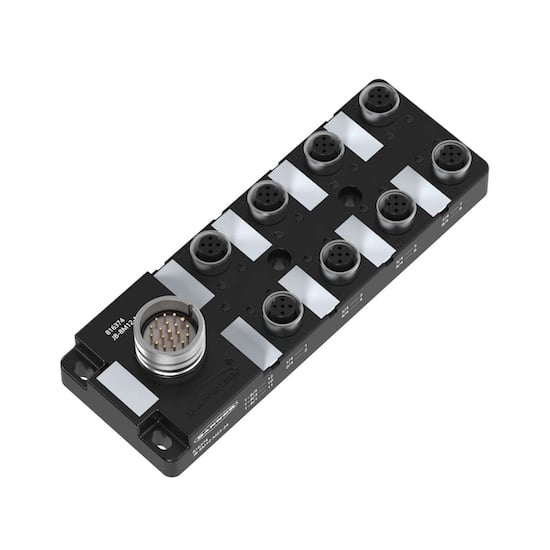
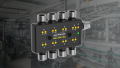
The JB series I/O junction block. Image used courtesy of Banner Engineering
JB I/O Junction Block
An I/O junction block takes one big connection with multiple pins and breaks it into multiple input and output ports. The JB series from Banner comes in either an eight-port or a four-port block, and they can be ordered for NPN or PNP. The four-port model can be ordered with either M12 or M8 signal connector size and either an 8-pin (M12) or 12-pin (M23) main connector. The eight-port models have either 12-pin or 19-pin main connectors. All models and their variants have common power pins to reduce wiring mistakes when using different models on the same equipment. Each block has status and diagnostic LED indicators to identify problems quickly.
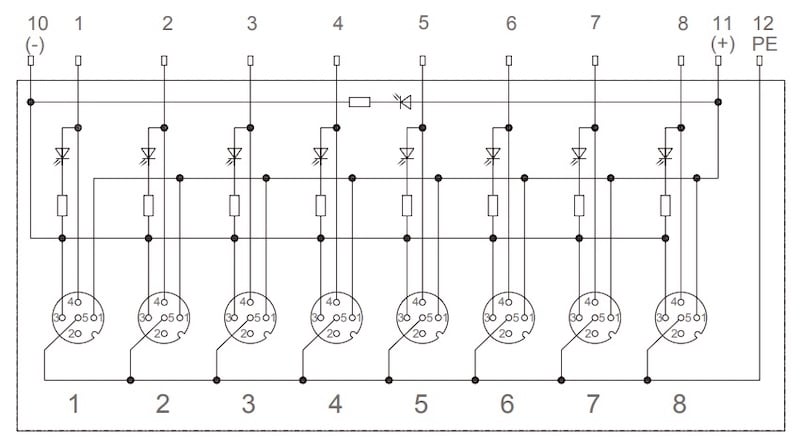
Wiring schematic of the 8-port JB junction block. Image used courtesy of Banner Engineering
How A Junction Block Works
Similar to an electrical junction box where you have one cable going into the box and multiple cables going out of the same box, an I/O junction block has one main cable with up to 19 conductors and multiple ports that can be used for inputs or outputs. For example, the wiring schematic above shows that port 1 has 5 pins with pins 1 and 3 connected to power and ground, respectively; pin 4 is used for the input or output signal. Those port pins are connected to the main cable on pins 11, 10, and 1. So if pin 1 is connected to an output on your PLC rack, then pin 4 of port 1 becomes an output. All of the connections between the main connector and the different ports are done internally, so there is no need for additional wiring.
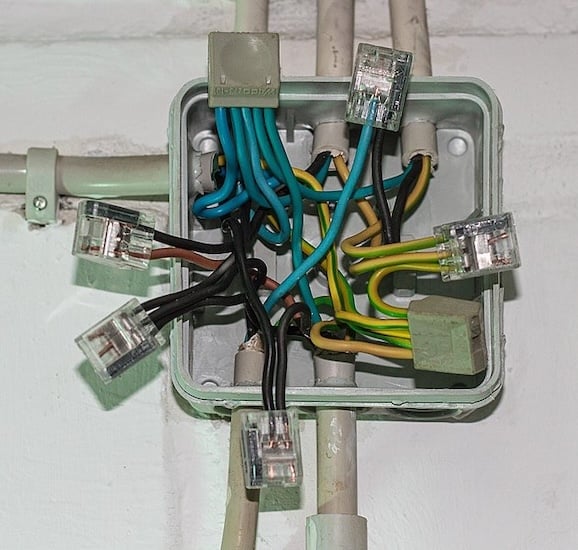
An electrical junction box with multiple connections. Image used courtesy of Wikimedia
Remote I/O
There are many applications where you only want one large cable instead of multiple little cables running through your equipment or field. Motion applications will often use large high-flex multi-conductor cables to reduce the number of cables that travel through an energy chain. Robot installations often use single multi-conductor cables along the outside of the arm to provide inputs and output for the end effector. These applications will then need a break-out or junction box to separate each conductor to their respective function. The JB series I/O junction box provides a simple and efficient way to provide multiple input or output signals while running only one cable through high-flex applications. Each port uses industry-standard connectors, which reduce wiring time and help troubleshoot wiring mistakes. Before designing a junction box for your next project, look at the JB series I/O junction block from Banner Engineering.