Facebook
 Google
 GitHub
 Linkedin
SMC Releases Remote Control Valve Electric Speed Controller
SMC has released a speed controller that can be operated remotely via electric signals. The new device aims to optimize and simplify flow control by serving as an alternative to manually operated speed controllers.
With any pneumatic system, the speed of the actuator or pump is dependent on the speed at which the air pressure rises. If you apply air pressure quickly, you will get a fast actuator, but if you use a controllable orifice in series with the valve and actuator, you can control the speed of the air pressure. The pneumatic flow control is a device that is placed in series with a pneumatic device, and it contains a needle valve. The needle valve has a long stroke that moves in and out, causing a restriction in flow. This restriction allows the air pressure to slowly increase, and the long stroke gives operators a large adjustment in speed. Up until now, these devices were manually adjusted, but SMC has released a flow control that can be adjusted via an electrical signal.
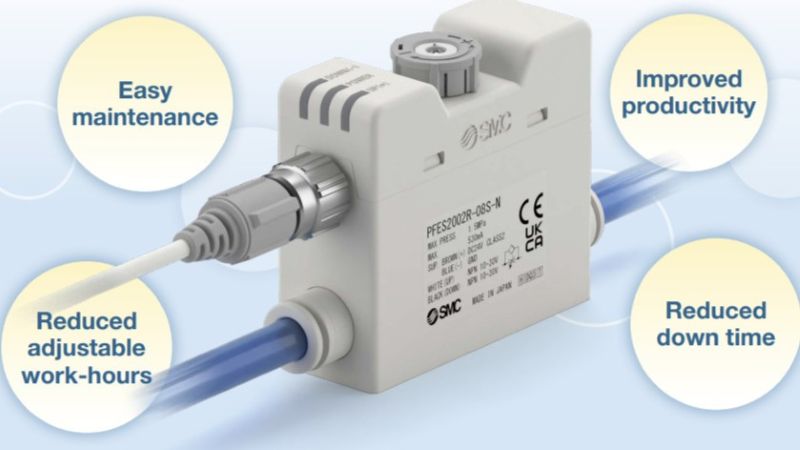
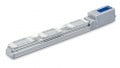
SMC’s new PFES series remote control valve can be adjusted with an electrical signal. Image used courtesy of SMC
PFES Series Remote Control Valve
A big part of OEM commissioning equipment is adjusting flow controls. It is typically done shortly after the equipment is powered on and requires two people. One person actuates the cylinder from the HMI while the other person adjusts the flow control valve. The process is fairly time-consuming and can present a safety issue as the device needs to be actuated under air pressure. With SMC's latest PFES series remote speed controller, this process can be done electronically.
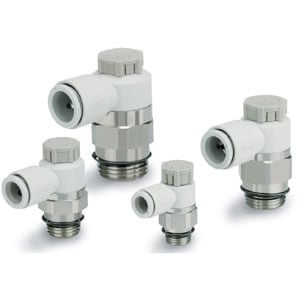
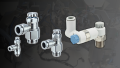
Unlike manual flow controls (pictured above), SMC’s new PFES series electric speed controller can be operated remotely. Image used courtesy of SMC
The valve is connected in series between the pneumatic source and the device, just like a standard control valve. The valve also has a four-pin M12 connector for the remote control feature. Pins one and three are 24 VDC and 0 VDC, respectively, and pins 2 and 4 are for sending the flow rate up or flow rate down signal. The valve can also be adjusted manually if power is absent from the system. Simply pull the knob away from the valve housing, and the manual adjustment will be engaged. Push the knob towards the valve body, and the auto adjustment will be engaged.
Three status LEDs are used to indicate adjustments up, down, and system power. The PFES can be ordered in four sizes, ranging from small flow to high flow, and three different port sizes, 4, 6, and 8 mm. There are also models for NPN or PNP inputs, and they can be ordered with lead wires or without.
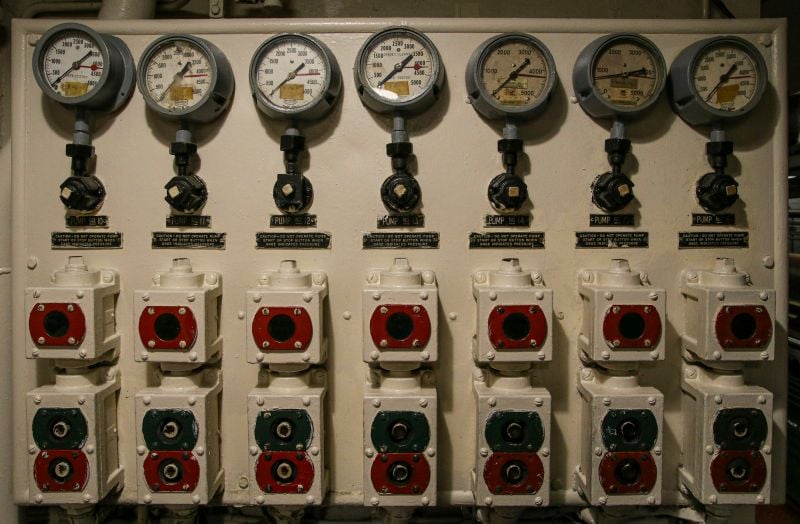
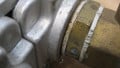
Traditional flow control valves that need to be manually adjusted. Image used courtesy of Unsplash
Pulse Signals
To control the valve in or out, a control system needs to send a pulse signal. The amount of time this signal stays on will determine how far out or in the valve will move. The PFES series valve will fully open or fully close in 5.5 turns, so the shorter the pulse, the more times you will need to send the pulse in order to fully open or fully close the valve. To get a 180° turn, the PLC would need to send a 1.0-second pulse and a 1.1-second delay of the next pulse. With this pulse configuration, it would take 11 pulses and 24.2 seconds to fully close the valve. The pulse width and period can be adjusted for finer adjustments.
This device can save time and resources for OEMs and can also allow for more control over equipment, resulting in a more flexible machine for the customer.