Facebook
 Google
 GitHub
 Linkedin
Swarm Robots Provide Contactless Transport for Small Items
A lesson from insects opens up possibilities in cooperative transport. Researchers have developed robots that use sound waves to transport objects in mid-air.
University College London (UCL) researchers have developed a new system for the contactless transport of small items, a method inspired by ant colonies. The goal is to save time and system complexity by transferring items between a swarm of robots instead of assigning each robot to travel individually.
While simply transferring items between robots is nothing new, UCL researchers determined how to use sound waves to suspend small items. This method enables contactless individual transport and contactless item transfer between swarm robots.
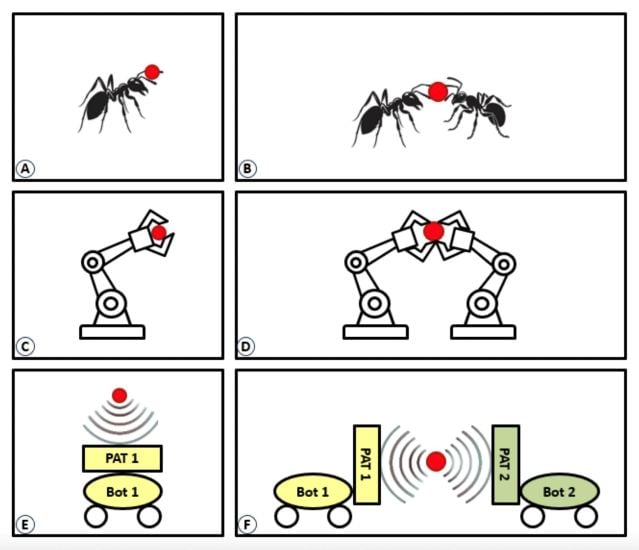
Just as ants transfer items, robots can too! Researchers have developed robots that use sound to collectively transport small items. Image used courtesy of arXiv
Swarm Robots and Cooperation
Robots that can communicate with each other and work together provide a whole new host of possibilities. For example, consider an AMR or AGV whose battery is dying. It can send out a distress call, and another robot will come retrieve its load. Another example is having robots hand off packages over a step, just as a human might hand a package to another human over a step to avoid a trip or fall. Ultimately, robots that can work together autonomously have the potential to move items more efficiently than the same number of human-programmed robots, each performing its own, individual task.
Acoustic Signaling and Transport
The collaboration between the robots developed by UCL researchers begins with acoustic communication. Each robot is fitted with an ultrasonic transmitter and receiver. The frequencies are high enough that humans cannot hear them, but the robots can turn the sound into control signals.
The sound waves are pressure waves that are powerful enough to suspend small items and particles in the air between robots, providing contactless delivery. Each robot changes configuration to reflect sound and suspend the object in a contained environment to move to the next destination. Increasing the intensity of the sound wave can suspend larger items, all without damaging the hearing of human workers.
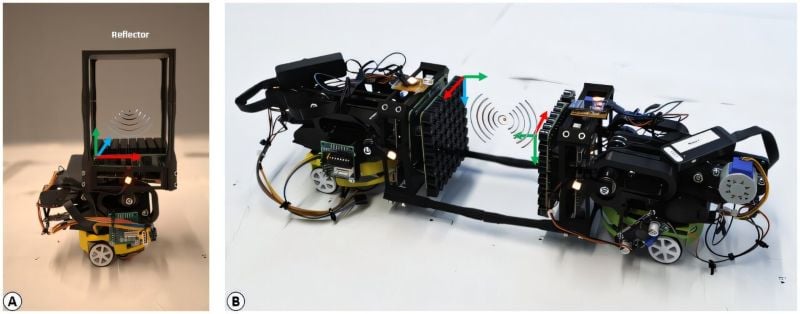
Using acoustic pressure fields, robots can move small objects individually (left) and then transfer them to another robot (right). Image used courtesy of arXiv
Contactless Applications
Currently, the robots can only suspend small items for contactless transfer, but more research is being performed to move heavier objects. In particular, the ability to perform contactless transfer will be useful in medicine, as the more exposure to humans an organ, treatment, or patient has, the more vectors there are for infection. If robots could, for example, move a thin flap of skin using ultrasound during surgery, the chances of infection would be much lower.
Another potential application is microassembly tasks. The ultrasonic waves can be tightly controlled to precisely manipulate components for assembly that would not be possible with human hands. Small fasteners, too fine for the finest jeweler’s screwdriver to tighten, could be used to make the assembly of small objects possible. Consider the numerous small electronic devices with an embedded battery that must be thrown away when the battery dies. With a small, contactless robot, a few screws are loosened, and the device can be recycled or reused.