Facebook
 Google
 GitHub
 Linkedin
The Banner R50C MDR Controller: 80% More Power in 60% of the Footprint
Banner has developed a small yet powerful conveyor controller that combines control and feedback from sensors.
Banner’s new R50C MDR Controller simplifies conveyor design by integrating all sensor feedback and control into one system. Built to occupy a small footprint and easily integrate with many hardware components, the R50C is designed to meet the needs of manufacturing facilities of all sizes. As a matter of engineering, the R50C can handle 80% more power than similar controllers, and it does so by occupying 40% less space, making it an option for upgrading conveyor controllers on existing systems.
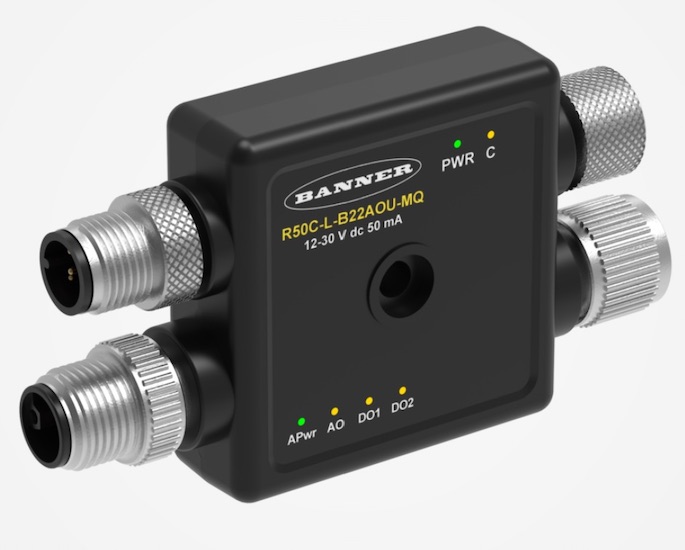
The R50C MDR Controller. Image used courtesy of Banner
Simplified Communication
The ModBus communications protocol makes the R50C MDR controllers versatile and easy to integrate, as ModBus is commonly used in many automation systems. The controllers have two programmable I/O channels, as well as one 0-18 V analog output channel, allowing the programmer to provide precise control to the conveyor system’s powered rollers.
It also can be daisy-chained with other controllers and can allow up to 16 A of current to pass through to feed these other controllers. The high current pass-through reduces the chances of “fan out,” where power loss downstream causes intermittent, hard-to-diagnose controller errors. Daisy-chaining controllers reduces the overall wiring requirements for the system and, when properly designed, can simplify the installation and reduce ground loop issues as well as other common electrical problems that are difficult to trace.
Another useful feature is that the conveyor system's communications and power are on separate circuits. This allows technicians to troubleshoot issues, communicating with the device while also having the motor locked out for safety reasons.
Built for Industry
The R50C controllers were built with heavy industry in mind. They are sealed to Ingress Protection level 67 (IP67), which makes them suitable for use in environments where water and dust are present. Even the M12 connectors used on this controller are sealed. Consider a stainless steel wire mesh belt that drives components through a wash cycle where high-pressure water is sprayed on the components, and excess water drains through the mesh. The controller is protected from splashing and draining from this operation.
Besides the ingress protection, the controllers are built to withstand temperatures from -40 °C to 70 °C (or -40 °F to 158 °F ), making them suitable for the harshest environments, such as near heat-treating furnaces or flash-freezing processes. Its compact size makes this controller a good choice for tight spaces in existing conveyor systems.
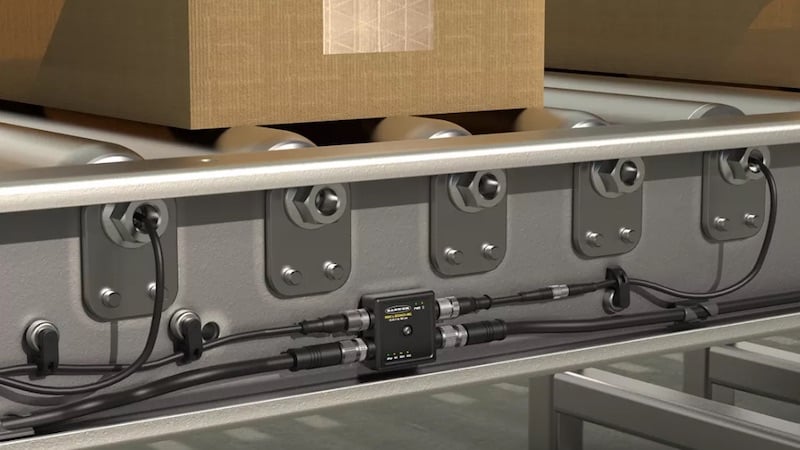
The Banner R50C MDR controller integrates two drive motors in a roller conveyor system. Image used courtesy of Banner
Potential Applications
The stereotypical image of a conveyor system is a motor controlling a roller, with a polymeric belt stretched between non-drive (passive) rollers. This is just one conveyor design. Wire mesh belts, overhead hooks and baskets, wheels, multiple-drive motors, and other schemes are commonly used to move goods through the production facility. With the R50C MDR controller, control of these drives can be implemented much more simply.