Facebook
 Google
 GitHub
 Linkedin
Autonics Unveils Closed-Loop Stepper System for Precise Position Control
The AiC-MT series combines the precise positioning of a servo system with the high-holding torque of a stepper motor. The system can control up to 254 axes with Modbus TCP.
Stepper motors are a special breed of electric motors. The stator is broken into segments, and each segment can be energized. This design allows for high holding torque with no hunting.
Autonics has released the AiC-MT series, a high-torque, high-accuracy stepper motor system with a controller pre-connected. The system includes an encoder to enable closed-loop control, along with Modbus TCP communication for positioning and parameter configuration. The AiC-MT system offers the benefits of a stepper motor system, along with added features typically found in a servo system.
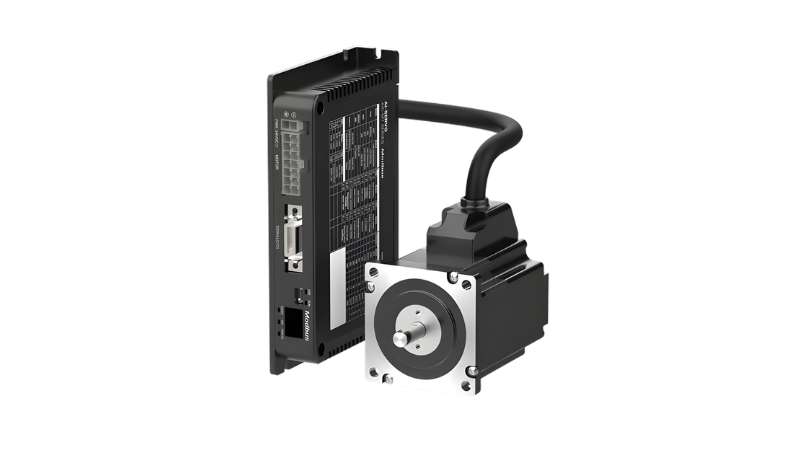
Autonics’ AiC-MT closed loop stepper motor system. Image used courtesy of Autonics
AiC-MT Closed Loop Stepper System
Each AiC-MT system comes with an integrated controller and encoder. Each controller is configured with Modbus TCP communication and can daisy chain up to 254 axes, as well as discrete inputs and outputs for standard motor control signals such as start, stop, direction, in position, and alarms. Users can set motor parameters over the fieldbus or through Autonics' Windows-based software atMotion.
The AiC-MT motor can be ordered with or without a brake and is available in six frame sizes ranging from 20 mm to 60 mm. Optional gearboxes can be ordered for the 42 mm or 56 mm frame sizes. Powering the AiC-MT is similar to other stepper motors with a 24 VDC power source, drawing up to 240 W for running and 15 W for holding.
Positioning Without Hunting
In a typical servo system, you might find that your position keeps moving when holding a load; this is called position hunting. As the load moves the servo position, the servo controller detects this movement and drives the position back to the commanded position. Due to the AiC-MT stepper motor's configuration, it has a very high holding torque, preventing hunting when holding a load.
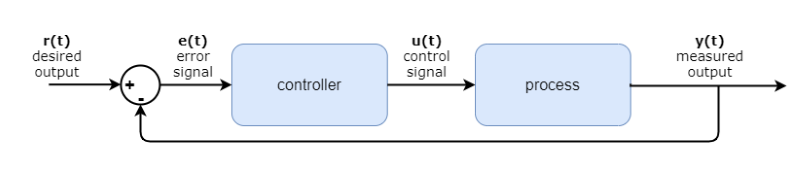
Example of a closed-loop control system. Image used courtesy of Wikimedia
What Is Closed-Loop Control?
An open-loop system doesn't provide a feedback mechanism; a closed-loop system provides feedback through the use of an encoder. For stepper motors, this isn't a huge problem because the controller provides the motor pulses for each step of the motor.
In high-speed applications, the controller can often overrun the motor, causing pulses to be missed and resulting in an incorrect motor position. By adding an encoder and additional logic to the controller, the motor position can be verified in real time. If the expected position and the encoder disagree, a correction can be made in real-time or an alarm can be generated.
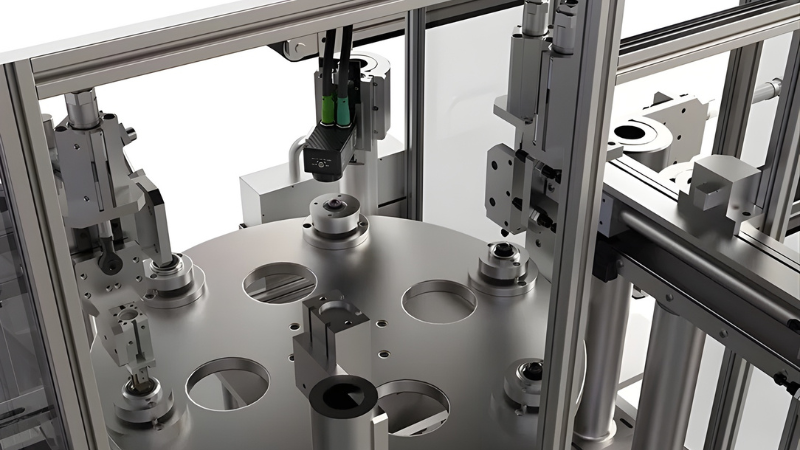
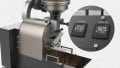
A vision positioning system with a feedback stepper motor. Image used courtesy of Autonics
Choosing a Stepper Motor System
A stepper motor system can be used in most applications where you might use a servo motor. You might choose a stepper motor when you don’t have access to three-phase AC power, or you need stationary, accurate positioning. Camera positioning requires accurate placement and no hunting. If the system is hunting while the image is being processed, the result could be slightly blurry, and inspection features could be missed.
Autonics’ new AiC-MT stepper system, with its integrated encoder and high-speed processing, can provide a stable positioning system for your next vision application.