Facebook
 Google
 GitHub
 Linkedin
Universal Robots Introduces Direct Torque Control Interface
Universal Robots has introduced a low-level torque control interface for its entire cobot lineup. This new interface provides developers with direct torque control for cobot joints, making it easier to build advanced AI-driven applications.
The ability to directly control torque at the joint level has long been a goal for researchers working with collaborative robots. It opens the door to precise, compliant interaction with the environment, which is essential for applications such as screwdriving, part insertion, and assembly. However, building a software stack capable of managing such low-level control has traditionally required substantial effort.
Universal Robots is addressing this challenge with the release of a new torque control interface. The system allows users to set target torque values for each joint of a UR cobot at a control frequency of 500 Hz. This feature is now supported in both the company’s PolyScope 5 and PolyScope X platforms and is available across all Universal Robots’ cobot models, including the e-Series and UR Series.
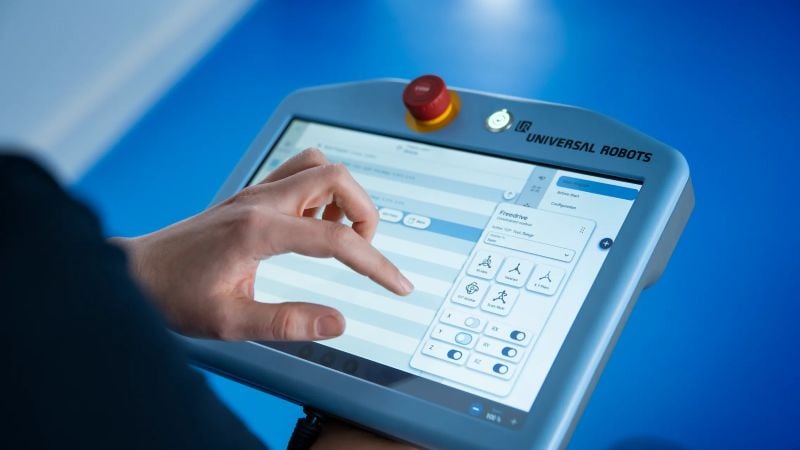
Universal Robots’ new Direct Control Interface can be accessed through the company’s PolyScope 5 and PolyScope X automation software. Image used courtesy of Universal Robots
Direct Torque Control
Universal Robots’ Direct Torque Control is a cobot-focused low-level torque interface. Torque-based control enables robots to adjust to physical interactions in real time, making the robot more responsive to subtle environmental cues and better suited for delicate tasks where force needs to be precisely regulated. These capabilities are especially useful in tasks where components must be inserted with exact alignment or force. Using torque as the primary input allows the robot to "feel" the interaction between components and avoid misalignment or excessive pressure.
Sim-To-Real Robotic Assembly
One of the most compelling examples of how Universal Robots’ Direct Torque Control interface is being used comes from NVIDIA Robotics. As part of a research effort into robotic assembly, NVIDIA engineers developed a full gear assembly task using a UR10e cobot. This project involved training policies in simulation using Isaac Lab and transferring them directly to a physical robot without additional fine-tuning. The success of this effort depended on the ability to use impedance control.
With early access to Universal Robots’ low-level torque interface, the NVIDIA team was able to implement a custom impedance controller running at 500 Hz, allowing the robot to interact with the gears and assembly environment with the same behavior observed during simulation.
NVIDIA’s Gear assembly utilizing Universal Robots' new low-level torque interface. Video used courtesy of NVIDIA
To train the gear assembly task, the NVIDIA team used Isaac Lab, an open-source training framework built specifically for robotics. The task itself included grasping, transporting, and inserting gears on shafts, each treated as a separate skill. Motion generation and insertion behaviors were trained using reinforcement learning, while grasp poses were generated through a standard planner.
Each control policy used a neural network with long short-term memory (LSTM) and was trained using the Proximal Policy Optimization (PPO) algorithm. Training was performed across thousands of randomized environments using domain randomization techniques. These variations included changes in friction, damping, and gear placement, which helped the model generalize better during real-world deployment.
Collaborative Robot Control
Once the policies were trained, they were deployed on a UR10e robot using Isaac ROS and a custom controller written in URScript. The sim-to-real transfer relied on a full perception pipeline: RGB camera images were passed through Meta’s Segment Anything model to identify gear components, and FoundationPose estimated their 6D positions.
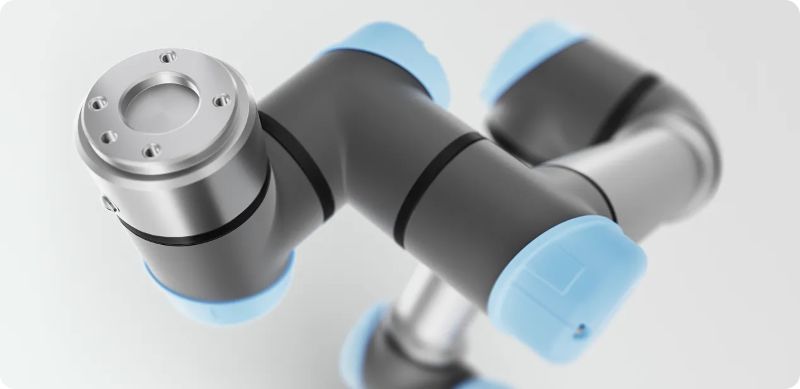
The Direct Torque Control interface can be used on all Universal Robots cobots, including the e-Series and UR Series. Image used courtesy of Universal Robots
These poses, along with joint encoder data from the robot, were used as inputs to the control policy. The policy output was converted into target joint positions, which were then processed by the custom impedance controller. Operating at 500 Hz, the controller computed the necessary joint torques and delivered smooth, compliant motion on par with simulation results.
Robots in Motion
The combined effort between Universal Robots and NVIDIA aims to create a powerful new direction for robotics. By providing the Direct Torque Control interface as a standard feature, UR has attempted to remove one of the most difficult barriers to deploying advanced control strategies. Developers and researchers no longer need to build custom hardware or firmware to test compliant behaviors. Instead, they can focus on building smarter, more adaptable robots that can perform in unstructured or contact-rich environments.