Facebook
 Google
 GitHub
 Linkedin
Installing and Using Modern Industrial Joystick Controls
Discover how digital and analog industrial joysticks can provide crucial precision in sectors like manufacturing and industrial automation, used mainly for motion control applications.
No matter whether we find ourselves operating heavy machinery, such as an overhead crane at a machine shop, robotic arms in a manufacturing plant, or complex remote operations, there will always be a need for intuitive and accurate control. It’s a delicate challenge, that of finding a device that can translate the nuanced movements of a human operator into precise machine actions, often taking place in harsh or demanding environments.
Industrial electrical joysticks are not mere video game peripherals; they are robust, specialized input devices designed to withstand rigorous use and provide critical control in various sectors. The principles behind their operation, however, were developed alongside their gaming counterparts, and they have evolved from simple switch designs to sophisticated sensor-driven systems.
Looking for information about hydraulic joystick controls? Check out this article.

Figure 1. Colorful game control joysticks are quite similar to their industrial counterparts. Image used courtesy of Adobe Stock
Digital Joysticks for Industrial Applications
Digital joysticks were designed to provide basic discrete commands such as moving up, down, left, or right, making them ideal for specific industrial applications. Digital joysticks function by registering movement in fixed directions, such as up, down, left, and right, but that’s all they do. They don’t have a means of measuring the intensity of the movement. This on/off nature makes them suitable for tasks requiring clear, distinct commands, like controlling the direction of a conveyor belt, moving a crane from point A to point B or activating specific functions in a machine.
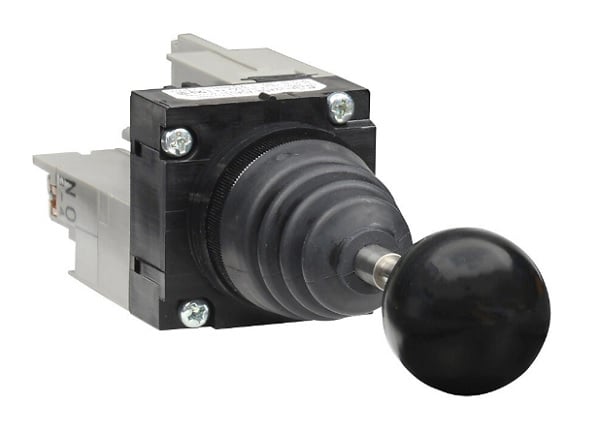
Figure 2. Digital joysticks typically come with N/O or N/C switches already included (AR22A0N-A0A0B). Image used courtesy of AutomationDirect
Characteristics of digital joysticks:
- Register movement at a fixed speed in fixed, discrete directions
- Ideal for tasks requiring on/off commands very similar to push-button control
- Simple design, often more robust in harsh environments
- Used in applications where precise pressure is not needed, but clear direction is
In older industrial setups, digital joysticks were prevalent, but they still find use in modern systems where simplicity and reliability are key. For instance, in some basic material handling systems such as an overhead crane, a digital joystick can provide straightforward directional control.
Digital Joystick Wiring
Overall, digital joysticks are essentially pushbuttons and are therefore wired very similarly, as shown in the figure above. In a 1-axis system, the joystick will have four contact terminals, a pair to indicate +x and a pair for -x. In a 2-axis system, the joystick will have eight terminals, since another four are added for +/-y. If the user pushes the joystick forward, the contact in that position will close, allowing the object to move in the set direction at the set speed.
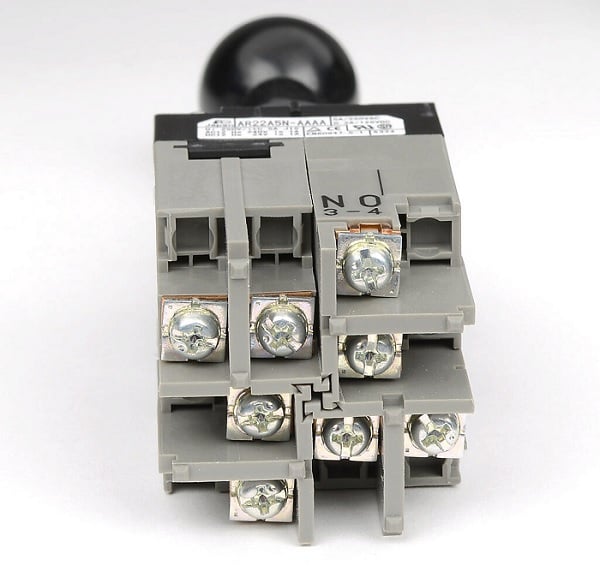
Figure 3. When wiring a digital joystick, it's as easy as wiring a normal switch. This one includes 4x sets of normally open contacts. Image used courtesy of AutomationDirect
Analog Joysticks for Fine-Tuned Movement
In order for integrators or machine builders to achieve finer control for movement and speed, analog joysticks will be the integrator's choice, as these devices use potentiometers, variable resistors, force sensors, or optical sensors to translate the stick's position into an electrical signal. As the operator moves the joystick, the resistance changes, altering the voltage to allow for smooth, proportional control that is essential for their daily tasks such as operating a six-axis industrial robot, controlling a CMM during programming, or controlling mobile robots.
Characteristics of analog joysticks:
- Continuous Control of multiple axes through a wider range of motion
- Variable resistance gives a proportional output that translates the stick's position into a proportional electrical signal
- Used in applications where precise speed or direction control is necessary
Potentiometer-Based Joysticks
As industries evolved, the need for more nuanced control became apparent. This has led to the development of analog joysticks, which use potentiometers to measure the stick's position. Picture a variable resistor, where moving the stick alters the resistance, generating an analog electrical signal proportional to the stick's displacement, and allows for continuous, proportional control, essential for tasks like operating hydraulic systems in construction or regulating the speed of conveyor belts in manufacturing.
Potentiometer-based joysticks:
- Provide continuous, proportional control
- Robust design for industrial environments
- Very susceptible to wear and tear due to mechanical components
- Essential for hydraulic and speed regulation
Yet, potentiometers have limitations, particularly in harsh industrial environments where wear and tear can compromise accuracy. To address this, manufacturers have turned to non-contact sensing technologies.
Hall Effect Sensor Joysticks
These joysticks utilize the Hall effect, which is a phenomenon where a magnetic field creates a voltage in a conductor. A magnet attached to the joystick moves relative to a stationary Hall effect sensor. This movement changes the magnetic field and produces a proportional analog voltage output.
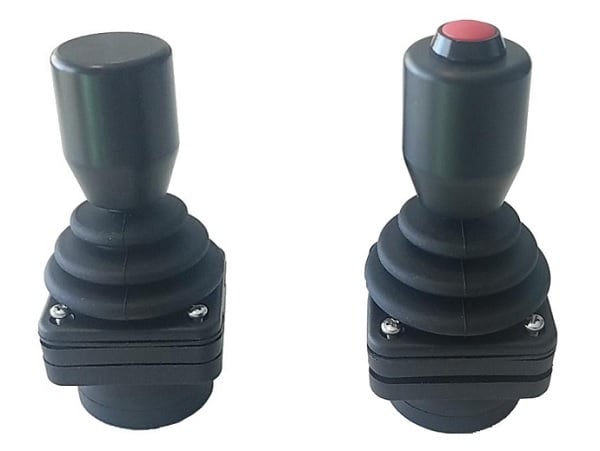
Figure 4. Dual-axis Hall effect analog joysticks. Image used courtesy of Avioni Technologies
Hall effect sensor characteristics:
- Non-contact operation, significantly reducing wear and tear
- Higher reliability and longer lifespan compared to potentiometers
- Improved accuracy and stability, especially in environments with dust or debris
- Used in areas such as aerospace and advanced robotics
Other Electrical Joysticks
Optical sensor joysticks employ LEDs and photodetectors to detect movement. A coded disk or wheel, connected to the joystick shaft, interrupts light beams. The photodetectors then produce analog signals proportional to the joystick's position.
Optical sensor characteristics:
- Non-contact operation, minimizing wear
- High precision and resolution
- Immune to electrical noise and magnetic interference
- Common in medical equipment and high-end robotic systems
In applications requiring extremely fine control, such as robotic surgery or remote handling of hazardous materials, force sensors (strain gauges) are employed. These sensors are sensitive enough to measure the force that the operator applied directly to the joystick, rather than only its displacement. This can allow for incredibly precise manipulation. Optical sensor technology can provide the highest level of sensitivity that is crucial in situations where even a minute error can have significant consequences such as in the medical industry.
Force sensor joystick characteristics:
- Measure the applied force, not displacement
- Provide extremely fine control and sensitivity
- Essential for critical applications like robotic surgery
The integration of advanced microprocessors and digital signal processing has further enhanced the capabilities of industrial joysticks. It's new technologies such as these that can give end users the ability to enable features like programmable control curves, that enable operators to customize the joystick's response to their specific needs.
Analog Joystick Wiring
As for the wiring of an analog joystick, it is very simple. The contacts will include a pin for GND and a VCC pin for the supply voltage (typically 5 V for microcontroller integration, or 10 V for industrial use). There is likely also a switch pin which is an optional output for a pushbutton that’s on top of some joysticks. This switch pin is meant for a digital input module, but it must be provided with 24 V for most PLCs.
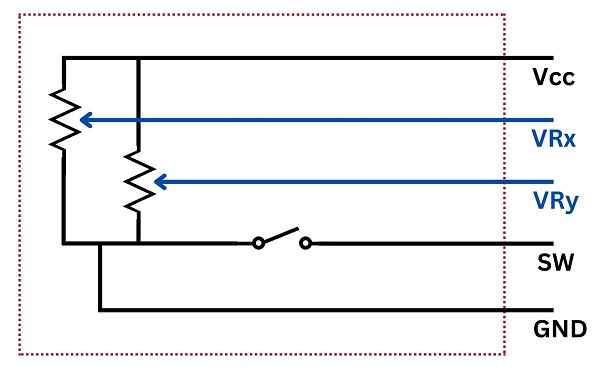
Figure 5. Contacts for a typical analog joystick with an optional pushbutton control (usually at the top of the joystick).
Finally, and perhaps most importantly, you will find variable outputs for the X and Y (perhaps labeled VRx and VRy), and possibly more depending on the number of axes controlled. These two variable signals will be attached to analog inputs in the PLC.
In the above example image, we see a two-axis system: x and y. The VRx and VRy contacts generate a voltage that is proportional to the position of the joystick when it is moved. So let’s say for a 10 V system, if you let go of the joystick, VRx should read 5 V. As the joystick is jogged to the left or right, VRx will read between 0-5 V or between 5-10 V, proportional to its position from the center point.
|
Note: Due to the wiring setup of this switch in the image, our digital input module must be of a 'sourcing' variety. A Vcc of 10 volts will be suitable for the analog input voltage, and 24 volts supplied by the digital module will both be compatible at the same time. If the switch is attached to the Vcc pin, then a sinking input module may be used, but you cannot provide both 24 volts for the switch and 10 volts for the potentiometer. This is a somewhat rare case that proves the usefulness of a sourcing input module! |
Joysticks for Human-Machine Control
In industrial settings, both digital and analog joysticks are essential tools, each serving distinct purposes. While digital joysticks offer reliable, discrete commands, analog models can provide machine builders and integrators with fine-tuned control that is needed for complex operations.
By using technologies like potentiometers, optical sensors, and force sensors, industrial joysticks are another tool that can be used to complete their daily job tasks, ensuring that any operator can maintain fine control over almost any system.
Related Content