
 Facebook
 Google
 GitHub
 Linkedin
Robot Safety
The common mantra for company values associated with safety practices is usually some variation of ‘Safety First’. However, from a pragmatic standpoint, the objective of any company is truly ‘Productivity First’. If safety really was the top priority, all production would be paralyzed by even the most minor of risks.
Instead, safety practices are built on a careful analysis of risk analysis matched with the proper protective or mitigating procedures. This risk management process is fairly standard across agencies and organizations, although the context might look quite different.
Instead of thinking about safety first, we should instead consider safety as a parallel to all operational practices. Not always at a higher priority, but always at the same time. For any project, be prepared to imagine, observe, and record all potential risks throughout the design and commissioning phases, and even into operation (although safety should be managed by that time).
For each risk, determine the potential impact of that risk. Is it a guaranteed loss of life, or simply a minor inconvenience to a worker or a machine? In addition, to keep the process grounded in reality, be willing to asses how likely the event is to occur. Some tragedies may be imaginable, yet highly unlikely. Architects and building designers, for example, must consider earthquake risks in their designs - it’s not very likely, but if it does happen, the result could be catastrophic. Therefore, protection measures are built into designs.
Deeper inside the facility, inside a robotic work cell, the same considerations can be taken. The good news is that many of them are relatively simple to manage, as long as the company is willing to take such preventive measures. As we can see in the news, many companies ignore the small problems leading to larger workforce and financial consequences.
Examples of Robotic Safety Concerns
This may not be an exhaustive list of robot work cell risks, but a few examples to demonstrate the thought process behind analyzing risk, severity, and the best course of management action.

Robot Collision
Why not start with the most obvious risk, where a person working near a robot moves into the travel path with a hand, arm, or head. Well, PPE practices dictate that we wear gloves and hard hats in the facility, so if the robot is traveling slowly, no problem, right?
That is exactly right.
Robot safety guidelines establish a teach mode of operation where the operator can move right beside the robot and test the program, with one hand free to move right next to the robot, but it must be limited to below 250 mm/second in speed. For this mode, external safety circuits (light curtains, door interlocks) are ignored, only the operator’s E-stop button will halt motion.
For speeds higher than the teach mode allowance, the mode must be switched to automatic run, and immediately all safety procedures are engaged. The robot cannot be started until personnel are safely following all safety procedures.
Trapment / Pinch Points
This is related to the previous problem, but pinch points can extend beyond the reach of the robot, so it does not always mean collision. When a robot is working alongside a machine, for example, loading a press brake, a signal is transferred from the robot to the machine when the robot has finished loading and it’s ready to bend the metal.
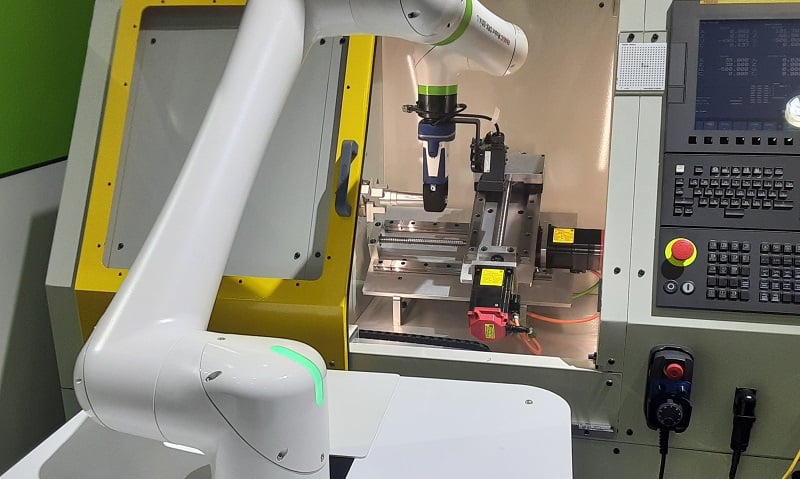
If an operator is working nearby on the other side of the machine, far away from the robot, but the robot finishes the task and activates the press, there could be inherent dangers for the operator.
To manage this risk, the robot safety circuit also monitors a physical or optical light barrier around the press opening, and if any operator is detected, the robot and machine instantly stop.
Calling this a ‘pinch point’ may seem a bit underwhelming, but the reality in most equipment is that a simple ‘pinch’ can immediately be fatal, and should not be brushed aside.
A ‘trapment’ is any space in which a person or appendage can be pressed between the robot or EoAT and a hard surface. Again, this may be considered a collision of sorts, but rather than focusing on the robot programming as the solution, the design of the cell is a greater factor.
Regardless of the problem type presented here, the isolation of robots from people is absolutely the most guaranteed form of safety. This means that the normal solution is a metal gridded cage around the robot with a single door, latched and monitored by magnetic coded interlock sensors. If any opening exists where a person may reach into the cage alongside conveyed products, an additional optical barrier (light curtain) ensures safety at all times.
Robot Stability
The stability of the robot installation is worth mentioning as a further risk. Most older facilities were not designed originally to hold heavy, fast metal robots. If these robots are mounted directly to the floor, they must withstand the repetitive forces of motion. Most floors are made out of concrete, and each robot will have specific instructions regarding anchors, slab thickness, and bolt pattern to ensure a safe operation.
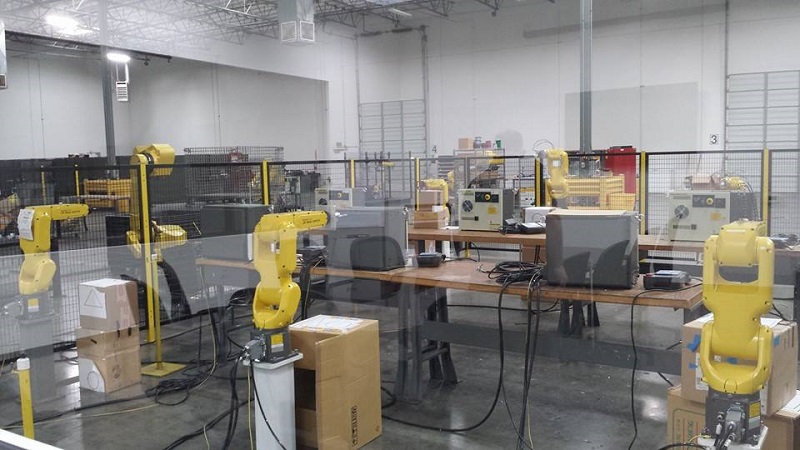
Some smaller models of robot can be mounted to steel fixtures, perhaps a pedestal, like those shown at a robot training facility in the image above, or they might attach to an elevating 7th axis column, or even mounted upside-down on a steel joist beam. All of these are permissible for many models, but once again, the manufacturer’s instructions must be followed very closely. Anchors mounted into concrete that’s too thin, or anchors too small, or even over-torqued bolts can all lead to failures that will not only cause the robot to tip over and become damaged, the floor will be broken, and the facility will be down much longer than for a simple collision.
Other Safety Hazards
Risk management procedures exist simply because there is no pre-defined list of all possible scenarios that can cause injury. It’s up to the individuals and the management of the team to ensure that preventive measures have been taken wherever reasonable to ensure a pleasant and productive experience for everyone. There is a reason that many safety mantras will state that YOU are the person in charge of your own safety. This is for a very good reason. Nobody can possibly imagine all safety factors, and no book or policy can protect you all the time. You must be diligent and observant all the time. You are, indeed, in charge of your own safety.
Human Engineering: Ergonomics
Sometimes, safety isn’t about keeping people away from injury during those harmful ‘mistakes’ that might appear in gripping headlines. Most of the time, safety is the entire point and purpose of automation: to prevent human workers from being subjected to jobs that will be harmful over even a short career. Palletizing robots lifting 50 lb boxes day after day may be construed as ‘replacing a human job’ but in reality, that job replaces itself every few years by back injuries, leaving a trail of people no longer able to enjoy life or further careers without extensive medical attention, if at all.
It’s important to consider how to work alongside these robots, especially when collaborative or mobile platforms are implemented.

First, we can look at the work cell and the shape of the robot. If there is any interaction between workers and robots (again, in the collaborative case) we should avoid brackets, tooling, and fixtures with sharp edges. The robot arm itself will already have incorporated such features, it will not be a concern of the end user.
For controlling the robot, the graphical interface is a great place to start for safety. Are there any monitored safety devices that should be displayed on the HMI? Are there force sensors in the robot that may provide an indication of which motor experienced the collision? Should we provide a real-time diagram of the placement of the product and the current status of the work cell?
These questions and many others are the subject of the human factor of engineering, how can we provide an environment that is not only safe, but comfortable and interactive in the long run that provides not only long tenure in a position, but easing of frustration around troubleshooting. With these considerations, you are certain to have a more enthusiastic, willing cadre of employees, ready to tackle new automation projects.
Safety Regulations
The main regulatory body in the United States is the Occupational Safety and Health Administration (OSHA), which started in the 1970s to ensure that companies were following proper safety practices. Each industry must follow proper workplace procedures relevant to its own operating environment. The rules that govern how a small machine shop operates will certainly be different than for a major semiconductor manufacturer.
Some practices are plain and obvious, like those mentioned above in regard specifically to robotics. Some procedures are more regulatory in nature, and might be less obvious to a novice.
Some of the regulations pertaining to robotics are found in the pages of manuals produced by the International Standardization Organization (ISO). One such publication is the ISO 15066 regarding safety around collaborative robots (cobots) which is explained in depth in a previous section of this book. ISO 10218 is the standard around industrial robots. For end tools and fixtures, ISO 20218 provides guidance.
The American National Standards Institute (ANSI) in cooperation with the Robotics Industries Association (RIA) founded the RIA 15, which is a consolidation of many parts of the above ISO documents, creating in effect a single global set of guidelines for the entire field of robotics.
It is up to end users to obtain these documents and understand how to apply actions and features. Some of the safety methods are implemented in the robot controller software, while others are in the hardware assembly. When using a robot, be sure you have addressed all required safety precautions before turning it loose on the project at hand.
Benefits
For all the talk about risks, caution, and safety, we must conclude with a comparison that asks: “Is it worth it?” Is the financial benefit of automating really worth the cost and safety risk?
The answer really comes down to the project. Most simple, repetitive projects that cause injury to workers are the fastest to be replaced with automation. In those scenarios, yes, it absolutely makes sense. In more advanced cases, the answer may be a tentative yes after much design consideration. In some situations, the work is so customized that automation really might not be the answer.
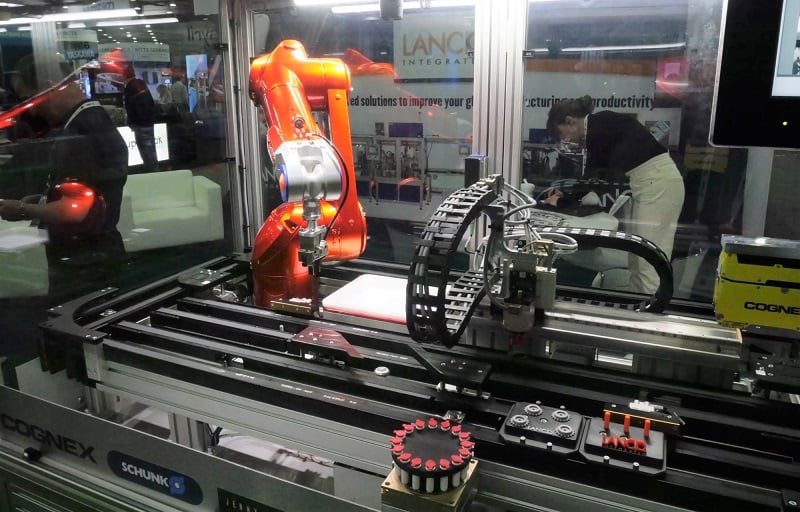
No matter which challenge is the first to be adopted by a facility, approach it with a forward-thinking attitude. How can the features installed today be leveraged to provide data, analytics, and a path forward to helping me become more profitable and efficient in the future? If you can answer this question, the ROI will be well worth the assumed cost and risk.
