Facebook
 Google
 GitHub
 Linkedin
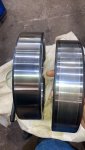
We are facing a persistent and unresolved issue with an 1850 kW ID Fan motor (VFD-driven), where the Non-Drive End (NDE) bearing repeatedly fails within ~3 months of operation under load.
Problem Description
Despite the above corrective actions, the failure trend remains unchanged.
Key Concern
Why does the motor consistently run vibration-free initially and then develop increasing vibration leading to NDE bearing damage within ~3 months, regardless of the motor installed?
Request for Discussion
We are seeking expert opinions on:
Any insights, similar experiences, or suggested investigation approaches would be highly appreciated.
Problem Description
- The failure is always preceded by progressively increasing vibration levels.
- This issue occurs irrespective of the motor used (i.e., even after replacing the motor with another healthy one).
- When a new or overhauled motor is installed, vibration levels are initially normal.
- After ~3 months of operation, vibration starts increasing gradually and ultimately results in NDE bearing failure.
- Once the motor is replaced, the same pattern repeats.
- DE side: NU240 C3
- NDE side: NU236 C3 + 6236 C3
- Bearings are from reputed manufacturers, and no inherent bearing defects are observed.
- FFT analysis indicates housing looseness.
- However, physical inspection does not reveal any looseness in the bearing housing or foundation.
- Motor foundation bolt holes enlarged to eliminate potential soft foot issues.
- Laser alignment carried out between motor and ID fan.
- Dynamic balancing of ID fan recently performed to address mass eccentricity.
Despite the above corrective actions, the failure trend remains unchanged.
Key Concern
Why does the motor consistently run vibration-free initially and then develop increasing vibration leading to NDE bearing damage within ~3 months, regardless of the motor installed?
Request for Discussion
We are seeking expert opinions on:
- Possible root causes (mechanical / electrical / system-related)
- Role of VFD-related effects (bearing currents, resonance, thermal growth, axial loading, etc.)
- Any missed checks or advanced diagnostics recommended
- Long-term corrective measures to permanently eliminate this issue
Any insights, similar experiences, or suggested investigation approaches would be highly appreciated.