7EA/9E Secondary Burnout

Howdy,

I'd like to preface this discussion by making it known that I am not an operator, but a repair/refurbishment guy. I've been working on repairing DLN and non-DLN fuel nozzles assemblies for a few years now and I've noticed a trend that I've not been able to nail down with my limited expertise.

I see many Fr7/9 units come in with relatively good-looking fuel nozzle assemblies, but a single secondary fuel nozzle burnt out. The severity of this burnout is not consistent, sometimes it is localized to the tip and other times it has slagged the entire outer sleeve above the fuel pegs. In each case though, it has been isolated to one or two fuel nozzles, and in the latter case they were not neighbors.

Many of the end-users I have spoken to with these burnouts are experiencing issues with primary reignition, either due to low-load or some other factor. From reading the forums here I've seen several people point the finger away from controls and toward the mechanical systems in the unit, which does make sense to me. In nearly every event I have seen, the end-user describes the problem as a sudden-onset (i.e. one day it makes the transfer to premix, and the next day it doesnt). These units are nat-gas only, with heated fuel. The operators have described their exhaust temperature spreads as 'normal' prior to the failure to go into premix.

My question here is what have y'all seen on these units that causes these sorts of issues with burnout, because from my end just staring at these fuel nozzles in isolation without any experience on the operator side I am having a hard time nailing down the cause. I am hesitant to suspect that the issues are within the secondary itself, but at this point I'm not sure where else the problem could be because my understanding of the other ancillary equipment is a bit lacking. Any users who can share the causes of any similar burnouts just for ideas would be appreciated.
 
Secondary burnout isn’t something you want on a 7EA or 9E. Do you think thermal fatigue from frequent startups could be a factor here, or is it mostly linked to fuel nozzle issues?
 
It might be a factor in a few failures, but only a handful that I've seen have been from peaking/starts-limited units. The majority have been on base load machines, a good number of which have also had PRI problems which makes me think that the fireball is perhaps moving further upstream than the design is meant for during premixed operation, but I'm not entirely sure what could be causing that.
 
GE does a very poor job of explaining which Process Alarms REQUIRE operator intervention and which don't. GE doesn't trip the unit unless there's a chance of major mechanical damage (such as with a high-high exhaust temperature spread or low-low L.O. pressure or high-high vibration) where there's very little chance of operator intervention saving the machine from serious mechanical issues because of lack of a timely response (such as reducing load or shutting down if the problem can't be solved relatively quickly).

But there are some alarms (not all that many) and the number of alarms that require timely intervention depends on a lot of variables (fuel(s); auxiliaries; etc.) so a list of the alarms that should be dealt with in a timely manner is unit-specific.

That being said, DLN-I combustor-equipped machines have this combustion mode that was implemented to keep from tripping the unit when a primary zone re-ignition event occurred while operating in Premix Steady-state and allow the machine to keep running while the operator reduced load to attempt another combustion mode transfer back to Premix combustion mode. And that mode is intended only as a transitory mode while some discussion is going on regarding the possible issues (checking things like high exhaust temperature spreads, emissions out of range, etc.). It's called Extended Lean-Lean combustion mode and in this mode there is diffusion flame in both primary and secondary combustion zones--AND fuel is flowing through the secondary fuel nozzles in what should be premix combustion inside the secondary fuel nozzle "tube" surrounding the secondary fuel nozzle and isolating it from the primary combustion zone (which surrounds the base of the secondary fuel nozzle). If the fuel exiting the secondary fuel nozzle pegs gets ignited into diffusion flame that can cause problems with the secondary fuel nozzle getting excessively hot and the welds "dissolving" resulting occasionally in separation of small parts of the secondary fuel nozzle tips. Diffusion flame is much hotter than premix flame and wreaks havoc when in contact with metal components (usually diffusion flameballs are downstream of the fuel nozzle tip--not "attached" to or extremely close to the tip (which is what most people envision)).

It's sort of like what's called "flashback" in DLN-2.x systems which typically run almost exclusively in premix combustion mode inside their respective "tubes."

It would be really helpful to know what the secondary fuel nozzle "tubes" of the combustion liner looked like when these secondary fuel nozzle tips are damaged.

It would also be good to understand what fuel was being burned when the failures occurred.

Getting back to Extended Lean-Lean combustion mode, GE estimates that every hour of operation (which usually means at high loads/fuel flows) in Extended Lean-Lean combustion mode is equivalent to ten hours of operation in Premix Steady State combustion mode--it's hell on the hot gas path components, especially combustion liners and fuel nozzle tips. Even at approximately a 50-50 spilt of fuel between the primary and secondary fuel nozzles when operating in Extended Lean-Lean the fuel flow-rates and diffusion flameball position can cause serious damage if left unattended for long to liners and fuel nozzle tips.

During the VERY early days of DLN-I the machines were tripped on detection of diffusion flame in the primary combustion zone--and it happened fairly regularly, too. But, as the technology and controls schemes got better the occurrence of primary zone re-ignitions lessened considerably and it was decided to only alarm on the detection of flame in the primary combustion zone and an automatic change to Extended Lean-Lean combustion mode from Premix Steady-state combustion mode.

And here's where the possible problem lies--because the machine ISN'T tripped or even automatically unloaded when automatically switched to Extended Lean-Lean combustion mode and continue to run--most operators, who aren't properly trained or knowledgeable about this condition, just leave the machine running at "high" load in Extended Lean-Lean combustion mode. Which ain't good for the machine at all. There have been reports on Control.com of machines operating for weeks or longer in Extended Lean-Lean combustion mode and the machine suffered serious damage and the turbine control system gets blamed for the trip AND the damage. Operators also don't want to lose their job for shutting a machine down "unnecessarily," especially in areas other than North America.

I also think that natural gas quality IS NOT what it was even 10 or 20 years ago; it has a lot of crap in it--think gasoline and diesel fuel (usually used a piping cleaning agents), natural gas compressor lubricating- and sealing oil, silica, rocks, swarf, sand--you name it. Not all of these contaminants get removed by filters, and there are sites which have been found to have ruptured filters and even NO filters in the filter canisters (they do cost money...). There are also natural gas liquid condensates which can collect in various areas of the fuel piping systems and when they get large enough and forced to move and ignite they can cause serious problems for fuel nozzles and combustion liners (and generally cause high load swings as the liquid fuel condensates burn).

Most Frame 7E/9E machines that have heated fuel have it because in some parts of the world the dewpoint of the natural gas supply is such that even flowing through pressure-regulating valves and control valves and fuel nozzle orifices can cause condensation of the natural gas fuel components. Especially during starting. So, GE--because they warrant the machines when new--decided to install the "start-up fuel gas heaters" as a standard component on many machines (beginning back in "The Bubble" (the late 1990's and early 2000's in the USA)). It's only heated enough to try to make sure there is at least 50 deg F of superheat on the gas fuel as it enters the machine fuel control valves and fuel system to try to prevent condensation and hydrocarbon chains because of the temperature drops as the fuel flows through valves and nozzle orifices. Gas fuel suppliers can change very quickly these days as new field come on line and old sources get depleted the constituents change and many sites rarely test their natural gas to see how much the constituents have changed or consult the OEM to see if there should be any change to valves/nozzles or control schemes to protect the machines.

These machines are marvels of engineering, but they are still machines. When the run well--they are workhorses and can take a licking and keep on ticking. But they need maintenance--preventive and anticipatory. And well-trained operators, too.

These are really just some of the possibilities for fuel nozzle damage. Nozzle orifices can erode, or they can become plugged. Sand, silica and small rocks can do all of these things. And filters, if not changed, can rupture--causing a LOT of contaminants to enter the fuel gas stream. Many sites no longer do any kind of "rounds"--where outside operators (who eventually became inside operators and brought their knowledge and experience with them) took gauge readings. Like fuel filter differential pressure readings. And these were logged and tracked. I have seen logs that showed an increase in filter differential pressure readings--and a sudden decrease, probably coincident with a rupture of the filters and the dp readings remained low for weeks. Natural gas fuel filters aren't usually supplied by GE, and don't often have dp transmitters connected to the plant DCS control system or the turbine control system. And without roundsheets or archival/historical data no one knows what the filter dp's did or are doing.

Many sites have determined long ago that the start-up fuel gas heaters supplied by GE were unnecessary (how they did that is a mystery--but because they were usually electric heaters and the current to run them costs money that detracts from profits...) so the fuel heaters aren't even in service. Some fuel heaters have control panels that haven't worked for years, maybe even decades.

Anyway, these are all possible causes--sometimes it's more than one cause at some plants.

And the turbine control system ALWAYS gets the blame. (Why not? It has SOOOO MANY LEDs and wires and no one really knows what it does or how it does it--so it must therefore be the cause of all problems. Right? RIGHT?)
 
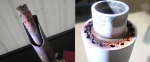
WTF, as requested some pictures of a couple failed secondaries. Both are from gas-only units, burning pre-heated natural gas. I cannot speak to the quality of fuel on these, but the nicer looking of the two was operating in the US while the other was operating somewhere with far fewer environmental concerns.

As stated, both of these were the only failed secondaries in their sets. The remainder of the fuel nozzle assemblies from these two machines certainly looked run, but none were burnt anywhere near as bad as these two.

If you've ever seen anything like this, let me know. I'm still scratching my head a bit at how you can burn away half a pound of stainless and superalloy without noticing anything on the operator side until you crack the unit open for a CI.
 

Attachments

@BraytonCycleEnthusiast,

I would agree that it's pretty difficult to imagine that there wasn't a high exhaust temperature spread on the machine with the nozzle on the left. Having said that, I have been to sites where--to keep the machine running--exhaust thermocouples were "jumpered out" which negated a problem no one wanted to believe existed OR wanted to shut the machine down to troubleshoot and resolve. (I hate to note it but there are versions of the Mark* turbine control system that can "force" analog inputs and there was some serious damage caused by this practice on some F-class machines many years ago. (This is the pseudo-electronic equivalent of jumpering--but It's a dangerous thing to do and it only holds an input at a constant value that will usually change with load, but that doesn't stop some people (usually after being told to do it by supervision/management/ownership).)

I would need to understand a little more about the nozzles and machines those pictures came from. Remember--when running in Premix Steady State mode only about 20% of the total fuel flow to the machine flows through the secondary fuel nozzles. AND, that a portion of that (I don't know how much) is burned in a diffusion flame while the remainder is burned in premix combustion (most of which, if I recall correctly is through the pegs on the lower portion of the body of the secondary fuel nozzle).

The nozzle on the left sure looks like there was diffusion flame inside the secondary fuel tube (the one the secondary nozzle resides in) and that diffusion flame probably melted the outer secondary nozzle body which at some point allowed the fuel from the tip of the nozzle to be flowing in an uncontrolled fashion. Recall also that the division of fuel between combustors and nozzles is all done via the fuel nozzle orifices which are connected to manifolds. So, if the orifices of one nozzle (a secondary nozzle in this case) enlarge significantly then more fuel is going to flow out of that nozzle than the others which, again, one would think would have resulted in a significant exhaust temperature spread. (It would also seem that either the machine tripped (probably due to high-high exhaust temperature spread) and/or was impossible to re-start with that damage. MANY operators don't really pay any attention to alarms unless the machine trips--it's their job to keep the machine running, right? And, in some parts of the world shutting down or tripping a machine by an operator can result in the loss of one's job. And, most operators--just about anywhere in the world--don't really have the training or even experience with high exhaust temperature spreads and their causes. Finally, in a typical Mark* turbine control system one only has 9 seconds to respond to a high exhaust temperature spread (also know as combustion trouble) before the machine will trip if left unattended--which doesn't leave much time to do much of anything.)

I also have to think that QC isn't always what it should be on fuel nozzle components. If the temperatures in the machine cause a small fuel leak out of a joint or interference fit joint (for lack of a better term) that fuel could be ignited into a diffusion flame and result in damage to the nozzle. Fuel nozzles can be tested--but they are usually tested at ambient temperatures--not internal running temperatures. There are lots of stories of factory personnel not following procedures when assembling components that lead to failures, some very serious. (The one that I always recall is some assembler found it difficult to fit generator stator windings into stator slots using the approved talcum powder, and decided to use hand lotion instead, which worked really well--until the generator went into service and the temperatures in the generator caused the hand lotion to degrade the insulation of the stator winding bars to deteriorate and a VERY large short occurred in the generator stator at that point. This happened on at least two occasions until all generator manufacturing was halted while all component manufacturing and assembly operations and methods were reviewed against factory practices and the hand lotion was found and tested to be the cause of the insulation degradation. This isn't a generator, but things like this happen--not often, but they do happen.) Tolerances--even factory tolerances--can sometimes be borderline and allow unanticipated problems.

The nozzle on the right seems to have had some diffusion flame right at the nozzle tip--which is not where the flameball should normally be. This has happened when there were contaminants (compressor lubricating/sealing oil; condensed natural gas liquids which carbonized on fuel nozzle orifices and because red hot ignition sources; excessive silica which enlarge fuel nozzle orifices; etc.). The liquid contaminants can collect in low piping points and high flows can eventually force them to move (either because of pressure fluctuations or the volume of the liquid increases) and they can cause excessive flows of combustible liquids through the gas nozzle orifices.

Another thing to consider is Lean-Lean operation (and Extended Lean-Lean operation) which higher than normal fuel flows (about 50% of total) occur through the secondary fuel nozzle including the pegs at the lower portion of the secondary fuel nozzle body. ALSO, while it is a transitory mode, the Lean-Lean-to-Premix fuel transfers have virtually ALL of the fuel flow going through the secondary fuel nozzle--either through secondary fuel nozzle passages (including the pegs) and the transfer fuel passages/orifices.

F-class machines usually heat gas fuel to increase the thermal efficiency of the machines (cold fuel entering the combustor has a chilling effect on combustor temperatures so more fuel (not a lot at any instant in time) has to flow to compensate for that cooling when the machine is running on exhaust temperature control--which most machines with DLN combustors do even at part load). But, E/EA-class machines didn't use fuel heating for efficiency, primarily only for start-up operation as was explained previously, at least in my experience. (The fuel flow-rates over the life of a GE-design F-class machine are so high that even a few tenths of a percent increase in thermal efficiency can mean hundreds of thousands of dollars in savings/profits. And, F-class machines usually use steam condensate or low-pressure/temperature steam for heating the fuel; while E/EA-class machines used electric gas fuel heaters to prevent natural gas liquids from condensing, mostly during start-up.) I'm not so sure fuel heating is the primary culprit here--again all the fuel flows through manifolds which essentially equalize the fuel flow-rates to the combustors/fuel nozzles, assuming the nozzle orifices are all within specification.

That's all I have. If you learn something more it would be great if you could share it here.
 
Top