Overvoltage on a 3 phase motor.

S

Thread Starter

stts

I have a 575v 3p trans with taps down to 510v. It does run our 5hp 460v motor on our hydrolic unit but I have yet to walk away from it while its running. :) Im not keen on all the equations and stuff, but I was thinking a little overvoltage makes motors run more efficiently. Am I right, or is this a slow fire waiting to happen?

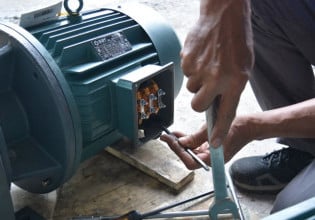
 
There are no hard and fast rules; it depends on the motor manufacturer. I find that Italian motors cannot take a 10% over voltage for very long. Others can. The speed will be the same, as this is controlled by the hertz The current will be 10% lower than the name plate but this does not equate to 'more efficient' The higher voltage may or may not lead to premature winding insulation failure. It is often a case of suck it and see. I have done it many times with no adverse effects, but I take regular temperature readings etc until I am reasonably satisfied.
As for catching fire, motors may emit dense clouds of smoke as they burn out but they do not usually catch fire. Do not use it near flammable things though or in a hazardous area.
 
Motors are should be used at there design voltage. Normal design voltage with a +/- 10% are the limits from the normal design. You are pushing the limits and will pay the price if your motor has been designed to a maximum of +10% voltage operation.
 
Responding to ssts' Mon, Jul 8, 2:13pm query:

The following Table shows the "general" effect of a 10.9% (510/460) overvoltage on a motor's major parameters. Please note that these values are approximate and some are based on, yep, you guessed it... GOROT or "Good Old Rules of Thumb!"

Starting Torque, 23 % Increase
Full Load Torque, 23 % Increase
Percent Slip, 18 % Decrease
Full Load Speed, 1 % Increase
Full Load Efficiency,1 point Increase
Full Load Amps, 7 % Decrease
Starting Current, 12 % Increase
Carcass Temp, 3-4 degrees C Decrease

The above shows you are right. Walk away and get some sleep!

Regards,
Phil Corso, PE
(Boca Raton, FL)
 
Responding to Anonymous' reply (Tue,9 Jul, 2:05pm) to stts:

Your advice is rather ominous. Actual conditions of load and ambient temperature were not presented.

The values I produced were based on full-load and a 40 deg (C) ambient. The temp-rise over ambient is approx 3 to 4 deg (C) less than rated. But, with an 80% load and 35 deg (C) ambient, the temp-rise is lower by 10 to 15 deg (C).

I understand your wanting to err on the side of caution. Just note how many of the list provide "disclaimers" when issuing advice... another indication of the litigious society we've become.

BTW, if anyone wants a reprint of the reference used for my response, please contact me.

Regards,
Phil Corso, PE
(Boca Raton, FL)
 
Hello,

Thanks for your input. I'm happy to say the hydrolic unit has been running like a champ. There is no discernable performance difference that we can tell for sure, but it seems to have more pep on startup. Since its not running hotter, Im confident that 50 more volts wont do anything to breakdown the shalac on the wireing.

Have a good one all.
stts
 
Responding to stts' comments (Sat, Jul 13):

Wow! Where did you get the word "shellac?" I haven't heard that term used since I did a job for a marine-shellac company, way back in the
'50's!

Regards,
Phil Corso, PE
(Boca Raton, FL)
 
Top