Parallel running of dissimilar generators with different droop settings

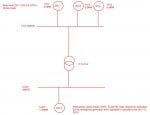
DG-123_STG.JPGIn this setup, is it possible to operate all three generators in parallel by configuring DG-1, DG-2, and the STG in Droop mode, while operating DG-3 in Fixed kW mode?
The manufacturer claims that DG-3 cannot run in parallel with 11kV generators, citing a mismatch in droop settings: the maximum attainable droop for DG-3 is 2%, whereas the 11kV generator has a 3% droop setting. Therefore, they argue parallel operation is not feasible. However, I believe parallel operation could still be possible if DG-3 is set to Fixed kW mode instead of Droop mode.
Additionally, are there any potential issues with running the STG in parallel with the diesel generators? What key factors should I consider to ensure stable and safe parallel operation?
Your insights and suggestions would be highly appreciated.
 
@Selk,

At the risk of sounding like a broken record, you really haven't provided enough information to be of help. It appears the DG3 machine is an emergency generator--which may (likely does) run in Isochronous Speed Control Mode. And that wouldn't play well with a system that is synchronized to many more generators (such a utility grid). And, if one of the other DGs are operating in Isoch mode--then having two machines with their governors operating in Isoch mode is a recipe for disaster.

So, without LOTS more information about the configuration and operation of the machines, it's next to impossible to answer your question simply or easily.

@J OP,

FixedkW mode is probably something akin to Droop Speed Control or possible Droop Speed Control with a load setpoint. In other words, the machine won't try to control (keep at nominal) the system frequency or fight with other machines operating in Isoch mode. It may be possible for the DG3 machine to operate in either Droop or Isoch mode, but the description of "emergency generator" says to me that it will be used to provide power to help restore operation in the event of a black-out condition or tripping of the other machines or separation from a larger utility grid. Again, there's just too much missing information about the intended operation of the system and what's being proposed and what's possible with each of the DG governors.
 
@Selk,

At the risk of sounding like a broken record, you really haven't provided enough information to be of help. It appears the DG3 machine is an emergency generator--which may (likely does) run in Isochronous Speed Control Mode. And that wouldn't play well with a system that is synchronized to many more generators (such a utility grid). And, if one of the other DGs are operating in Isoch mode--then having two machines with their governors operating in Isoch mode is a recipe for disaster.

So, without LOTS more information about the configuration and operation of the machines, it's next to impossible to answer your question simply or easily.
1. Yes, DG3 is emergency generator
The parallel operation is only done during testing or Non emergency mode so that machine can be loaded fully and clean the soot deposits
2. The other two generators will be running in parallel in droop mode with external control from PMS
 
@Selk,

The problem probably isn't the difference in Droop setpoints--many generator prime movers are synchronized that have different droop regulation. The Droop setpoint (regulation) defines how much load the machine will take or give up for a given change in the machine actual speed (how much the machine load will change for a given change in actual speed--so, how much load will change for a 1% change in actual speed when the speed reference IS NOT changing). On a well-regulated system with stable frequency control Droop setpoint only describes how much the machine speed reference will change for a given change in the reference (so, how much load will change for a 1% change in machine speed reference when the machine actual speed IS NOT changing--for example).

Remember--Droop Speed Control has TWO (2) variables: Machine actual speed, and Machine speed reference, and it's the difference (the ERROR) between the two that causes the load of the machine to change. Under normal operating conditions for machine operating in Droop Speed Control mode when the system frequency is at or very near rated and is very stable for long periods of time the machine actual speed is also at or very near rated and stable for long periods of time. In this normal and desirable operating condition, changing the speed reference will cause the ERROR between the machine actual speed and the machine speed reference to change which will cause the load of the machine to change.

When the machine is running at a stable load in Droop Speed Control mode with the machine speed reference at a stable value (one could say "fixed kW") IF the system frequency changes then the ERROR between the machine actual speed and the machine speed reference will change--and that will result in a change of the load of the machine. (SOME other person or entity or control scheme is responsible for restoring the system frequency, Droop Speed Control DOESN'T do that.)

Droop Speed Control is all about how much the machine load will change for a given change in the ERROR between the machine actual speed or the machine speed reference. Under normal conditions the machine speed is always stable, so changing the machine speed reference will change the machine's load--by an amount proportional to the error and the Droop setpoint (regulation). When the operator is happy with the machine load value he/she stops changing the machine speed reference (which he really doesn't even know he/she is changing!!!) and the load will remain at the present value as long as the machine actual speed (the system frequency) remains stable. If, while the machine is operating at a stable load output (stable machine speed reference) the system frequency changes then the ERROR between the two signals (machine speed reference and machine actual speed) changes and the machine load will change.

I recall you have a "marine" bent to your thinking, and that's important to explain when asking these kinds of questions. But, for this particular question--there is a lot of missing information. And, you have to remember how Droop Speed Control works--but monitoring the ERROR between the machine actual speed (controlled by the system frequency) and the machine speed reference. The Droop setpoint (regulation) only defines how much the load will change for a given change in the ERROR between the two signals. A machine operating in Droop Speed Control mode with a 2% Droop setpoint will change it's load by 50% of rated when the machine actual speed changes by 1%. A machine operating in Droop Speed Control mode with a 3% Droop setpoint will change it's load by 33% for a 1% change in the machine's actual speed. That's how Droop Sped Control works.
 
@Selk,

The problem probably isn't the difference in Droop setpoints--many generator prime movers are synchronized that have different droop regulation. The Droop setpoint (regulation) defines how much load the machine will take or give up for a given change in the machine actual speed (how much the machine load will change for a given change in actual speed--so, how much load will change for a 1% change in actual speed when the speed reference IS NOT changing). On a well-regulated system with stable frequency control Droop setpoint only describes how much the machine speed reference will change for a given change in the reference (so, how much load will change for a 1% change in machine speed reference when the machine actual speed IS NOT changing--for example).

Remember--Droop Speed Control has TWO (2) variables: Machine actual speed, and Machine speed reference, and it's the difference (the ERROR) between the two that causes the load of the machine to change. Under normal operating conditions for machine operating in Droop Speed Control mode when the system frequency is at or very near rated and is very stable for long periods of time the machine actual speed is also at or very near rated and stable for long periods of time. In this normal and desirable operating condition, changing the speed reference will cause the ERROR between the machine actual speed and the machine speed reference to change which will cause the load of the machine to change.

When the machine is running at a stable load in Droop Speed Control mode with the machine speed reference at a stable value (one could say "fixed kW") IF the system frequency changes then the ERROR between the machine actual speed and the machine speed reference will change--and that will result in a change of the load of the machine. (SOME other person or entity or control scheme is responsible for restoring the system frequency, Droop Speed Control DOESN'T do that.)

Droop Speed Control is all about how much the machine load will change for a given change in the ERROR between the machine actual speed or the machine speed reference. Under normal conditions the machine speed is always stable, so changing the machine speed reference will change the machine's load--by an amount proportional to the error and the Droop setpoint (regulation). When the operator is happy with the machine load value he/she stops changing the machine speed reference (which he really doesn't even know he/she is changing!!!) and the load will remain at the present value as long as the machine actual speed (the system frequency) remains stable. If, while the machine is operating at a stable load output (stable machine speed reference) the system frequency changes then the ERROR between the two signals (machine speed reference and machine actual speed) changes and the machine load will change.

I recall you have a "marine" bent to your thinking, and that's important to explain when asking these kinds of questions. But, for this particular question--there is a lot of missing information. And, you have to remember how Droop Speed Control works--but monitoring the ERROR between the machine actual speed (controlled by the system frequency) and the machine speed reference. The Droop setpoint (regulation) only defines how much the load will change for a given change in the ERROR between the two signals. A machine operating in Droop Speed Control mode with a 2% Droop setpoint will change it's load by 50% of rated when the machine actual speed changes by 1%. A machine operating in Droop Speed Control mode with a 3% Droop setpoint will change it's load by 33% for a 1% change in the machine's actual speed. That's how Droop Sped Control works.
As I understand then, keeping the machines with different droop settings will become a concern when starting /stopping large loads, Now thinking to operate the emergency generator should operate in fixed kW mode and the other generators in droop based on the Emergency tie breaker status; if the tie breaker is open, the emergency generator should be operate in Isochronous mode and if the tie breaker is closed, the emergency generator to be operated in fixed kW mode.
 
@Selk,

When the machine is running at a stable load in Droop Speed Control mode with the machine speed reference at a stable value (one could say "fixed kW") IF the system frequency changes then the ERROR between the machine actual speed and the machine speed reference will change--and that will result in a change of the load of the machine. (SOME other person or entity or control scheme is responsible for restoring the system frequency, Droop Speed Control DOESN'T do that.)
Is the "Fixed kW" control then a droop control with an aim to keep the ERROR constant?
 
@Selk,

I knew there was a PMS, not mentioned in the original post.

DG-1, DG-2 and STG are all rated at 3.25 MW--each more than three times the capacity of DG-3--the Emergency Generator. It's very difficult for a small generator to maintain frequency when large loads are starting and stopping; not impossible but there will be some noticeable swings in frequency, and it's possible the smaller machine might even trip on reverse power (depending on how the protective relaying is configured).

I don't think any of us have a real good understanding of "Fixed kW" mode--and neither do you. AND we don't have a clue about how the PMS works and what it monitors to know how to do it's intended functions, and again, it seems you don't have that information clear in your mind, either.

What does the term "Emergency Generator" mean to you? To me it means it is intended to be a means of starting a "plant" that has no grid connection for operating auxiliaries necessary for the plant to start and operate without grid power--whether it be while separated from the grid or eventually tied to the grid. The emergency generator MIGHT be used to synchronize the plant to the grid (if it was separated from the grid when the Emergency Generator was started). BUT, to me it doesn't mean the Emergency Generator is intended to be used to provide power IN ADDITION TO the other generators--either when the plant is tied to the grid or when it's separated from the grid.

I'm not going to say anything more about "Fixed kW" mode than I have already said. There are probably several ways the machine could be operated in this mode--and there simply isn't enough information to say HOW "Fixed kW" is accomplished. And, I don't like guessing--because that is essentially making assumptions and I REALLY don't like making assumptions. Is the Emergency Generator even connected to the PMS? We don't know that either. If it is, does the PMS perform the "Fixed kW" control of the emergency generator? Do you know if it was ever the intent of the plant designers to use the Emergency Generator to "supplement" the other three generators to supply power to the grid or nearby loads?

I can't provide any more information without being able to see and examine/review the operations documents for the plant and the PMS. And, I really wonder if the plant designers ever intended for the Emergency Generator to be supplying power at the same time the other three generators (or some combination of the other three generators) are also supplying power to some load or loads. If the Emergency Generator was being used to supplement the outputs of the other generators and it failed (or some component of the Emergency Generator equipment (breaker; transformer; fuel system; etc.) then the Emergency Generator couldn't be used to start the plant if there were no grid power. And--yes--I'm guessing the function of the Emergency Generator is assist with starting and initial operation of at least one of the other three generators. Because I haven't seen the design and operation documents--and the PMS--for the plant. We don't even know where the sketch you provided in your original post came from, along with the notations on the sketch.

Too much missing information to try to answer your very specific questions with the general, and incomplete, information provided. These days, many plants such as the one depicted in the sketch have some operating instructions provided with the plant which are intended to be used to understand the intent and actual operation of the plant. We just don't have that--or much other--information to be of much use. And, as I wrote, I'm uncomfortable with guessing or even trying to write some description to try to list all of the various possibilities--there are just too many intangibles and possiblities. And workarounds (which it sounds like what you may be trying to do with this thread and your questions.?.?.?).

Best of luck. Find the operations and design documents (if they exist--they probably do) and you will have a much better chance of doing whatever it is you want to do with this system. If the Emergency Generator load isn't controlled by the PMS, then it's possible the machine could be run for short periods of time in Droop Speed Control while the larger machines are running and the plant is connected to the grid, if all your trying to do is "blow out the carbon" (which it's presumed comes from running the Emergency Generator running at zero load for testing purposes.?.?.?) but it would be best to try to do so.

REMEMBER--when a Droop Machines speed reference is stable and not changing and the frequency of the system the machine is connected to is also stable and not changing then the load of the Droop Machine will not be changing. It's only when EITHER the system frequency changes (which changes the speed of the machines synchronized to the system) OR the machine's speed reference changes that the machine's load will change without operator intervention (and here I'm presuming the PMS isn't trying to control the Emergency Generator's load during this period). This is "straight" Droop Speed Control--nothing else going on. Some major manufacturers have a mode of controlling load that uses a machine load reference and monitors the machine's actual load and if the two drift apart will change the machine's speed reference to try to return the load to be equal to the load reference value. (This DOES NOT work very well when the system frequency is changing.... And in some parts of the world that's a more common occurrence than other parts of the world.) GE, for example, calls this method of "load control" Pre-Selected Load Control. And under normal steady-state operation it's totally unnecessary and if being used when the frequency of the system the machine is synchronized to is unstable can even cause the system frequency disturbance to be worse than it would otherwise be. But, the machine is still operating technically in Droop Speed Control--it's just that there is an "outer loop" which is controlling the machine speed reference (that value that most machine operators NEVER know they are changing when they are manually changing load while watching the MW meter!) when the machine is operating in Droop Speed Control.
 
@Selk,

I knew there was a PMS, not mentioned in the original post.

DG-1, DG-2 and STG are all rated at 3.25 MW--each more than three times the capacity of DG-3--the Emergency Generator. It's very difficult for a small generator to maintain frequency when large loads are starting and stopping; not impossible but there will be some noticeable swings in frequency, and it's possible the smaller machine might even trip on reverse power (depending on how the protective relaying is configured).
The parallel operation is intended only for 30 minutes to 1 hour; as there is no sufficient load at the emergency switchgear for testing the Emergency generator. Thus parallel operation with DG-1 & DG-2 to share the load is required (to test the emergency generator at full load). Why the Emergency generator would be motored as the speed is dictated by DG-1 and DG-2 in this case even if the large loads are starting /stopping during this period as the emergency generator does not have to pick up extra load and the DG-1 and DG-2 take care of this additional load? If the load is stable during the intended period, then it is no problem to use the fixed KW or load control mode (it just supplies the desired amount of power regardless of the speed) for emergency generator?

I don't think any of us have a real good understanding of "Fixed kW" mode--and neither do you. AND we don't have a clue about how the PMS works and what it monitors to know how to do it's intended functions, and again, it seems you don't have that information clear in your mind, either.
Agree, I do not have good understanding of this.

What does the term "Emergency Generator" mean to you? To me it means it is intended to be a means of starting a "plant" that has no grid connection for operating auxiliaries necessary for the plant to start and operate without grid power--whether it be while separated from the grid or eventually tied to the grid. The emergency generator MIGHT be used to synchronize the plant to the grid (if it was separated from the grid when the Emergency Generator was started). BUT, to me it doesn't mean the Emergency Generator is intended to be used to provide power IN ADDITION TO the other generators--either when the plant is tied to the grid or when it's separated from the grid.
What you said is correct. as said above, the parallel operation is intended only for 30 minutes to 1 hour during the testing period; as there is no sufficient load at the emergency switchgear for testing the Emergency generator. Also it is required by the client specification to have the parallel operation arrangement. There is no grid (if we can call DG-1 & DG-2 running parallel as grid).

I'm not going to say anything more about "Fixed kW" mode than I have already said. There are probably several ways the machine could be operated in this mode--and there simply isn't enough information to say HOW "Fixed kW" is accomplished. And, I don't like guessing--because that is essentially making assumptions and I REALLY don't like making assumptions. Is the Emergency Generator even connected to the PMS? We don't know that either. If it is, does the PMS perform the "Fixed kW" control of the emergency generator? Do you know if it was ever the intent of the plant designers to use the Emergency Generator to "supplement" the other three generators to supply power to the grid or nearby loads?
There are 2 modes that can be selected from the selector switch; Test mode and Auto mode. Typically the emergency generator is operated only in auto mode which is a standalone operation when the emergency generator starts automatically on bus voltage failure. only during Testing, the emergency generator can be operated by selecting the Test mode and "Fixed kW" mode that can be set by the operator from the PMS. What I want to achieve is that the emergency generator will not respond to any speed variation, but it will have to produce a fixed amount of power, set by the operators from the PMS.

I can't provide any more information without being able to see and examine/review the operations documents for the plant and the PMS. And, I really wonder if the plant designers ever intended for the Emergency Generator to be supplying power at the same time the other three generators (or some combination of the other three generators) are also supplying power to some load or loads. If the Emergency Generator was being used to supplement the outputs of the other generators and it failed (or some component of the Emergency Generator equipment (breaker; transformer; fuel system; etc.) then the Emergency Generator couldn't be used to start the plant if there were no grid power. And--yes--I'm guessing the function of the Emergency Generator is assist with starting and initial operation of at least one of the other three generators. Because I haven't seen the design and operation documents--and the PMS--for the plant. We don't even know where the sketch you provided in your original post came from, along with the notations on the sketch.

Too much missing information to try to answer your very specific questions with the general, and incomplete, information provided. These days, many plants such as the one depicted in the sketch have some operating instructions provided with the plant which are intended to be used to understand the intent and actual operation of the plant. We just don't have that--or much other--information to be of much use. And, as I wrote, I'm uncomfortable with guessing or even trying to write some description to try to list all of the various possibilities--there are just too many intangibles and possiblities. And workarounds (which it sounds like what you may be trying to do with this thread and your questions.?.?.?).

Best of luck. Find the operations and design documents (if they exist--they probably do) and you will have a much better chance of doing whatever it is you want to do with this system. If the Emergency Generator load isn't controlled by the PMS, then it's possible the machine could be run for short periods of time in Droop Speed Control while the larger machines are running and the plant is connected to the grid, if all your trying to do is "blow out the carbon" (which it's presumed comes from running the Emergency Generator running at zero load for testing purposes.?.?.?) but it would be best to try to do so.

REMEMBER--when a Droop Machines speed reference is stable and not changing and the frequency of the system the machine is connected to is also stable and not changing then the load of the Droop Machine will not be changing. It's only when EITHER the system frequency changes (which changes the speed of the machines synchronized to the system) OR the machine's speed reference changes that the machine's load will change without operator intervention (and here I'm presuming the PMS isn't trying to control the Emergency Generator's load during this period). This is "straight" Droop Speed Control--nothing else going on. Some major manufacturers have a mode of controlling load that uses a machine load reference and monitors the machine's actual load and if the two drift apart will change the machine's speed reference to try to return the load to be equal to the load reference value. (This DOES NOT work very well when the system frequency is changing.... And in some parts of the world that's a more common occurrence than other parts of the world.) GE, for example, calls this method of "load control" Pre-Selected Load Control. And under normal steady-state operation it's totally unnecessary and if being used when the frequency of the system the machine is synchronized to is unstable can even cause the system frequency disturbance to be worse than it would otherwise be. But, the machine is still operating technically in Droop Speed Control--it's just that there is an "outer loop" which is controlling the machine speed reference (that value that most machine operators NEVER know they are changing when they are manually changing load while watching the MW meter!) when the machine is operating in Droop Speed Control.
Where is the "Speed reference" set? The actual speed is measured from the magnetic pickup. Why the load control mode will not work well when the system frequency is changing?
 
@Selk,

You're probably going to have to do your own test running the Emergency Generator to see how it works with other, larger machines. Please write back to let us know how it goes.

The machine speed reference for Droop Speed Control is set in the prime mover governor--the prime mover control system. AGAIN, while almost NO operators know what's happening in the background when they are changing load (increasing or decreasing) the thing that's actually causing the energy flow-rate into the prime mover to change is the change in the prime mover's speed reference. (The generator just converts available torque from the prime mover to amperes to be sent out to the loads connected to the system the generator is synchronized to. ALL of the control of the load is done by changing energy flow-rate into the prime mover--the generator is just "along for the ride" so to speak.)

And you are probably asking, "Why do modern machines use speed (frequency) for load control? Why don't they use watts/kW/MW for load control??!!?!!" Because, modern machines have to be able to synchronize with older (in some cases VERY old) machines/governors in order to supply power stably and share in powering the loads of the systems/grids the machines are synchronized to. It's probably possible--and even being done to some extent--to do some very fancy calculations using speed (frequency)-biased load control instead of Droop Speed Control using only speed. BUT, still--the new, modern machines need to ALSO be able to respond to frequency disturbances on the system/grid to help support grid stability when the machine actual speed changes.

I would be VERY curious to know if, in "Fixed kW" mode the Emergency Generator did or didn't respond to grid frequency disturbances. Responding to grid frequency disturbances is one of the very great benefits of Droop Speed Control (for machines not operating at rated power output!). Again, it's ALL ABOUT the ERROR between the machine's actual speed (dictated by the system frequency--or, on some small independent systems the machine running in Isochronous Speed Control, or the PMS controlling one or more machines in Droop Speed Control instead of an Isoch machine to control frequency) and the machine's speed reference. As long as the system frequency--meaning the machine's actual speed--is stable (which it should be under normal circumstances!) if the machine speed reference is also stable (not changing) then the energy flow-rate into the prime mover will also be stable (constant), meaning the electrical power being supplied by the generator will also be stable (think "Fixed kW"...!!!). As long as the ERROR between the machine speed reference and the and the machine actual speed is stable (not changing) the energy flow-rate into the prime mover won't change--meaning the electrical load being produced/supplied by the generator won't change.

BUT, when the system frequency is changing--for whatever reason and however fast and for however long--machines operating in Droop Speed Control at Part Load (NOT at rated power output) WILL respond to the frequency change because the machine actual speed will change even if the machine speed reference ISN'T changing. That's SUPPOSED to happen. System/grid operators WANT that to happen--even though individual plant managers, plant operations supervisors and plant owners INSIST the machine at THEIR plant should remain stable when the grid frequency is changing (which can't really happen while supporting system/grid stability during a frequency disturbance). NO MATTER what operators and their supervisors and managers THINK should happen. Because that's NOT how Droop Speed Control works--never has and never will (at least for the foreseeable future--until large scale energy storage becomes the norm for systems/grids to handle temporary frequency disturbances). Machines operating in Droop Speed Control WILL NOT return the system frequency to normal--again, that's NOT their job. They will only change the load of the machines to try support grid stability (so it doesn't keep decreasing (or increasing as the case may be--it works both ways!) NOT the frequency of the system/grid. That's some other entity's responsibilty/function.

These are AC power generation fundamentals--something even the overwhelming majority of people in the business take for granted and don't really understand. Yes; Droop Speed Control is difficult to easily explain, until you break it down into it's inputs and outputs and functions. Understanding that instead of one variable (say, machine speed) there are two variables (machine speed and machine speed reference). Under normal circumstances machine speed when synchronized to a system/grid is stable at or very near 100%. It's only when system/grid frequency (machine actual speed) IS NOT normal does one of the functions of Droop Speed Control become active. At all other times the change in machine electrical load is strictly a function of the change in machine speed reference--which is what changes when the operator is changing load and watching the MW meter (even though the overwhelming majority of operators don't know what's actually happening in the background).

Your questions and some frustration is understandable, but you need to grasp the fundamentals of Droop Speed Control--one at a time. You need to understand that machine actual speed is determined by the frequency of the system/grid the machine is synchronized to. The machine speed reference is generated in the prime mover governor (control system). As long a the system/grid frequency is stable (as it should be!) load is controlled by changing the machine's speed reference. It's been this way since the very beginnings of AC power generation--and it continues because there are thousands of prime movers driving generators in service for decades and new "modern" machines must be capable of working together with those machines so Droop Speed Control is around to stay for the foreseeable time being, at least as long as there are large rotating generators producing AC power. Droop Speed Control is about the ERROR between machine actual speed and machine speed reference--the machine speed reference is just the way that energy flow-rate is controlled and has been controlled for over a hundred years. Droop Speed Control is actually genius--in that it doesn't require ALL prime movers and generators to be connected together by anything other the output terminals of the generators. Since machine actual speed and system/grid frequency are one and the same thing (thinking them as percent of rated/nominal/desired) there doesn't need to be any other communication other than system/grid frequency.

Yes; it seems difficult to understand that the prime mover governor is telling the machine to go faster than it can go--and it never actually goes faster. But the designers of Droop Speed Control KNEW that's how AC power production worked and they used that knowledge when designing Droop Speed Control which works for ALL rotating AC power-producing machines. They KNEW the machine would not (under normal circumstances) go faster than synchronous speed (the speed related to system/grid frequency). Droop Speed Control--for normal operation (which should be the overwhelming majority of the time an AC power generator and its prime mover are synchronized to a system/grid with other machines!)--RELIES on the fact that the machine actual speed IS stable and not changing by very much if at all!!! That's how the ERROR works so well for normal operation--the machine speed is (or should be) held relatively constant (stable) because the frequency of the system/grid it is synchronized to is (or should be) relatively constant (stable).

Under normal operations the operators generally set the machine to operate at some load specified by their operations supervisor or some contract for producing power. (I'm NOT speaking about machines producing rated power most of the time they are not (shouldn't) be operating on Droop Speed Control!) That means when the desired load is reached the operator stops increasing or decreasing the load (because they are usually only looking at the MW meter, not the machine speed reference which is what is actually changing when they are raising or lowering load)--meaning the machine's speed reference stops changing and remains constant until something or someone causes the machine speed reference to change (again--I'm presuming the system/grid frequency is constant) which means the ERROR between the machine's actual speed and the machine speed reference IS NOT CHANGING. Which means load is not changing.

There are other benefits to Droop Speed Control--but the biggest one, which should be abundantly clear now--is that it is how EVERY machine operating with Droop Speed Control active will produce stable, near constant, power and will "share" in powering the load with other machines with which it is synchronized. Droop Speed Control doesn't control speed or frequency--that's the job of some other entity or machine(s). A machine operating on Droop Speed Control only cares about the ERROR between the machine's speed reference and the machine's actual speed. And it will change the load linearly (ramping up or down) in a smooth and predictable fashion when the machine's speed reference changes. We know that a machine with 4% Droop regulation will change its load by 25% of rated for each 1% change in the ERROR between the machine's actual speed and the machine's speed reference. So even the loading/unloading rate (how long it will take the load to change for a given change in the machine speed reference) can be calculated. EVEN THOUGH THE MACHINE'S ACTUAL SPEED ISN'T CHANGING JUST BECAUSE THE MACHINE'S SPEED REFERENCE IS OR HAS CHANGED!!! (To me this describes a sort of "Fixed kW" control--because when the machine's speed reference isn't changing and the system/grid frequency is stable at or near rated if the machine's speed reference isn't changing then the machine's load will not be changing....!)

Droop Speed Control is MANY things--all at once. Most importantly it allows a machine to produce/supply a stable (constant) load (presuming the frequency of the system/grid it is synchronized to is stable and not changing!)--meaning multiple machines will "play nice" with each other and won't fight each other for control of the system/grid frequency (because that's NOT the job of machines operating in Droop Speed Control). In this way, MANY machines can be synchronized together to supply a total load that is MUCH greater than any single machine could ever hope to supply by itself. In contrast to trying to operate multiple machines in parallel (synchronized together) running in Isochronous Speed Control mode--they would be VICIOUSLY fighting each other and the system frequency would be changing very wildly until the system/grid just went black. THAT'S why Droop Speed Control was invented--to allow multiple machines to be synchronized together (to operate in parallel) to act as one large (or VERY large) generator in a stable and harmonious manner. While I don't recommend it as a practice, seeing more than one machine operating in Isochronous Speed Control in parallel with one or more other machines also operating in Isochronous Speed Control mode is ... instructive. The MW meter moves so fast back and forth and it can't even keep up with the load oscillations. Usually one of the Isoch machines will trip on reverse power. (Ask me how I know--I was FORCED to switch a 120 MW machine producing about 10 MW to Isochronous Speed Control while synchronized to a system with another 120 MW machine producing about 80 MW--and then I got blamed because the bigger machine tripped on reverse power!!! I had refused to obey the directive (during commissioning of a power plant) but it was 3:30 am and the young operations supervisor INSISTED while screaming at me I do the switching because he INSISTED nothing should happen when two machines were operating in Isochronous Speed Control, and tried to say the unscheduled "test" was a failure because the larger machine tripped off-line. (His supervisor suspended him for a week when he learned what had happened--fortunately the young operations supervisor who insisted on the test took responsibility for ordering the test in the investigation because he still insisted nothing should have happened and the turbine control systems failed to operate correctly. The young operations supervisor was a very recent graduate of George Washington University in Washington, DC, USA, with zero power plant operating experience but an electrical engineering degree from GWU.)

The basic formula for machine speed and machine frequency AND the basic formula for Droop Speed Control have both been covered MANY times before in other threads on Control.com. They are two very basic equations which are pivotal in understanding AC power generation fundamentals--and Droop Speed Control. Again, it never ceases to amaze me when I describe Droop Speed Control just how genius it is. And it was developed before computers of any kind, and doesn't require slide rules or calculators or computers to learn and understand. Simple addition, subtraction, and multiplication (and division--for the speed/frequency formula). And yet Droop Speed Control is so misunderstood--but it works even though people don't really understand it. Two variables instead of one makes it fit two very important operating conditions--when the system/grid frequency is normal (which is should normally be) and when it's not (when control of machines can greatly affect grid stability if being operated correctly). And, it's the method by which two or more generators can be synchronized together and produce power stably and in a controlled manner.

Sorry if I've repeated myself several times. It's not an easy subject to describe in writing (maybe why so many textbooks and references describe Droop Speed Control SO POORLY and even incorrectly...). Hope this helps in some small way. Maybe not with your main issue in this thread, but I hope over time if you continue to work towards developing a solid understanding of Droop Speed Control this will all play at least some small part in helping your understanding and maybe even in being able to explain it to other people so they understand it. (It took me more than 20 years of working in the power generation industry to finally grasp the concept and realize how genius it is and how difficult it is to explain.)

Tchau!
 
Thank you for the detailed explanation as usual!
say, when the EDG is running at part load or fixed power, in parallel with other generators, if some loads are added/removed, because of this, system frequency is reduced/increased, then the machine running at part load will increase/decrease the power output, in proportion to the “Error=Reference speed – Actual speed”. Simultaneously, the part load loop “Error=Reference load – Actual load” also acts. So both these loops fight for the control till the period it takes the frequency to be restored by other generators. In my case, since the other generators (DG1 and DG2) are also in droop, but controlled from the external source (from PMS), it may have some lag to restore the gap in power demand/generation (thus indirectly restoring frequency after the correction). I wonder what would happen during this lag?
 
@Selk,

You're beginning to understand. I am encouraged that your understanding, if not your terminology, is improving. But you have to clean up your use of technical terms--for yourself and others you are discussing this topic with. Part Load typically refers to machines running at some loaded condition (i.e., producing electrical power) OTHER THAN rated power output OR zero load (0 kW; 0 Mw). When a machine is running at rated power (I'm specifically referring to the prime mover's nameplate rated power value--NOT the generator's nameplate power rating!) if the frequency of the system/grid with which it is synchronized decreases (because of an increase in load on the system/grid OR a loss of generation asset(s)) that machine CANNOT increase it's power output because it's already making rated power. Conversely, if a machine is synchronized to a system/grid and producing zero electrical power (0 kW; 0 MW) and the frequency of the system/grid increases (because of a decrease in load OR an increase in generator output by another machine) the machine CANNOT decrease its power output; it will likely be tripped on reverse power (to protect the prime mover). The only machines that can change their power output when synchronized to a system/grid whose frequency is deviating from rated frequency are machines that are not at zero output (or very close to zero output) or machines that are at rated power output (or very close to rated power output). This is an important distinction because many people mistakenly believe that a machine with Droop Speed Control capability will ALWAYS change its power output when the frequency of the system/grid it is synchronized to deviates from normal--and that's not true in all cases. (Many of these same people who think their machine should produce more than rated power or less than zero power during a frequency disturbance ALSO believe their machines' power output should remain constant and not change when the system/grid is experiencing frequency disturbances. (Ask me how I know this.... because I've repeatedly heard it from Operations Supervisors and Power Plant Managers and -Owners, IN THE SAME CONVERSATION...!)

Anyway, with regards to Speed ERROR and Load ERROR--you are beginning to understand how using Load Control (using a Load Reference and Load Feedback to control the electrical output of a machine NOT RUNNING at rated power output (BASE LOAD) can cause problems for a system/grid. Most of these types of control schemes (such as GE's Pre-Selected Load Control) use the error between the Load Reference and the Actual Load to change the Machine Speed Reference. So, if the Machine Actual Speed is changing (because the system/grid frequency is changing) AND the prime mover governor is changing the Machine Speed Reference because the Machine Actual Speed is changing that results in a "competition" between the Load Control and Droop Speed Control that results in the EXACT OPPOSITE reaction the machine should have when the system/grid frequency is deviating from normal. This reaction actually makes the system/grid frequency deviation WORSE--which is destabilizing to the system/grid.

I'm going to repeat what I wrote before: You do not appear to understand what the "Fixed kW" mode of the EDG is or how it works. (And neither do I.) It could be something that doesn't respond to system/grid frequency disturbances and just maintains a set power output regardless of the system/grid frequency, or it could be, like GE's Pre-Selected Load Control, a scheme that uses the ERROR between the Pre-Selected Load Control Reference and the Machine's Actual Load to change the machine's Machine Speed Reference--which sets up the "competition" (fight) between Pre-Selected Load Control and Droop Speed Control. "Fixed kW" could be some kind of control scheme that completely ignores Machine Actual Speed and any Machine Speed Reference--but that would be pretty unusual, at least in my experience. Again, we--and you--don't have any concrete idea of what exactly "Fixed kW" mode is or how it works. You said you ASS-U-ME-D that because the EDG had a digital prime mover control system that it had BOTH Isochronous Speed Control and Droop Speed Control capability--but that is just an assumption, isn't it? And, I'm NOT into guessing (by making assumptions).

I think you are beginning to come to the realization that when a machine is operating at Part Load on Droop Speed Control--and ONLY Droop Speed Control!--that when the system/grid frequency is stable and relatively constant AND the Machine Speed Reference is stable and constant that the machine output will be stable and relatively constant. That could also be termed "Fixed kW", couldn't it? The operator adjusts the machine output to a desired load while at Part Load (which means changing the Machine Speed Reference to get the ERROR between the Machine Speed Reference and the Machine's Actual Speed to produce the desired load value) and then stops making any adjustments to the machine load (by changing the Machine Speed Reference--which most operators don't even know they are doing...). In this case as long as the system/grid frequency is at or very near rated and nothing changes the Machine Speed Reference the ERROR between the Machine Speed Reference and the Machine Actual Speed is stable and very nearly constant (only affected by any minor deviations in system/grid frequency which directly affects the Machine Actual Speed).

We--me, at least--don't know how the PMS works or would respond in the test scenario that you want to try to "blow the carbon out" of the EDG. This is where your understanding of how the PMS normally works could help you in trying to anticipate what might happen when a large load change occurs during your test.

Everyone wants the power plant to respond automatically at all times to a load change or frequency disturbance--and here I'm referring to an independent power plant (independent of a large or infinite grid) powering a load that is not connected to the grid. They want the frequency of the system to be as stable as possible and the machines to automatically adjust load to prevent any machine from tripping (excess load or reverse power) and they want all of this to happen without manual intervention. A noble desire, for sure. It rarely works that way, depending on the planning and forethought put into the plant and load conditions. The magnitude of the largest load which might start or stop has to be known when programming the PMS in order to properly anticipate how to respond to such a change, meaning the load must be split by the PMS between machines such that the worst case won't result in the loss of any generator AND the system frequency will be as unaffected as possible and restored as quickly as possible. THAT is a VERY large want--and very difficult to achieve. Very difficult.

You are proposing a test. Something which may never have been attempted before at your site, or which wasn't anticipated during the design phase of the plant. If you're looking for some kind of certainty from this line of questioning, you're not likely to get it here. That's why managers get paid the big bucks--to assess risk and make well-informed decisions and minimize upsets or worse. Sometimes it works; sometimes it doesn't, but that's why--generally--experienced people are chosen to be managers. Good managers will surround themselves with people whose counsel they trust and can rely on--knowing full well that some decisions are riskier than others. Executing ill-advised and uninformed risks always has the possibility of uncertain outcomes. Good managers will look at the specifics of the situation being analyzed and choose when the most opportune time is to attempt them (weekend evenings or nights, for example) when load is anticipated to be more stable. If the process the power plant is providing power to is a continuous one and a loss of power, even for a short time, will cause long delays in restoring the process to normal operation that needs to considered with everyone's awareness and general consent. Sometimes asking for forgiveness can be very unforgiving....

Droop Speed Control is a very simple concept--it's just that the fact there are two variables adds a considerable amount of complexity, which is also what makes Droop Speed Control work well for unusual situations, with the proper planning and training and experience. Simply adding a PMS to the equation doesn't always result in optimal control or response....

Here's one more thing about Droop Speed Control--the amount of Droop regulation defines how much the load of a machine will take or shed during a frequency disturbance. The amount of Droop regulation defines how much the Machine Speed Reference will change--under normal circumstances--when the prime mover is loaded to rated load. For example, a machine with 4% Droop regulation will have a Machine Speed Reference of approximately 104% when the prime mover is operating at nameplate rated load under nameplate rated operating conditions (ambient temperature; ambient pressure; exhaust back-pressure (or vacuum, as the case may be; etc.) and for a machine is basically new and clean condition (good nozzles and buckets (blades) for turbine; good piston rings (no excessive loss of compression) for piston engines; clean inlet air filters (if applicable); etc.). This means that for every 1% of change in the ERROR between the Machine Speed Reference and the Machine Actual Speed the load of the machine will change by approximately 25% of rated.

A machine with 2% Droop regulation means the machine's speed reference will be at 102% when the machine is running at rated load (at or near nameplate conditions, in a basically new and clean condition). This means that when the ERROR between the Machine Speed Reference and the Machine Actual Speed changes by 1% the machine's load will change by approximately 50% of rated. That's considered fast, in my experience--and fast is better for machines that are supplying load(s) when separated from a larger system/grid and expected to maintain frequency.

What this means is that the load of the machines with 4% Droop regulation will change by 12.5% of rated for a 0.5% change in the ERROR between the Machine Speed Reference and the Machine Actual Speed. And, the load of the machine with 2% Droop Regulation will change by 25% of rated for a 0.5% change in the ERROR between the Machine Speed Reference and the Machine Actual Speed. So, if the system/grid frequency the two machines are synchronized to changes for 0.5% (a large amount, admittedly) the machine with 4% Droop regulation will change by a different amount than the machine with 2% Droop regulation. For simplicity, if the two machines were rated at the same power output the load of the machine with 4% Droop regulation will change by a smaller amount than the load of the machine with 2% Droop regulation. This presumes two machines are operating at a load that will not cause the machine to reach maximum power output or zero power output--they are operating in Part Load and can deal with the 0.5% frequency change without being limited because of maximum power or zero power.

In your case, the rated loads of the two machines differ by more than 200% (almost 300%). THIS is the balancing act which must be anticipated. If ALL of the machines synchronized together are operating in Droop Speed Control and each machine can deal with the load change then all will be good. I think that's why "someone" said the EDG should be operated in "Fixed kW" mode when being operated while synchronized to the other machines possibly because the anticipated load swings MIGHT cause the EDG to exceed maximum power or fall below zero power. IF--and I don't know this answer--the EDG were operating in Isochronous Speed Control mode and the system frequency deviated from normal the EDG would be the first machine to respond to the frequency change within its capability and if the PMS were also trying to respond to the frequency deviation at the same time that could cause some instability or worse.

I hope you can see maintaining system/grid frequency is delicate a balancing act--a very tricky balancing act--for a system/grid of any size. (The larger the system/grid, it's a little easier in some respects. I'm sure you read or heard about the blackout of the Iberian Peninsula (Spain and Portugal) last week. That's being blamed The amount of power being generated by the system must match the amount of power being consumed by the loads of the system for the frequency to be constant (hopefully constant at the desired system frequency!) IF the EDG's power output could be set to some specific ("Fixed") value of load and NOT respond in any way, shape or form to a system frequency disturbance for the test you are proposing then that would good for the test you are proposing--and I don't think any of us know that the EDG can or cannot be set to some constant ("Fixed") load value and NOT respond to a system frequency disturbance. To my mind, that would be a unique operating mode for a prime mover governor driving an AC (Alternating Current) generator that is or would be expected to be operated while synchronized to a system/grid with other machines. I'm SURE it's been done, but I've never experienced it in my more than 40 years in the biz.
 
Keep one machine fixed and others with lower inertia should be slave to it. The fixed machine should run at a fixed frequency, which if decrease should be catered by smaller machines with faster responses. The droop settings can't be changed as they are typical to each machines depending on various factors. You will need an external system that will manage the mw and frequency setpoints for the system.
 
@supratim,

Well, that all sounds great, but droop settings can usually be changed (though it should ONLY be done with a lot of forethought and consideration and understanding of pertinent factors).

Isochronous Speed Control and Droop Speed Control are perfectly fine for this kind of operation--but it IS NOT entirely automatic as most people believe. And, some external systems are horribly programmed because while some really smart PLC programmers did some pretty nifty programming--it WASN'T done with any real knowledge of how the system should operate. Someone had an idea without much, if any, personal experience and that is usually a pretty good recipe for a disaster of a power management system.

Yes; Woodward Governor Company makes some pretty good load sharing controls--but very often the people programming and configuring them don't have enough training or experience and that leads to some really serious issues, which usually get blamed on the machine governors (which aren't always Woodward equipment).

The original poster is under the impression that machines with different droop regulation settings may not always work well together. And it's the definition of "working well together" that is missing or is not properly defined. On grids and electrical power systems of all sizes around this planet Earth MANY times machines of different capacities with differing droop regulation settings are working well--participating in supplying the required load as the load changes and with very few issues. Of course, the bigger the system and the more machines that are synchronized together the smoother things operate. But, again, I've seen a 400 kW diesel gen-set synchronized to a 1.2 MW diesel gen-set synchronized with a small 250 kW waste heat steam turbine generator all along with a 5 MW combustion turbine generator--providing power to a small man-camp at a remote oil well pumping facility with very few frequency deviations. the 1.2 MW diesel genset (with a 5% droop regulation setting) was the primary machine operating in frequency control mode (Isochronous Speed Control mode). The little steam turbine had a 3% droop regulation (and it was pretty much just running flat-out all the time with the control valve fully open). The other gensets had droop regulation of 4%. It took some manual oversight for times when work was slow or the mancamp was not fully manned, but it all worked fine because the operators had training and experience and could anticipate things. Of course when the unanticipated things could get a little sketchy, there was a small load-shedding scheme that was developed over time that lessened the effects.

Again, the original poster was asking if generators with different droop regulation settings could be operated in parallel without serious problems. He provided a sketch but left out some important information (including the presence of a PMS (Power Management System).
 
Top