Rain Cleaning out Gas Turbine Filters

Working with SGT-700, i recently observed this strange phenomenon of the GTG Air Filter Dp falling (0.51 to 0.42kPa) after there was slight drizzle. Falling Dp can be caused by either

A) HP side falling: Ruled out - 04 Trasnmitters monitoring the Dp showed same behaviour
B) LP side Rising: Probable, which would imply the resistance across the filters actually reduced
C) Any other possibilty?

But is this possible? Has Anyone observed a similar thing?
----------------------------------------------------------------------------
TREND LEGENDIMG_1584.jpg
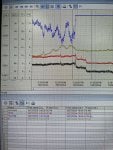
Black Line - Single DP Transmitter across first stage Jet Pulse Filters
Red Line - Three (2oo3) DP Transmitter across entire Air Intake (Jet Pulse + HEPA)
Blue Line - Ambient Humidity
Olive Line - Ambient Temperature

 
If this behavior repeats, it could even be a beneficial side effect of light rain improving filter performance. Compare similar weather events in the past to see if the phenomenon is consistent.
 
I looked at the past events and it is generally the opposite. The Dp increases when the the filters get wet and then comes down as the filters dry out!
 
@salz,

It seems odd to me that at the same time the ambient humidity spiked and flatlined the filter dp numbers seemed to decrease.

And, the fact that the ambient humidity flatlined seems odd also. Though the humidity seems to have been around 90% at the start of the trend in the photo. In your riview of past events did the humidity spike and flatline also?

I'm suggesting there's an instrumentation problem, or a sensor wiring issue, or an input card problem or that water made it's way 'into' the sensing lines? Do the dp sensors and the humidity sensor have any common piping/tubing lines?

In my experience axial compressor inlet air filters are usually made of some kind of hybrid paper--and when they get wet from high ambient humidity or rain/water they become clogged/choked as the paper swells and the pores get smaller. We don't know what material(s) your filters are made of, or if there are pre-filters on the filter elements, etc.
 
a) Humidity Flatline
This is normal when it rains/get foggy the humidity hits 100%
This is inline with past events.

b)Water in sensing lines
I thought of that too as HP leg of all the Dp sensors is open to atmosphere. But I found no water in impulse line upon checking. If there was water upon removal the trend would have reverted but that was not the case.

c)Humidity sensor is separate sits outside the filters has no impulse line.

One Dp transmitter is across the Jet Pulse Filter set has its own impulse lines. Hp being open to air and Lp taken from after the Jet pulse chamber

There are Three Dp transmitters across the Jet pulse and HEPA set (2oo3) each having its own impulse lines. Hp being open to atmosphere and LP taken from down stream of HEPA set

Faulty instrumentation should be ruled out as 4 transmitters “cannot” go bad at once.

d) Material of filters
I’ve attached the specification.
 

Attachments

@salz,

Yes, it's highly unlikely that 4 transmitters can go bad at the same instant, but if they connected to analog input boards that share a nominal 24V power supply, or there is a ground/ground loop somewhere in the circuitry that could cause multiple transmitters to appear to fail at the same time.

Something odd certainly seems to be happening, because it would be pretty unusual for the air filters to suddenly "get cleaner" when the ambient humidity increased--and it seems it was already fairly high before spiking and flatlining (the latter which you say is normal). I've worked on a LOT of gas turbine inlet air filtration systems, mostly with "jet pulse" cleaning systems, and sometimes when the dust and airborne contaminants in a particular location are very high with any significant increase in humidity the filters would form almost mud. Many of these systems had rain hoods to try to prevent direct impingement of rain on the filters. The owners/operators would scream the filters weren't working, and because the filters were very expensive they wouldn't always change them when they should. There have even been reports on Control.com of one site that "washed" their filters--but when pressed for more details the original poster went silent.

Anyway, it seems you have good reason not to suspect the sensors. But those sensors are connected to an analog input card or cards. I have seen dp sensors not reconnected properly after being removed for machine maintenance outages and cause some unusual indications. There's also the wiring to consider between the sensors and the turbine control system input card(s).

How "young" is your installation?

Is this the original turbine control system?

I don't know, that's about all I can think of at the present time.
 
“there is a ground/ground loop…” will get it checked.

“Something odd certainly seems to be happening…”
This is what concerns me. We are operating with coal fired boilers in vicinity, there is a huge ash handling facility and a lot of ash ends up in our filters which forms a “nice cake” on the filters and the Dp increases rapidly if there is no rain. Last set lasted only 2months when the DP reached alarm levels.

a) Our installation was commissioned in 2021.

b) Yes it is the original turbine control system (PCS7)
 
@salz,

"... a lot of ash ends up in our filters which forms a “nice cake” on the filters and the Dp increases rapidly if there is no rain."

That's a very interesting statement, if it's what you meant to write. That would make your air inlet filters kind of unique if, indeed, they can be "cleaned" of coal ash with rain. Do you know if rain impinging on the filters washes the rain off or makes it pass through the filter pores and into the air filter housing (eventually into the axial compressor inlet)? It might be difficult to tell if the coal dust/particles in the filter housing are passing through the filters or coming in through gaps in the housing structure. (One installation I worked on in a farming area used stitch welds to assemble the metal sections of the filter housing and that let a lot of dust and debris into the filter housing, downstream of the filters. Eventually, during a maintenance outage, all the joints and seams were welded along their entire length and that reduced the amount of dust that came in downstream of the filters.

Have you tried spraying (lightly at first) water on a small group of filters when they are coated with the coal dust to see what happens to them, visually at least?

The inlet air filter houses I worked on included a variety of methods to try to improve the service life of the filters. One used a very large series of "corrugations" UPSTREAM of the filters and a large fan to "vibrate" the corrugations. The idea was that the dirt and contaminants in the air being drawn into the filters had to make a series of flow direction changes and would impinge on the corrugations, and the vibrations would cause the to fall down to a trough at the bottom where an auger would push them out one end of the auger trough. This system only worked well on large dirt particles, and not even that well on them. Eventually that site went to "jet-pulse" cleaning.

A few sites used horizontal filter arrangements, meaning the filters were arranged in a horizontal plane. This, of course, required very large areas (as opposed to a vertically stacked plane of filters), but in my personal opinion when used with a "jet-pulse" filter cleaning system was the most effective at knocking dirt and some contaminants as they would mostly fall to the ground (though the lighter particles would just get sucked back into adjacent filters--some of which had just been cleaned. Also, at some sites with a lot of dust and contaminants it would begin to collect on the ground below the filters and a strong breeze would disturb them and get sucked back up into the filters overhead. But, still this worked as well or better than most vertically stacked air filter arrangements.

Most of the installations I worked on had vertically-stacked air filters. When the "jet-pulse" cleaning system was used it would dislodge the particles from the row or column of filters being cleaned and and a lot of the dirt would simply get sucked back into adjacent filters (they are usually placed within 10 m (4 inches or so) of each other. And, as the dirt fell from the upper filters the dirt that wasn't sucked into adjacent filters around those being pulsed clean would be drawn back into filters near the bottom of the stack.... Still, the filter dp would be reduced with the "jet-pulse" cleaning, though sometimes not by that much.

Some vertical filter houses with "jet-pulse" cleaning systems in areas where there was a lot of sand storms had the auger/trough arrangement to try to catch the sand dust and direct it away from the air inlets. This required large trucks to contain the dust and drive it away from the installation, and that means drivers and maintenance and fuel, etc. And, it was not very effective at all--again, the dust blown off the filter row/column being cleaned would be sucked into nearby or lower filters and not make it down into the trough where the auger would take it to the waiting truck to (sometimes) be driven away to be emptied.

In most of the vertically-stacked air filter arrangements with "jet-pulse" filter cleaning systems the filters were cleaned by horizontal row, starting from the top--the idea being that the dirt will fall and even if its drawn into lower filters as the next rows are cleaned they will eventually remove a lot of the dirt/contaminants, even from the bottom sections. My experience is that at very dusty/dirty sites the lower filters were always the most dirty when being replaced.

Some filter houses had "rain hoods" which were more common in areas with heavy seasonal rains, and the purpose of these was to prevent, as much as possible, the rain from being drawn into the filters. These were reasonable effective--as long as the units weren't arranged such that the predominant rain and winds blew directly into the filter assemblies and then they still did a reasonably good job of keeping the majority of rain off the filter--unless it was a gully-washer with high, strong winds.

We don't know how the air filters are stacked at your site--vertically or horizontally. We don't know if there are any "secondary" methods being used to try to remove dislodged coal dust from the filters during "jet-pulse" cleaning. There's a lot we don't know about the filters at your installation. BUT, if, indeed, rain or a light water spray (the amount of the spray would probably need to be determined by trial and error) does "clean" the filters then you might be on to something of use at your site. I would wonder what happens to the wet coal dust as it falls (I'm assuming a vertically-stacked air filter arrangement)--would it fall onto/in lower filter arrangements?

Anyway, some ideas of what has been tried in different areas around the world. Sometimes, because of ambient conditions (such as large coal ash piles nearby) frequently changing filters is going to be necessary. Working with a filter supplier/manufacturer might produce some ideas and configurations/filters which would be better for your installation than what you currently have.

One more possible suggestion--pre-filter "socks". These are flexible "tubes" that are slid over the outside of the individual filter elements. They can be removed, cleaned and replaced--usually in groups (so an entire set of pre-filters doesn't have to be purchased). They have proven to be very effective at some sites, though it does reduce the efficiency of the "jet-pulse" cleaning somewhat.

One very old installation I worked on (from the 1960's) had rolls of filter cloth that over the air entrance ports of the filter house and they could be manually rolled to put a clean filter cloth area when one area became too dirty. If I recall correctly, they weren't too expensive, but changing them was difficult and time-consuming (meaning labor costs were high). So, there's all kinds of possibilities if you think outside of the box--and if you can find a filter supplier/manufacturer willing to work with you to analyze your situation and propose one or more different solutions.

Or, do some local data collection on the "rain cleaning" method, because you seem to be saying that--historically--when it rains at your installation the filter dp decreases during the rain. It would seem counter-intuitive--but, again, there's a lot we don't know about the particulars of your installation.

Please keep us informed of your progress and findings.
 
Well I thank you first for the ton of experience that you have shared with me.

Getting back to the issue:

a) "Dp increases rapidly if there is no rain" : I guess i need to clarify this. What i meant was when it rains the dust in the atmosphere settles which means the filters don't get dirty as quickly. This enhance the life of filters.

*But when it rains, the Dp increases which i think is because some small droplets get sucked in and reach the filter surface where it forms a film. Once the rain is over and the ambient humidity drops, the Dp the settles back as before the rain. This is of course the normal phenomenon.

Just this time we had an exception where the Dp dropped after it rained.

b) No dust is getting across the Jet Pulse filters: I can say this with certainty as the HEPA filter set Dp stays fairly constant

c) Filters on our site are horizontal. They are placed on top of a collection hopper. Upon Jet Pulsing the dirt/dust falls into the hopper and the floor of the hopper is slanting towards a dust extraction fan which sucks out the dust.
There is a bug screen and then a rain hood as well.

In my opinion: The Jet Pulse System is not really useful. It pulses the filters twice a day as per schedule or when the Dp reached the alarm levels it goes on continuously. But i have never observed the Dp settle to a lower value after a cycle of Jet Pulse flushing.
You have put it very appropriately as "though the lighter particles would just get sucked back into adjacent filters--some of which had just been cleaned"

d) Exploring options:
i}We though of the sock method but yes we figured the exact same thing that it would render jet pulse useless.
ii} One of our seasoned guys suggested about the roll of filter cloth. We need to think more about it, i suppose a small motor can do the job.

Still investigating!
 
Top